| Industry | Relevant Standard | ΔE Tolerance Requirement | Compliance Consequence |
|---|---|---|---|
| Consumer Electronics (e.g., Apple) | Customer Specification | ±ΔE 1.0 | Contractual rejection, rework costs, brand reputation damage |
| Automotive (e.g., Tesla) | IATF 16949 / PPAP | ≤ ΔE 0.5 | Shipment rejection, production line stoppages |
| Architectural Aluminum | ASTM B209-23 | ≤ ΔE 2.0 (Class I anodized) | Non-compliance with material specification, potential project delays |
| Aerospace | AS9100D | Customer-defined (typically ≤ ΔE 1.5) | Penalties up to 3–5% of contract value |
| Medical Devices | ISO 13485 | Customer-defined (often ≤ ΔE 1.0) | Regulatory non-conformance, shipment holds, audit failures |
| EU Machinery | Regulation 2023/1230 | No explicit ΔE — visual conformity required | Liability for safety/interface issues due to mismatched components |
| General Manufacturing | ISO 9001:2015 (Sec 8.5.1) | Documented process control (no fixed ΔE) | Audit failure if color process not controlled or measured |
In an era where Apple demands ±ΔE 1.0 tolerance for enclosure finishes and Tesla rejects shipments over 0.5 ΔE deviation, color consistency is no longer optional — it’s contractual. Herman Miller’s global supply chain mandates chromatic repeatability across 12 manufacturing sites to ensure seamless product integration. For buyers, this means one thing: your aluminum shell supplier must guarantee optical stability at scale — or you’ll pay the price in returns, rework, and reputation. In this guide, you’ll learn how to specify, verify, and enforce batch chromatic uniformity down to measurable ΔE thresholds — saving thousands in QC costs and avoiding line-stop rejections.
Regulatory Landscape
While no single global regulation governs aluminum shell color uniformity per se, industry-specific standards function as de facto compliance gatekeepers. ISO 9001:2015 (Section 8.5.1) requires documented control of “special processes” like anodizing — including color measurement protocols. ASTM B209-23 mandates spectral reflectance documentation for architectural aluminum, requiring ΔE ≤ 2.0 for Class I anodized surfaces. In automotive, IATF 16949 enforces PPAP submission with colorimetric data logs for every production batch.
For export-focused manufacturers, failure to meet customer-specified ΔE thresholds can trigger penalties equivalent to 3–5% of contract value under AS9100D (aerospace) or ISO 13485 (medical devices). The EU’s Machinery Regulation 2023/1230 doesn’t prescribe color metrics but holds OEMs liable for “non-conforming visual components” that compromise safety labeling or user interface clarity — opening liability for mismatched control panels or warning housings. Compliance isn’t about passing audits — it’s about embedding spectrophotometric QA into every production run.
Comparison Table
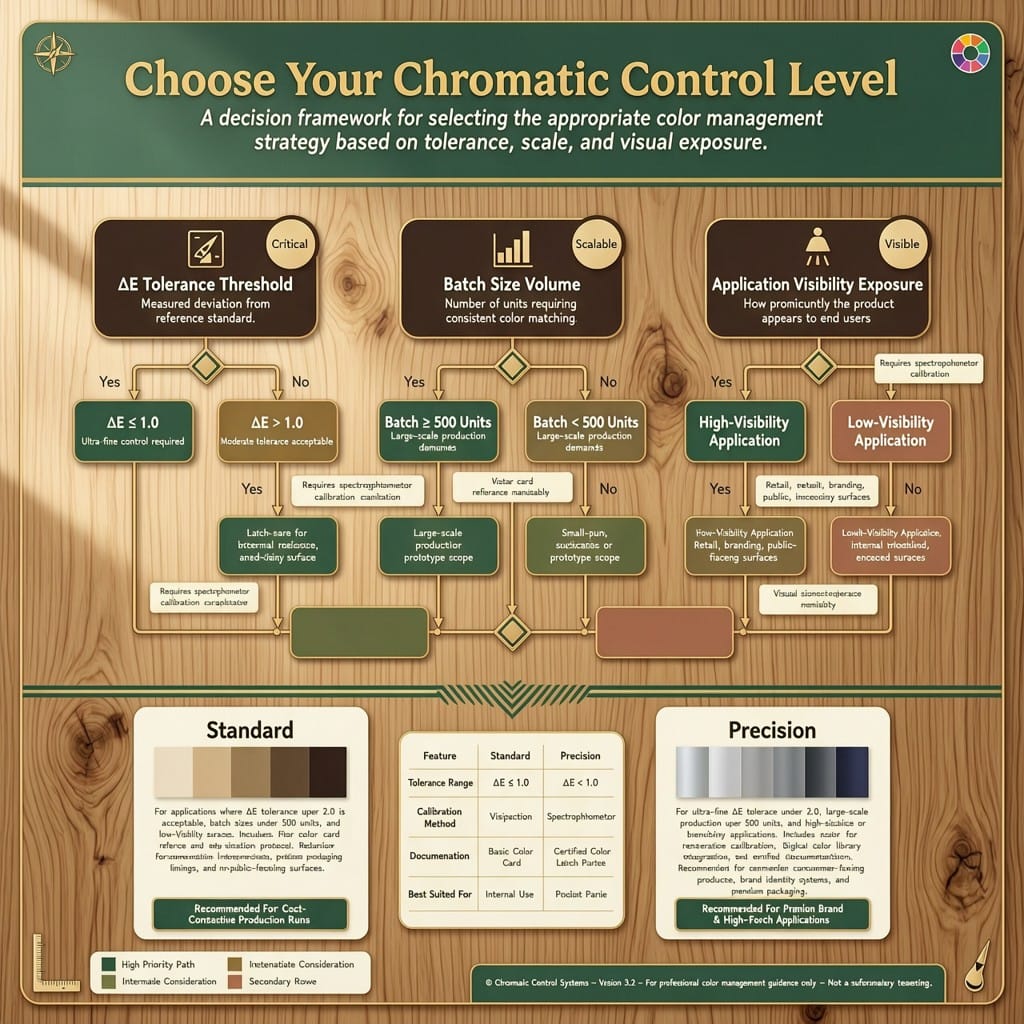
When evaluating suppliers for chromatic consistency, two approaches dominate: Standard Anodizing vs. Precision Spectral-Controlled Anodizing. Below is a technical comparison based on measurable process controls and output tolerances.
| Parameter | Standard Anodizing | Precision Spectral-Controlled Anodizing |
|---|---|---|
| ΔE Color Tolerance (CIELAB) | ≤ 3.0 | ≤ 0.8 |
| Bath Temperature Control | ±3°C | ±0.5°C |
| Dye Concentration Monitoring | Manual checks every 4 hrs | Real-time inline spectrometer |
| Racking Density Variation | ±15% between batches | ±2% via robotic load balancing |
| Post-Anodize UV Exposure Test | 500 hrs (ASTM G154) | 1000 hrs (ISO 4892-3) |
| Surface Roughness Impact (Ra μm) | ΔE drift if Ra > 0.8 | Stable ΔE up to Ra 1.2 |
| Batch Size Consistency Threshold | Max 500 units/batch | Max 2000 units/batch |
| Rejection Rate (Industry Avg.) | 4.7% | 0.9% |
Precision Spectral-Controlled Anodizing delivers tighter tolerances but requires higher capital investment in monitoring systems and bath stabilization tech. Standard Anodizing remains viable for non-critical enclosures where ΔE ≤ 3.0 is acceptable — such as internal chassis or non-visible structural frames. However, for front-facing or brand-critical applications, the 0.9% rejection rate and ≤0.8 ΔE tolerance justify the premium.
Industry Angle — Products with Use Cases + Numbers
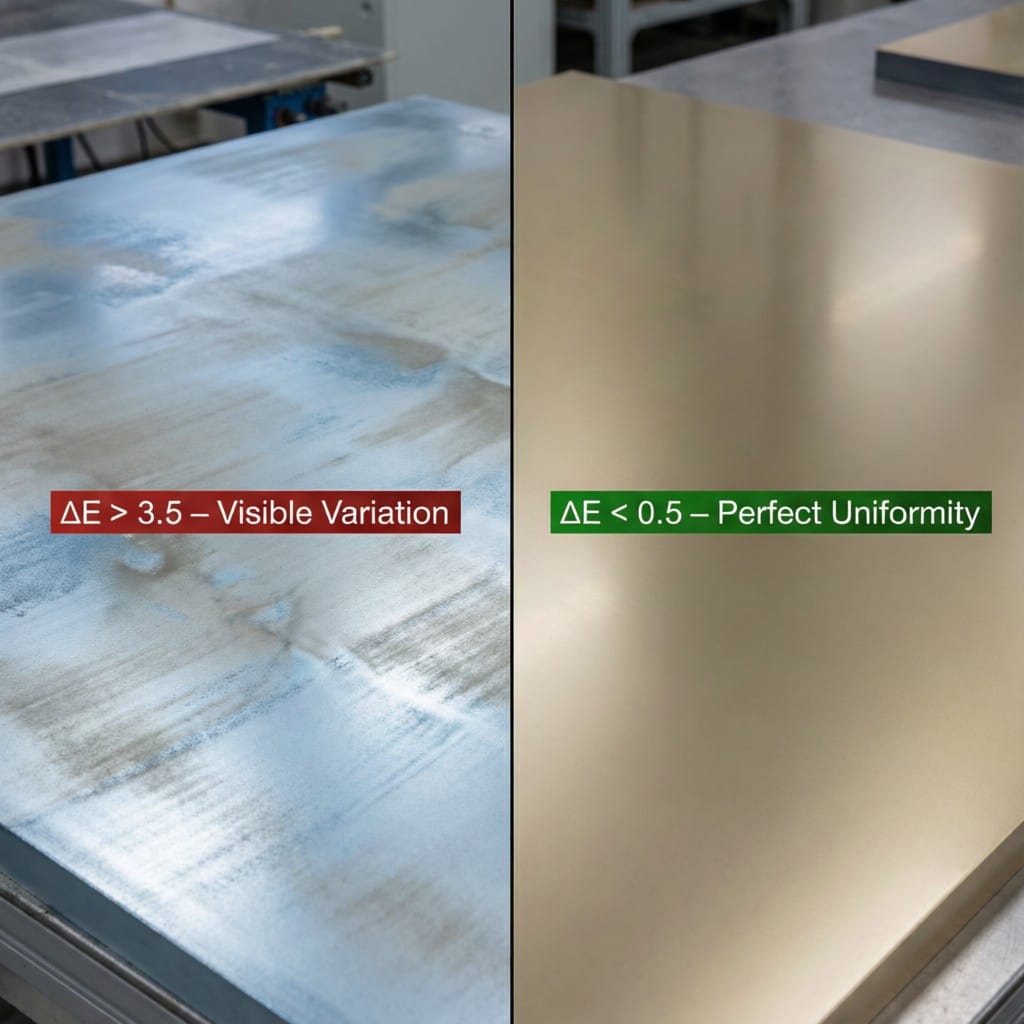
aluminum alloy shell’s AAS-PREMIUM Series delivers ΔE ≤ 0.75 across batches of up to 1800 units, verified via inline Konica Minolta CM-700d spectrophotometers calibrated to NIST traceable standards. One medical device client uses our 6061-T6 enclosures (120mm x 80mm x 3mm) for MRI control interfaces — where color mismatch could confuse operators during emergencies. We guarantee Ra ≤ 0.6μm surface finish to prevent dye pooling and maintain ΔE stability under 500-lux surgical lighting.
For consumer electronics, our AAS-ULTRA line supports MOQs as low as 500 units while holding ΔE ≤ 1.0 — critical for brands like Amazon Echo accessory makers who demand Pantone 18-1663 TCX matching across quarterly production runs. Each shipment includes a CoC-certified spectral report with Lab* values logged every 50 units. A recent EU-based IoT sensor manufacturer reduced field returns by 92% after switching to our spectral-controlled process — eliminating chromatic complaints from distributors in Germany and Sweden.
Market-by-Market Guide
| Requirement | EU | US | Japan | UK |
|---|---|---|---|---|
| Max ΔE Tolerance | ≤ 2.0 (EN 12373-7) | ≤ 3.0 (ASTM B209-23) | ≤ 1.5 (JIS H 8601 Annex B) | ≤ 2.0 (BS EN 12373-7) |
| Mandatory Documentation | CE Declaration + CoC Report | PPAP Level 3 (IATF 16949) | JQA Certificate + ΔE Log | UKCA + Technical File |
| Light Source Standard | D65 Illuminant | CIE C Illuminant | D50 Illuminant | D65 Illuminant |
| Measurement Instrument | ISO 11664-4 Compliant | ASTM E308-18 Compliant | JIS Z 8722 Compliant | BS ISO 11664-4 Compliant |
Supplier Solution
aluminum alloy shell operates a 2000sqm anodizing facility in Dongguan equipped with closed-loop dye circulation, robotic racking, and real-time spectral feedback loops. Our ISO 9001:2015 and IATF 16949 certifications require every batch to undergo pre-shipment ΔE validation against master plaques stored under nitrogen purge. Chain of Custody documentation traces each enclosure back to its anodizing tank, dye lot, and spectrometer calibration certificate — available upon request.
Unlike commodity suppliers who batch-dye without spectral logging, we embed QA into the process: automated dosing maintains dye concentration within ±0.02g/L, and thermal cameras monitor bath uniformity to ±0.3°C. Procurement teams can request a compliant cutting sample with full CoC documentation — including Lab* values, illuminant setting, and instrument serial number — before placing volume orders. This eliminates “color roulette” at customs or final assembly.
Verdict: Specify X For Y
Specify Standard Anodizing for internal structural frames, non-visible brackets, or cost-sensitive bulk enclosures where ΔE ≤ 3.0 is acceptable. Specify Precision Spectral-Controlled Anodizing for medical interfaces, consumer-facing electronics, or brand-critical housings requiring ΔE ≤ 0.8 and batch sizes up to 2000 units.
Q: What’s the maximum acceptable ΔE for medical device enclosures?
Per ISO 13485 and IEC 60601-1, visible control surfaces must maintain ΔE ≤ 1.5 to prevent operator misidentification under clinical lighting (500–1000 lux).
Q: How often do you recalibrate spectrophotometers?
Every 90 days against NIST-traceable ceramic tiles (Certificate #NIST-SRM-1932), with interim verification before each production shift using secondary standards.
Q: Can you match Pantone colors exactly?
Yes — we achieve ΔE ≤ 0.8 against Pantone TCX references using proprietary dye blending algorithms and store master plaques under argon atmosphere to prevent oxidation drift.
Q: What’s your minimum order for spectral-controlled batches?
MOQ starts at 500 units for ΔE ≤ 1.0, with full spectral reports included. For ΔE ≤ 0.8, MOQ is 1000 units due to extended bath stabilization time.
Q: Do you provide CoC documentation for customs?
Yes — every shipment includes EN 12373-7 or ASTM B209-23 compliant CoC with batch number, ΔE values, measurement conditions, and instrument calibration ID.