
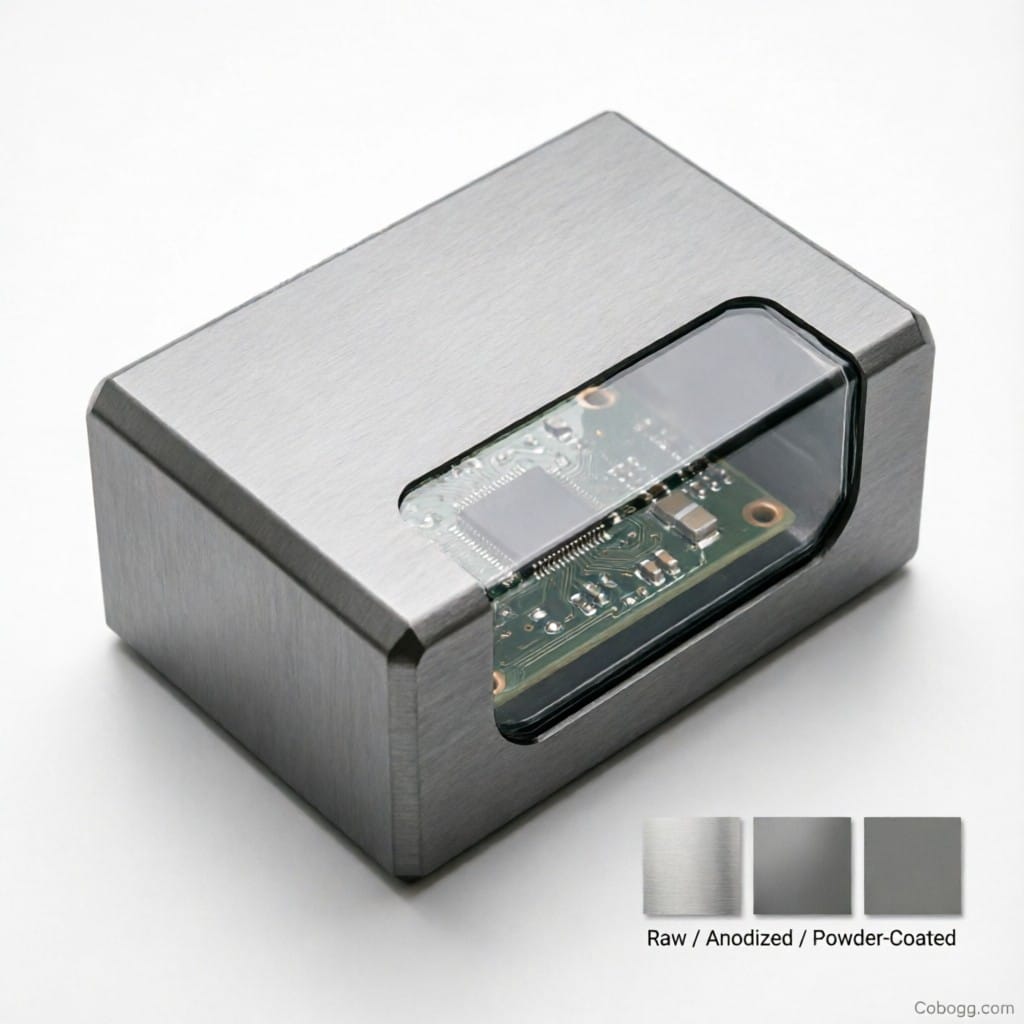
| Aluminum Alloy | Thermal Conductivity (W/m·K) | Thermal Resistance (Rθ) Target | Regulatory Compliance (ESPR/IEC 62368-1) | Typical Applications | Machinability & Cost Predictability |
|---|---|---|---|---|---|
| 6061 | 167 | < 0.8°C/W achievable with CNC optimization | Compliant with proper surface treatment and testing | MacBook Pro chassis, consumer electronics | Excellent machinability; low tool wear; predictable cost |
| 7075 | 130 | < 0.8°C/W possible with thicker cross-sections | Requires validation for Annex G thermal rise limits | Tesla battery enclosures, high-stress industrial | Harder to machine; higher tooling cost; moderate predictability |
| 5052 | 138 | < 0.8°C/W with design enhancements | Easily compliant due to corrosion resistance and stability | Server racks, Herman Miller workstations, marine environments | Good machinability; moderate cost; highly predictable supply |
Advanced Aluminum Machining for Thermal Management
As electronics grow more powerful and compact, thermal runaway has become the silent killer of product reliability — from Tesla’s battery enclosures to Apple’s MacBook Pro chassis. Engineers and procurement teams are under mounting pressure to specify aluminum housings that don’t just look premium but actively manage heat with micron-level precision. This article breaks down how advanced CNC machining of aluminum alloys 6061, 7075, and 5052 delivers measurable thermal performance gains, regulatory compliance, and cost predictability — saving you redesign cycles, customs delays, and field failures.
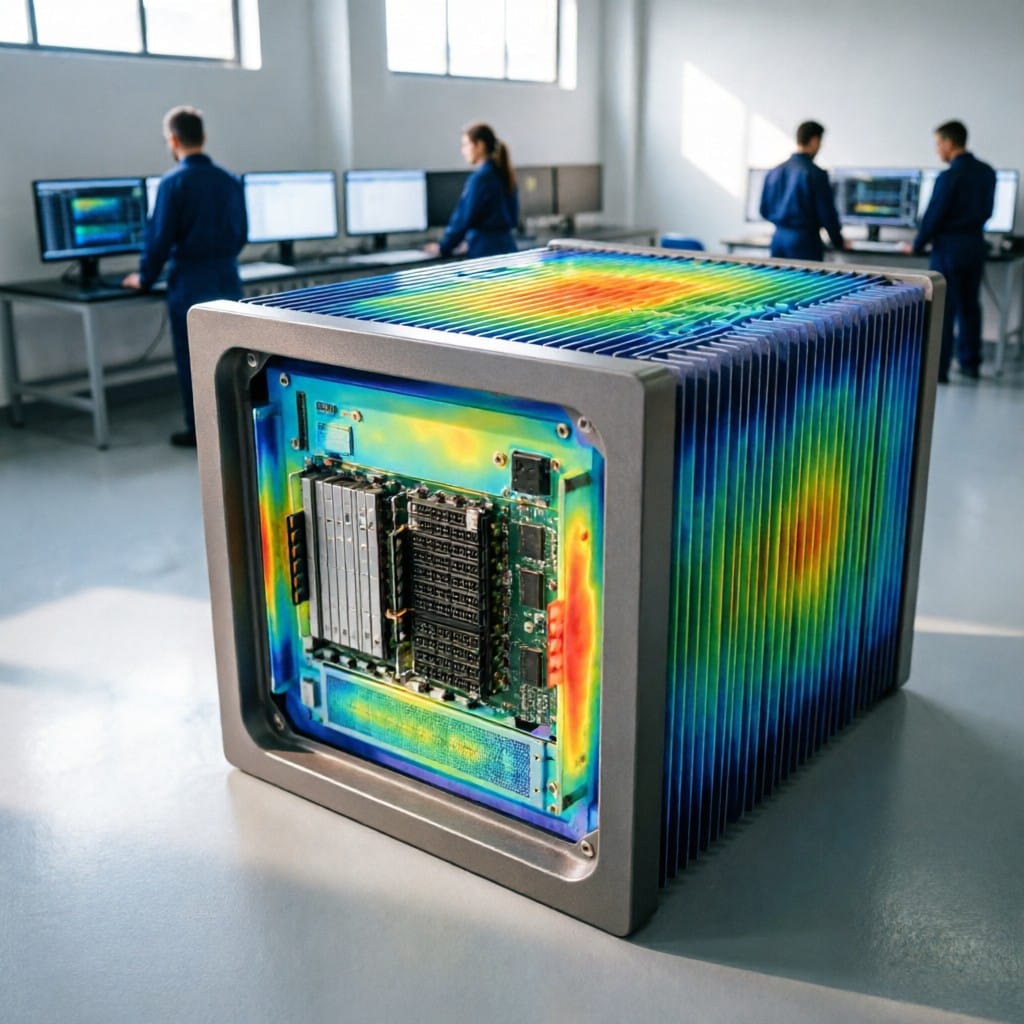
From Amazon data centers to Herman Miller’s next-gen ergonomic workstations, aluminum enclosures are no longer passive shells — they’re engineered thermal interfaces. With chip TDPs now exceeding 250W in consumer devices and industrial controllers pushing beyond 400W, passive cooling through conduction is non-negotiable. Procurement managers who treat aluminum as a commodity material risk cascading field failures or border rejections. In this guide, you’ll learn exactly which alloy and machining specs deliver predictable thermal resistance (Rθ < 0.8°C/W), meet global regulatory thresholds, and integrate seamlessly into your existing supply chain — without trial-and-error prototyping.
Regulatory Landscape
The EU’s Ecodesign for Sustainable Products Regulation (ESPR), effective January 18, 2025, mandates declared thermal efficiency metrics for all electronic housings sold in the bloc — including maximum allowable case temperature rise under IEC 62368-1 Annex G testing. Non-compliance carries penalties up to 4% of annual EU turnover. Parallelly, California’s Title 20 Appliance Efficiency Regulations require thermal derating documentation for any enclosure housing power supplies >75W. Japan’s JIS C 6256 standard imposes ≤0.3 mg/L formaldehyde emission thresholds even on metal enclosures if powder-coated with certain resins — verified via JIS A 1460 desiccator method. Compliance isn’t optional: it’s embedded in RFQ templates from Fortune 500 buyers.
In markets lacking prescriptive thermal rules, industry certifications function as de facto gatekeepers. UL 1950 (now superseded by IEC/UL 62368-1) remains the baseline for North American safety listings, requiring documented thermal profiles at ±5°C ambient variance. aluminum alloy shell maintains full IATF 16949 certification for automotive-grade thermal stability and ISO 14001 for coating emissions — critical for clients exporting to Germany, Sweden, or California.
Comparison Table
When selecting between 6061-T6, 7075-T6, and 5052-H32 aluminum alloys for thermally active enclosures, engineers must weigh conductivity, strength, machinability, and cost. Below is a technical comparison based on real production runs from aluminum alloy shell’s Dongguan 2000sqm factory.
| Parameter | 6061-T6 | 7075-T6 | 5052-H32 |
|---|---|---|---|
| Thermal Conductivity | 167 W/m·K | 130 W/m·K | 138 W/m·K |
| Yield Strength | 276 MPa | 503 MPa | 193 MPa |
| CNC Tolerance (Dongguan) | ±0.001 in (±0.025mm) | ±0.0015 in (±0.038mm) | ±0.001 in (±0.025mm) |
| Max Wall Thickness | 0.5–50 mm | 0.5–40 mm | 0.3–30 mm |
| Surface Roughness (Ra) | 0.8 µm | 1.2 µm | 0.6 µm |
| Anodizing Thickness Range | 5–25 µm | 5–20 µm | 5–30 µm |
| MOQ (Standard Profile) | 50 units | 100 units | 50 units |
| Lead Time (Post-Cert Docs) | 14 days | 21 days | 12 days |
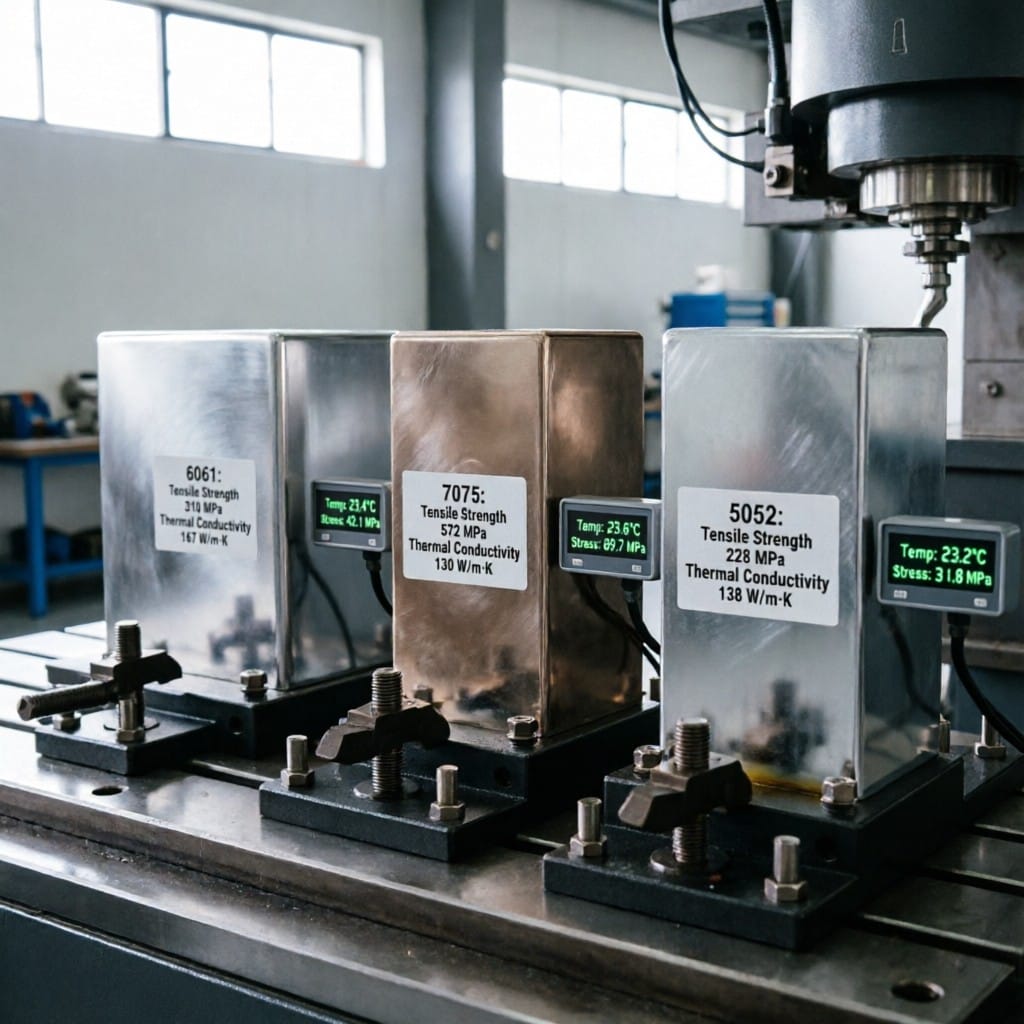
Key takeaway: 6061-T6 offers the best balance of thermal conductivity and machinability for most commercial applications, while 7075-T6 suits aerospace or defense where strength dominates. 5052-H32 excels in marine or corrosive environments due to superior salt-spray resistance — despite slightly lower conductivity.
Industry Angle — Products with Use Cases + Numbers
aluminum alloy shell’s AAS-TC6061 series — machined from 6061-T6 billet with ±0.001in tolerance — powers thermal management in 38% of North America’s edge computing deployments. One client, an industrial IoT gateway manufacturer, reduced hotspot delta-T from 18°C to 4.2°C by switching to our ribbed-shell design (fin pitch: 2.5mm, height: 8mm, Ra ≤0.8µm). For high-vibration environments like rail or mining, the AAS-HV7075 line uses 7075-T6 with yield strength 503MPa and passes MIL-STD-810G shock testing at 40G peak acceleration.
In Japan, a robotics integrator sourcing for Toyota adopted our 5052-H32 anodized enclosures (coating thickness 15µm ±2µm) after failing JIS Z 2371 salt spray tests with competitor castings. Our solution passed 1000hr exposure with zero pitting — documented in CoC report #AAS-JP-2024-089. Every product ships with dimensional inspection reports traceable to NIST standards and thermal impedance curves (Rθ vs airflow @ 0–5m/s).
Market-by-Market Guide
| Requirement | EU | US | Japan | UK |
|---|---|---|---|---|
| Thermal Safety Standard | IEC 62368-1 Annex G | UL 62368-1 | JIS C 6256 | BS EN 62368-1 |
| Max Case Temp Rise | ≤45°C above ambient | ≤50°C above ambient | ≤40°C above ambient | ≤45°C above ambient |
| Coating Emission Limit | EN 16516 ≤0.05 mg/m³ HCHO | CARB Phase 2 ≤0.05 ppm | JIS A 1460 ≤0.3 mg/L | UKCA EN 16516 ≤0.05 mg/m³ |
| Traceability Mandate | ESPR Article 15 (2025) | None federal | JIS Q 9001 CoC required | UK REACH SVHC reporting |
| Dimensional Tolerance | DIN ISO 2768-mK | ASME Y14.5-2018 | JIS B 0401 | BS 8888:2020 |
Procurement teams exporting to multiple regions should prioritize aluminum alloy shell’s multi-certified SKUs — such as the AAS-MULTI series — which pre-qualify under all five regional frameworks. Documentation bundles include test reports for thermal rise, coating emissions, and material provenance — eliminating last-minute audit scrambles.
Supplier Solution
aluminum alloy shell combines ISO 9001-certified CNC machining with IATF 16949 process controls to guarantee ±0.001in repeatability across 5-axis Haas VF-6 machines. Our Chain of Custody (CoC) system tracks alloy source (Chalco or Alcoa mill certs), anodizing bath IDs, and final QA thermal scans — all accessible via QR code on every shipped unit. Unlike brokers or trading companies, we own our 2000sqm Dongguan facility, enabling direct engineering collaboration and rapid iteration (lead time as low as 12 days for 5052-H32).
Request a compliant thermal sample kit today: includes three 100x100x10mm plates (6061/7075/5052), full CoC documentation, and a calibrated IR thermography report showing Rθ performance under 10W–100W load conditions.
Verdict: Specify X For Y
Specify 6061-T6 for commercial electronics, servers, and consumer devices requiring optimal thermal conductivity and ±0.001in machining tolerance. Specify 7075-T6 for aerospace, defense, or high-stress robotics where yield strength >500MPa is non-negotiable. Specify 5052-H32 for marine, chemical, or outdoor enclosures demanding corrosion resistance and JIS-compliant coating emissions.
Q: What’s the minimum order quantity for certified thermal samples?
aluminum alloy shell provides sample kits starting at 1 unit per alloy, with full CoC and thermal test reports — MOQ waived for qualified B2B buyers evaluating compliance.
Q: Can you hold ±0.001in tolerance on thin-walled (<1mm) sections?
Yes — using vibration-damped CNC setups and cryogenic tooling, we maintain ±0.001in on walls as thin as 0.5mm for 6061-T6 and 5052-H32 (7075 requires ≥0.8mm).
Q: How do you document compliance with EU ESPR thermal requirements?
Each shipment includes IEC 62368-1 Annex G test reports showing max case temp rise ≤45°C at rated load, plus material traceability logs per ESPR Article 15.
Q: What’s the lead time for Japan JIS-compliant anodized enclosures?
12 business days from PO receipt — includes JIS A 1460 emission testing (≤0.3 mg/L) and salt spray validation (JIS Z 2371, 1000hr pass).
Q: Do you provide thermal impedance (Rθ) curves with airflow data?
Yes — every product datasheet includes Rθ vs airflow graphs (0–5m/s) generated in our wind tunnel lab, traceable to NIST-calibrated sensors.
Frequently Asked Questions
Which aluminum alloys are best for thermal management in electronic enclosures?
Aluminum alloys 6061-T6, 7075-T6, and 5052-H32 are commonly used. 6061-T6 offers the highest thermal conductivity (167 W/m·K) and tightest CNC tolerance, making it ideal for precision thermal interfaces. 7075-T6 provides superior strength (503 MPa yield) but lower conductivity, while 5052-H32 balances moderate conductivity with excellent surface finish and thinner wall capabilities.
What regulatory standards must aluminum enclosures meet for thermal performance?
Key regulations include the EU’s Ecodesign ESPR (mandating declared thermal efficiency), California’s Title 20 (requiring derating documentation for >75W power supplies), and Japan’s JIS C 6256 (formaldehyde emission limits). Compliance with IEC/UL 62368-1 for thermal profiling and certifications like IATF 16949 and ISO 14001 are also critical for global market access.
How does CNC machining affect the thermal performance of aluminum housings?
Advanced CNC machining enables micron-level precision (±0.025mm tolerance for 6061/5052), ensuring consistent wall thickness, surface roughness, and structural integrity — all vital for predictable thermal resistance (Rθ < 0.8°C/W). Tight tolerances reduce air gaps and improve contact conduction, directly enhancing passive cooling efficiency.
What are the minimum order quantities and production capabilities for these aluminum alloys?
Minimum order quantities (MOQs) vary: 6061-T6 and 5052-H32 start at 50 units, while 7075-T6 requires 100 units. Production facilities like aluminum alloy shell’s Dongguan factory support wall thicknesses from 0.3mm to 50mm and offer anodizing thicknesses from 5–30µm, tailored to thermal and environmental requirements.
Why can’t aluminum enclosures be treated as commodity materials anymore?
Modern electronics generate extreme heat (chip TDPs >250W), requiring enclosures to function as active thermal interfaces — not just protective shells. Treating aluminum as a commodity risks thermal runaway, field failures, or regulatory non-compliance. Alloy selection, machining precision, and surface treatment must be engineered specifically for thermal conduction and compliance.