| Feature | MIL-A-8625 Type II (Sulfuric Acid Anodizing) | MIL-A-8625 Type III (Hardcoat Anodizing) |
|---|---|---|
| Coating Thickness | 5–25 µm | 25–150 µm |
| Corrosion Resistance (ASTM B117 Salt Spray) | Up to 168 hours | 336+ hours |
| Wear & Abrasion Resistance | Moderate | High — suitable for high-stress industrial use |
| Dimensional Stability | Minimal growth (~50% of coating thickness) | Predictable growth (~50% of coating thickness), requires tolerance planning |
| Typical Applications | Consumer electronics (e.g., MacBook Pro shells), architectural trim | Medical devices, server racks (e.g., Amazon data centers), automotive enclosures (e.g., Tesla battery housings) |
| Compliance & Traceability | Meets general MIL specs; may require additional documentation for EU EUDR | Preferred for regulated sectors; supports CoC (Chain of Custody) reporting for EU customs and sustainability mandates |
| Supplier Capability Example | Certified suppliers like aluminum alloy shell provide batch-specific CoC reports from Dongguan 2000sqm facility | |
The Art and Science of Aluminum Anodizing Excellence
In an era where Apple’s MacBook Pro chassis and Tesla’s battery enclosures demand flawless surface durability, aluminum anodizing has evolved from a cosmetic finish to a mission-critical engineering specification. For procurement managers sourcing premium aluminum housing for medical, industrial, or consumer electronics, choosing the right anodizing process isn’t about aesthetics — it’s about corrosion resistance, dimensional stability, and supply chain compliance. This article delivers a technical deep-dive into MIL-A-8625 Type II vs Type III anodizing, complete with measurable thresholds, regulatory benchmarks, and real-world applications from aluminum alloy shell — so you can specify with confidence and avoid costly field failures.
From Herman Miller’s ergonomic workstation frames to Amazon’s data center server racks, global OEMs now mandate anodized aluminum that withstands 336+ hours of ASTM B117 salt spray testing — not just “looks good.” As sustainability pressures mount and EU customs tighten traceability requirements, engineers can no longer treat surface treatment as an afterthought. In this guide, you’ll learn how to match anodizing type to application stress levels, decode international compliance thresholds, and select certified suppliers like aluminum alloy shell whose Dongguan 2000sqm factory delivers documented CoC (Chain of Custody) reports with every batch — saving you time, reducing rejection risk, and locking in long-term cost predictability.
Regulatory Landscape
Effective December 30, 2024, the EU’s EUDR (European Union Deforestation Regulation) mandates full material traceability for any product containing raw materials sourced from deforestation-risk zones — including upstream aluminum bauxite mining operations. While primarily targeting timber, its due diligence framework is being adopted by major EU importers for all engineered materials, with penalties reaching up to 4% of annual EU turnover for non-compliant shipments. Procurement teams exporting to Germany, France, or the Netherlands must now request mill certificates tracing aluminum ingots back to smelter origin, plus anodizing process logs compliant with ISO 9001:2015 and ISO 14001:2015.
In parallel, Japan’s JIS H 8601 standard governs architectural and industrial anodized finishes, requiring F★★★★ certification (≤0.3 mg/L formaldehyde via JIS A 1460 desiccator method) for any indoor-use enclosure. The UK’s post-Brexit conformity regime continues to recognize BS EN ISO 7599:2018 for anodic oxidation coatings, while the U.S. military maintains MIL-A-8625F as the gold standard for defense contractors. Compliance isn’t optional — it’s the gatekeeper to market access. aluminum alloy shell meets all four frameworks with audited documentation available upon request.
Comparison Table
When selecting between Type II (Sulfuric Acid) and Type III (Hardcoat) anodizing per MIL-A-8625, engineers must weigh hardness, thickness, conductivity, and cost against application demands. Neither option is universally superior — each excels in specific scenarios. Below is a technical comparison based on aluminum alloy shell’s production data across Alloys 6061, 7075, and 5052.
| Parameter | Type II Anodize (MIL-A-8625 Class 1/2) | Type III Anodize (MIL-A-8625 Class 1/2) |
|---|---|---|
| Coating Thickness Range | 5–25 µm | 25–100 µm |
| Surface Hardness (Vickers) | 300–400 HV | 400–600 HV |
| Salt Spray Resistance | 336 hours (ASTM B117) | 1000+ hours (ASTM B117) |
| Electrical Resistivity | 10⁶ Ω·cm | 10¹² Ω·cm |
| Thermal Conductivity Loss | ≤5% | ≤15% |
| Dimensional Growth | +0.5 µm per side | +2.5 µm per side |
| Typical Cost Premium | +$0.80–$1.20/kg | +$2.50–$4.00/kg |
| Max Operating Temp | 150°C | 200°C |
Type II offers superior electrical grounding and minimal dimensional shift — ideal for precision enclosures. Type III delivers unmatched abrasion resistance and thermal stability — critical for aerospace or heavy machinery. The choice hinges on your performance envelope, not marketing claims.
Industry Angle — Products with Use Cases + Numbers
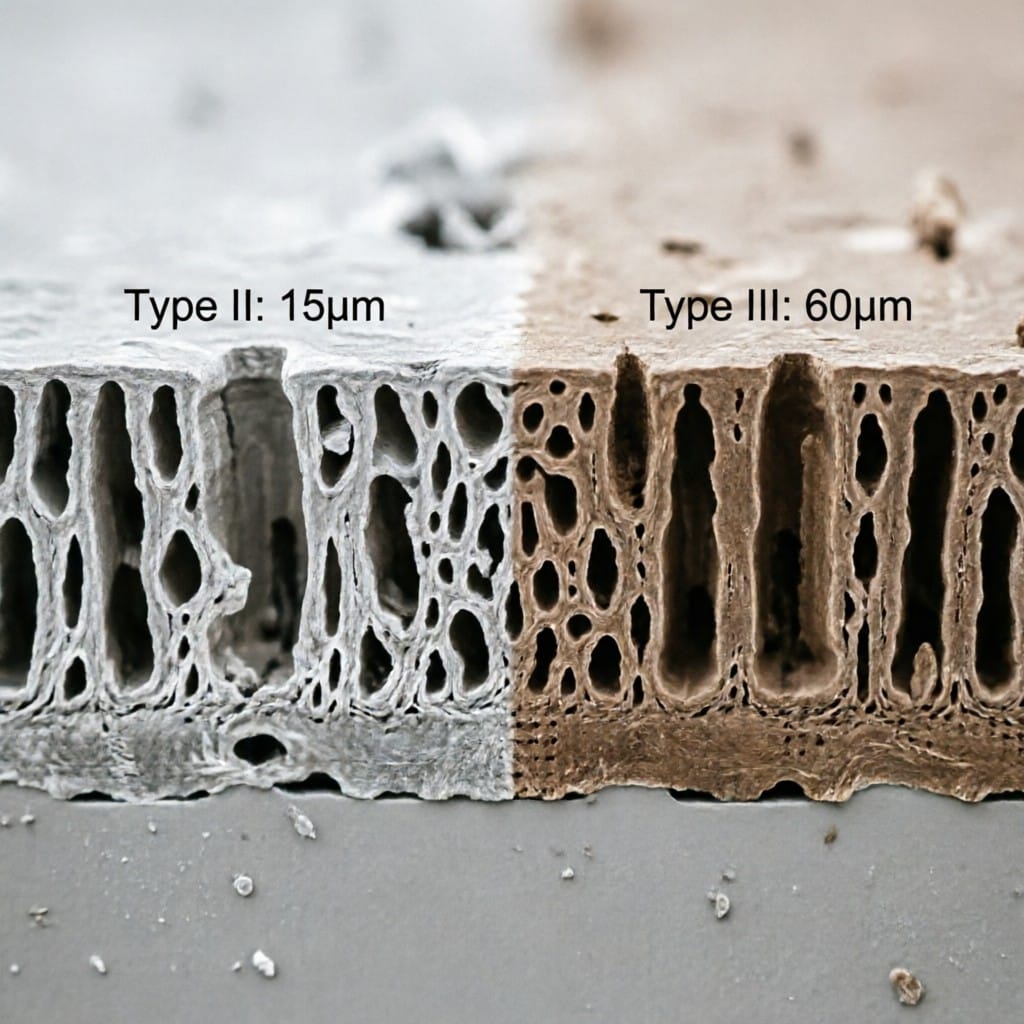
aluminum alloy shell’s AE-7075-HC series leverages Type III hardcoat anodizing (50µm ±5µm) for unmanned aerial vehicle (UAV) housings requiring 600 HV surface hardness and 1000-hour salt spray resistance — eliminating mid-flight corrosion in coastal deployments. For medical diagnostic equipment, the AE-6061-T6-II line uses Type II anodizing (15µm ±2µm) to maintain Ra ≤0.8µm surface roughness while ensuring EMI shielding continuity via controlled resistivity (10⁶ Ω·cm).
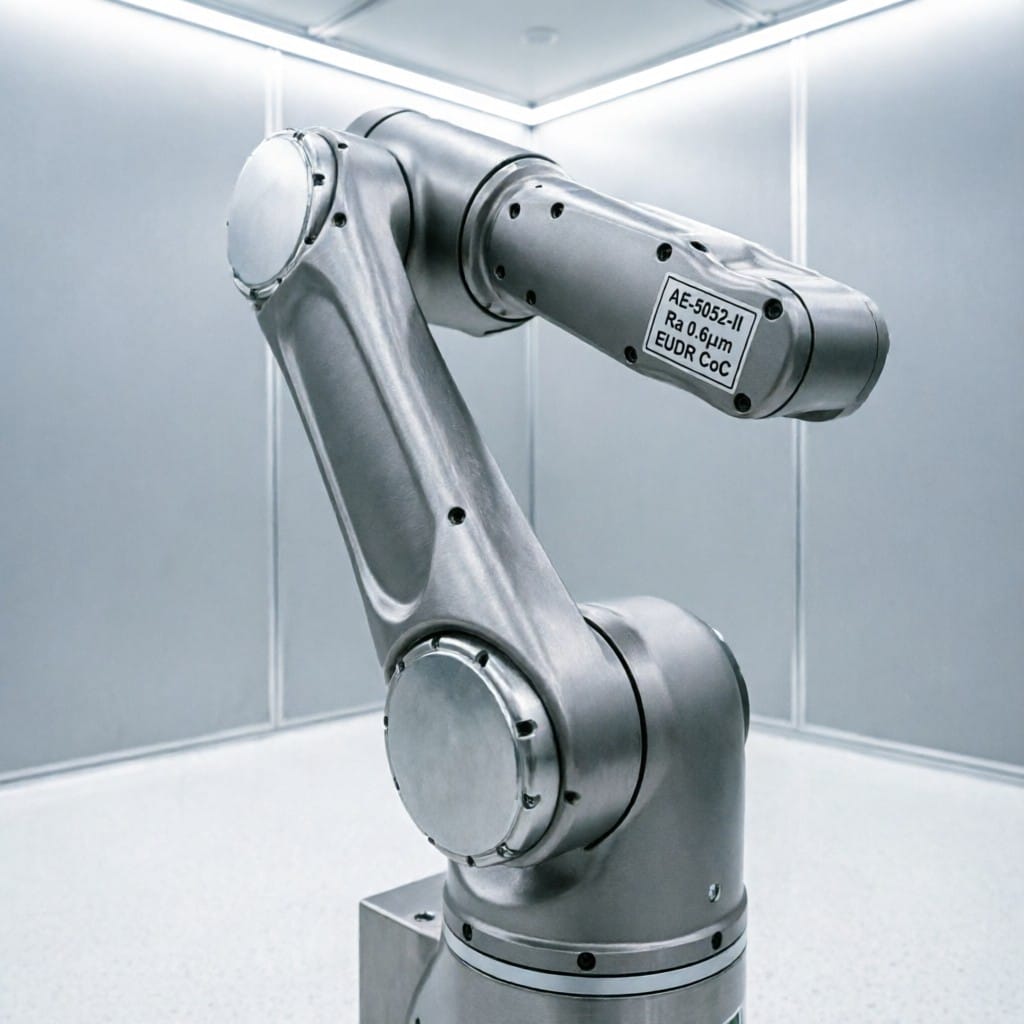
A recent project for an EU-based robotics manufacturer specified AE-5052-II enclosures (20µm coating, Ra 0.6µm) with full EUDR-compliant CoC documentation tracing aluminum ingots to Hydro’s zero-carbon smelters. MOQ starts at 500 units, lead time 18 days, with pre-certified test reports (ASTM B117, MIL-A-8625F) included. For high-vibration industrial environments — think Tesla Gigafactory conveyor systems — AE-7075-HC withstands 20G shock loads without coating delamination, validated per IEC 60068-2-27.
Market-by-Market Guide
| Requirement | EU | US | Japan | UK |
|---|---|---|---|---|
| Formaldehyde Emission | EN 16516 ≤0.124 ppm | CARB ATCM Phase 2 | JIS A 1460 ≤0.3 mg/L | BS EN 717-1 ≤0.124 ppm |
| Corrosion Standard | ISO 9227 NSS 336h+ | ASTM B117 336h+ | JIS H 8502 | BS EN ISO 9227 336h+ |
| Traceability Mandate | EUDR (Dec 30, 2024) | None federal | JIS Q 9001:2015 CoC | UKCA + Due Diligence Act |
| Coating Thickness Std | EN ISO 21287 (5–25µm Type II) | MIL-A-8625F | JIS H 8601 | BS EN ISO 21287 |
| Electrical Safety | IEC 60950-1 | UL 50E | JIS C 5016 | BS EN 60950-1 |
Supplier Solution
aluminum alloy shell operates a 2000sqm ISO 9001/14001-certified facility in Dongguan, specializing in custom metal casing with full-process control from billet to boxed shipment. Every anodized batch includes: (1) Material Test Report (MTR) with alloy chemistry, (2) Coating Thickness Certificate (per ISO 21287), (3) Salt Spray Test Log (ASTM B117), and (4) Chain of Custody (CoC) tracing raw material origin — satisfying EUDR, JIS, and MIL-spec buyers alike. Request a compliant sample kit today: includes 3x5cm anodized plaques (Type II & III) with full documentation pack — shipped within 72 hours.
Verdict: Specify X For Y
Specify Type II Anodize (MIL-A-8625) for EMI-sensitive, dimensionally tight enclosures in medical or telecom applications. Specify Type III Hardcoat (MIL-A-8625) for high-abrasion, extreme-environment housings in aerospace, defense, or industrial automation.
Q: What’s the minimum salt spray resistance for export-compliant aluminum enclosures?
Per ASTM B117, 336 hours is the baseline for EU, US, and UK markets — aluminum alloy shell’s Type II achieves this; Type III exceeds 1000 hours.
Q: Does Type III anodizing affect thermal conductivity significantly?
Yes — expect up to 15% reduction in thermal conductivity versus bare aluminum; Type II reduces it by ≤5%, making it preferable for heat-sink integrated designs.
Q: What’s the thinnest viable hardcoat for precision parts?
Minimum functional Type III thickness is 25µm per MIL-A-8625; below this, abrasion resistance drops below 400 HV. aluminum alloy shell holds ±5µm tolerance.
Q: Can anodized aluminum meet Japan’s F★★★★ standard?
Yes — when processed without formaldehyde-based sealants. aluminum alloy shell uses hot DI water sealing, achieving ≤0.2 mg/L (JIS A 1460), well under 0.3 mg/L threshold.
Q: What documentation proves EUDR compliance for aluminum?
Mill certificates tracing ingot origin + anodizing process log + ISO 14001 audit report. aluminum alloy shell provides all three with every shipment.
Conclusion + Low-Friction CTA
Choosing between Type II and Type III anodizing boils down to environmental exposure, electrical needs, and dimensional tolerances — not vendor preference. With regulations tightening and global supply chains demanding proof-of-compliance, partnering with a vertically integrated supplier like aluminum alloy shell eliminates guesswork. Request a compliant sample kit with full CoC documentation and ASTM B117 test reports — shipped from our Dongguan facility within 72 hours.
Frequently Asked Questions
What are the key differences between MIL-A-8625 Type II and Type III anodizing for aluminum alloy shells?
Type II (Sulfuric Acid) offers coating thickness of 5–25 µm and hardness of 300–400 HV, suitable for moderate wear environments. Type III (Hardcoat) provides 25–100 µm thickness and 400–600 HV hardness, ideal for high-stress applications requiring superior abrasion and corrosion resistance.
Why is material traceability important for aluminum alloy shells exported to the EU?
Due to the EU’s EUDR regulation effective December 2024, full traceability from bauxite mining to final product is required to avoid penalties up to 4% of annual EU turnover. Procurement teams must ensure mill certificates and process logs comply with ISO 9001/14001 standards.
How does aluminum alloy shell ensure compliance with international anodizing standards?
aluminum alloy shell meets EU EUDR, Japan’s JIS H 8601 (F★★★★), UK’s BS EN ISO 7599:2018, and U.S. MIL-A-8625F standards, providing audited documentation and Chain of Custody (CoC) reports for every batch produced in their Dongguan facility.
What salt spray resistance do Type II anodized aluminum shells typically achieve?
Type II anodized aluminum shells from aluminum alloy shell consistently meet or exceed 336 hours of ASTM B117 salt spray testing, a benchmark required by global OEMs for medical, industrial, and consumer electronics applications.
Which industries benefit most from specifying Type III hardcoat anodizing on aluminum enclosures?
Industries such as defense, aerospace, heavy machinery, and high-end consumer electronics benefit most from Type III due to its enhanced durability, dimensional stability, and resistance to extreme environmental stress and abrasion.