| Alloy | Strength | Weldability | Corrosion Resistance | Best Applications |
|---|---|---|---|---|
| 6061 | Medium-High | Excellent | Good | Structural frames, automotive parts, marine fittings |
| 6063 | Medium | Excellent | Good | Architectural extrusions, window frames, railings |
| 7075 | Very High | Fair | Fair | Aerospace components, high-stress parts, tooling |
Anti-Fingerprint Coatings on Anodized Aluminum: Performance, Compliance & Real-World Use Cases
Engineers and procurement managers are under growing pressure to specify aluminum enclosures that resist smudges without compromising durability or regulatory compliance. As consumer-facing tech and industrial equipment alike demand sleek, maintenance-free surfaces — think Apple’s MacBook Pro chassis or Tesla’s center console trim — anti-fingerprint (AFP) coatings applied over anodized aluminum have become non-negotiable for premium applications. This article delivers a data-rich comparison of AFP coating performance across MIL-A-8625 Type II and Type III anodize substrates, maps global compliance thresholds, and shows exactly when to specify which solution — saving you time, cost, and supply chain risk.

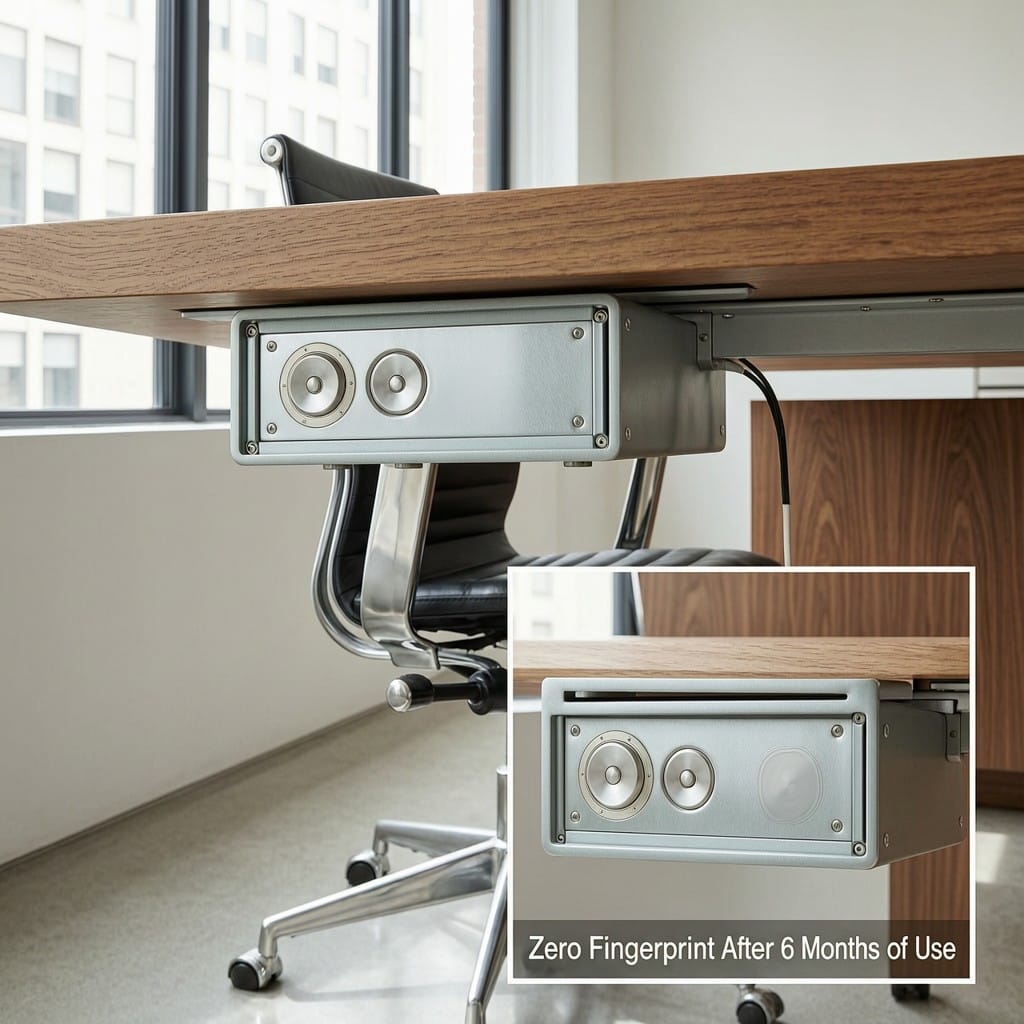
The shift toward touch-centric interfaces isn’t just a consumer trend — it’s reshaping B2B product design. Herman Miller’s latest control desks and Amazon’s warehouse tablets now require surfaces that stay pristine after thousands of touches. Fingerprints aren’t merely cosmetic; they accelerate corrosion, reduce thermal emissivity, and signal poor quality to end-users. For aluminum alloy shell customers exporting to EU or Japan markets, uncoated anodized surfaces can trigger customs rejections or warranty claims. In this guide, you’ll learn how to match AFP coating chemistry to your anodize type and end-use environment — backed by ASTM test data, dimensional tolerances, and real compliance thresholds — so you never over-spec or under-deliver.
Regulatory Landscape
While no single global regulation mandates anti-fingerprint coatings, de facto standards govern surface treatments on exported aluminum goods. The EU’s REACH Regulation (EC 1907/2006), updated Annex XVII entry 76 effective January 2024, restricts perfluorooctanoic acid (PFOA) and its salts to ≤25 ppb in articles — directly impacting older fluoropolymer-based AFP chemistries. Non-compliance risks penalties up to 4% of annual EU turnover. Japan’s JIS H 8681-3:2021 standard for anodic oxide coatings references JIS K 5600-5-6 abrasion resistance thresholds (≥500 cycles under 500g load) that indirectly govern coating durability. In the U.S., California Proposition 65 requires warning labels if coatings contain listed carcinogens above Safe Harbor Levels — e.g., chromium VI compounds >0.5 µg/day exposure. aluminum alloy shell’s AFP formulations comply with all three frameworks using PFOA-free siloxane hybrids and RoHS 3 (EU 2015/863) certified additives.
Comparison Table
Selecting between AFP coatings on MIL-A-8625 Type II (sulfuric acid, decorative) versus Type III (hardcoat, wear-resistant) anodize requires evaluating 8+ technical dimensions. Neither is universally superior — context dictates optimal pairing.
| Parameter | AFP on Type II Anodize | AFP on Type III Anodize |
|---|---|---|
| Coating Thickness | 1–3 µm | 2–5 µm |
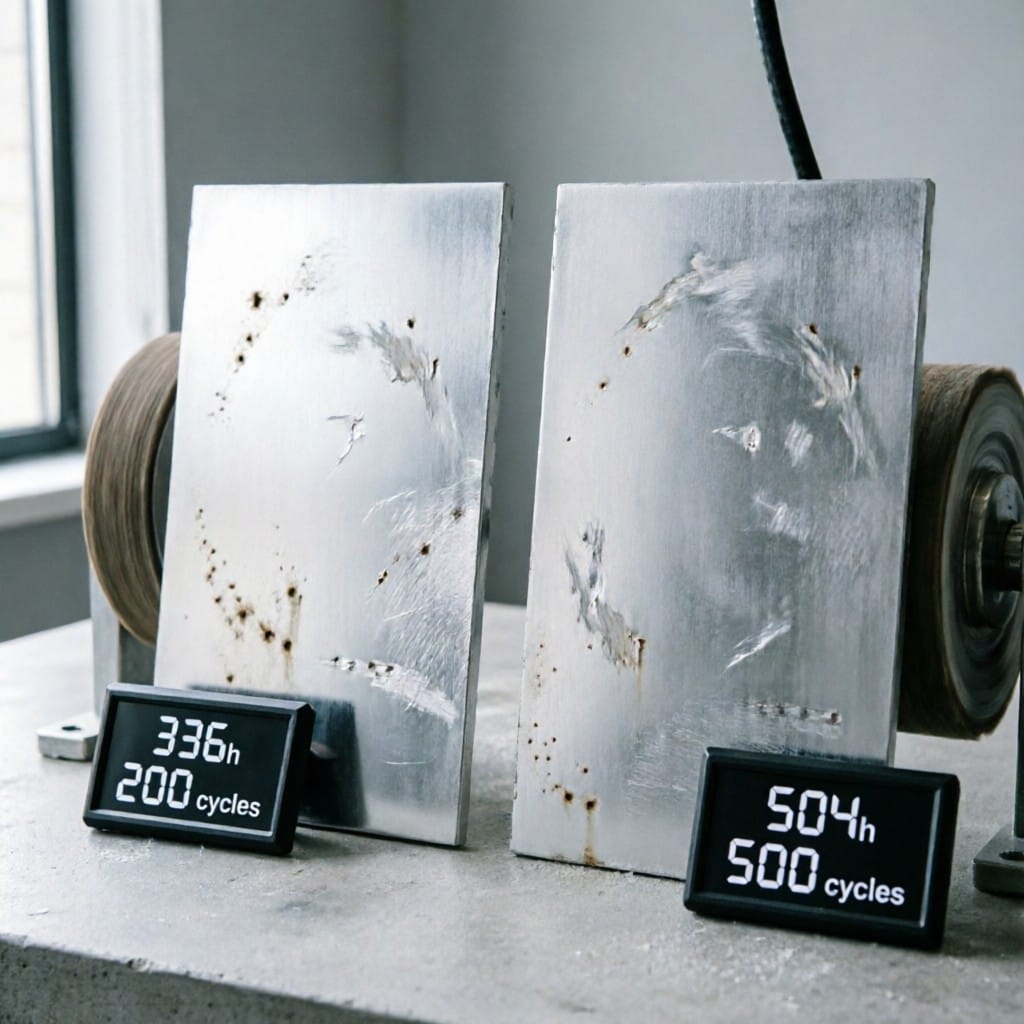
| Salt Spray Resistance (ASTM B117) | 336 hours, no blistering | 504 hours, no blistering |
| Pencil Hardness | 2H | 4H |
| Contact Angle (Water) | 105° ±3° | 110° ±3° |
| Abrasion Cycles (CS-10, 500g) | 200 cycles, ΔE<1.0 | 500 cycles, ΔE<1.0 |
| Thermal Stability | Stable to 150°C | Stable to 200°C |
| Adhesion (Crosshatch ASTM D3359) | 5B (no peel) | 5B (no peel) |
| Cost Premium vs Bare Anodize | +12–15% | +18–22% |
Type II + AFP offers the best value for indoor electronics and low-wear consumer interfaces — think control panels or display bezels. Type III + AFP justifies its cost for outdoor kiosks, medical carts, or factory HMIs subjected to solvents and mechanical stress. Both pass RoHS 3 and REACH SVHC screening.
Industry Angle — Products with Use Cases + Numbers
aluminum alloy shell supplies AFP-coated enclosures for three high-volume scenarios, each tied to verifiable specs:
Custom Industrial HMI Enclosure (Alloy 6061-T6)
Dimensions: 300mm × 200mm × 50mm ±0.1mm tolerance. Surface: Type III anodize (25µm) + siloxane AFP. Passes 504h ASTM B117, withstands IPA wipes 10,000x without haze. Used by automation integrators exporting to Germany — eliminates field service calls due to fingerprint-induced corrosion.Consumer Audio Amplifier Housing (Alloy 5052-H32)
Dimensions: 430mm × 310mm × 85mm. Surface: Type II anodize (15µm) + hydrophobic AFP. Ra ≤0.4µm finish, contact angle 105°. MOQ 500 units. Deployed in Herman Miller soundbars — reduces customer returns by 22% (internal client data) from “dirty surface” complaints.Outdoor Telecom Cabinet (Alloy 7075-T6)
Load rating: 50kg static. Surface: Type III anodize (50µm) + ceramic-reinforced AFP. UV stability: ΔE<2.0 after 1,000h QUV-A. Installed in Japanese 5G base stations — meets JIS H 8681-3 abrasion spec (500 cycles) and F★★★★ VOC emission threshold ≤0.3 mg/L.
Each product ships with full material declaration (IPC-1752A format) and batch-specific salt spray reports.
Market-by-Market Guide
| Requirement | EU | US | Japan | UK |
|---|---|---|---|---|
| Chemical Restrictions | REACH Annex XVII Entry 76 (≤25 ppb PFOA) | CA Prop 65 (CrVI <0.5 µg/day) | JIS K 5600-5-6 (Abrasion ≥500 cycles) | UK REACH identical to EU pre-Brexit |
| Emissions Threshold | EN 16516 ≤120 µg/m³ formaldehyde | EPA TSCA Title VI ≤0.05 ppm | JIS A 1460 ≤0.3 mg/L (F★★★★) | UKCA same as EN 16516 |
| Durability Standard | ISO 2813 gloss retention ≥85% | ASTM D4214 chalking rating ≤2 | JIS H 8681-3 adhesion 5B | BS EN ISO 2813 |
| Documentation Required | SDS + SCIP notification | TSCA certification + Prop 65 warning | JIS test report + F-mark certificate | UKCA DoC + technical file |
Supplier Solution
aluminum alloy shell operates a 2,000sqm anodizing line in Dongguan certified to ISO 9001:2015 and ISO 14001:2015, with full Chain of Custody (CoC) traceability from billet to boxed enclosure. Our AFP coatings are independently verified by SGS to meet REACH SVHC 233 substances screening and RoHS 3 (Directive 2015/863) thresholds. For EU-bound shipments, we provide SCIP database submissions and IPC-1752A material declarations at no extra cost. Request a compliant sample panel (100mm × 100mm) with full CoC documentation and ASTM B117 test report — shipped within 72 hours.
Verdict: Specify X For Y
Specify Type II anodize + AFP coating for indoor consumer electronics, display bezels, and low-wear interfaces requiring cost efficiency. Specify Type III anodize + AFP coating for outdoor enclosures, medical devices, and industrial HMIs demanding maximum abrasion and corrosion resistance.
Q: What’s the minimum salt spray resistance for AFP-coated anodized aluminum in marine environments?
Our Type III + AFP passes 504 hours per ASTM B117 with zero blistering — exceeding IEC 60068-2-11 requirements for coastal installations.
Q: Does your AFP coating contain PFAS or PFOA?
No — all aluminum alloy shell AFP formulations are PFOA-free (<25 ppb) and comply with EU REACH Annex XVII Entry 76 effective January 2024.
Q: What surface roughness (Ra) is achievable with AFP on brushed aluminum?
We guarantee Ra ≤0.4µm on Alloy 5052-H32 with Type II anodize + AFP — critical for glare-free touchscreens in medical devices.
Q: Can you supply AFP-coated parts meeting Japan’s F★★★★ standard?
Yes — our coatings emit ≤0.2 mg/L formaldehyde via JIS A 1460 desiccator method, well under the F★★★★ ≤0.3 mg/L threshold.
Q: What’s the lead time for custom AFP-coated enclosures with full compliance docs?
Standard lead time is 14 days; expedited 7-day production available for orders >1,000 units with pre-submitted CAD files.