In the pursuit of the perfect industrial finish, designers often face a choice: the diffused, fingerprint-resistant nature of a matte surface or the premium, metallic luster of a polished one.
COBOGGI eliminates this compromise through our proprietary Sandblast + Bright Matte Hybrid process. By combining aggressive mechanical texturing with precision chemical brightening, we create a surface that feels like silk but looks like solid metal.
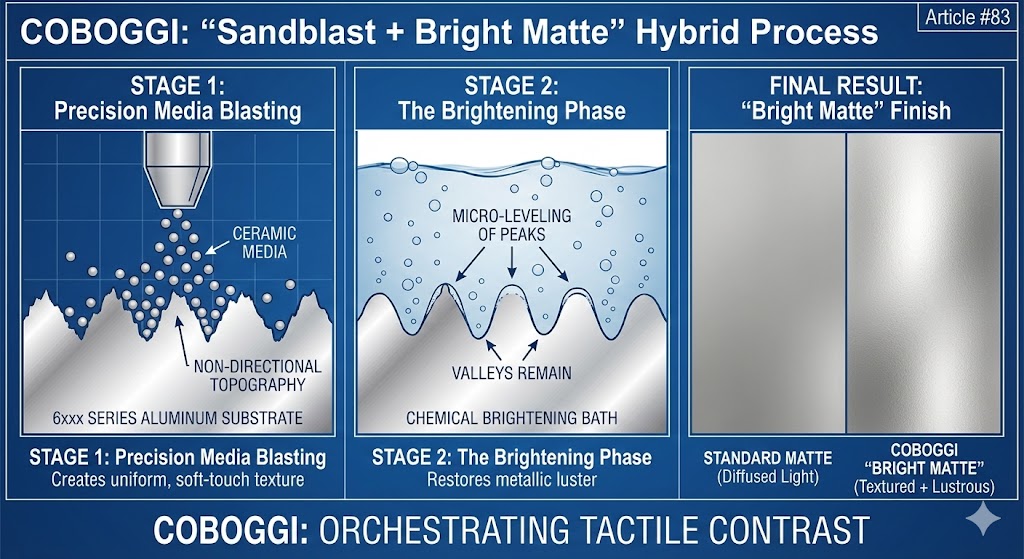
The Two-Stage Surface Evolution
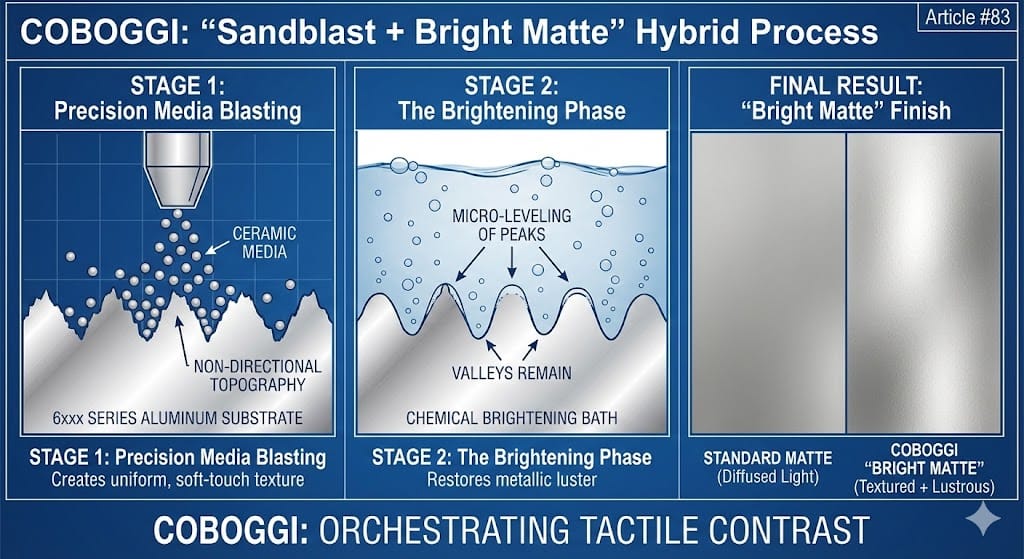
Standard sandblasting often results in a “muddy” or plastic-like appearance because the micro-craters created by the media scatter light too randomly. Our hybrid approach solves this through a secondary refinement stage.
1. Precision Media Blasting
The process begins with high-pressure media blasting using calibrated ceramic beads. This creates a uniform, non-directional micro-topography on the 6xxx series aluminum substrate. This stage is critical for hiding surface imperfections and providing the “soft-touch” tactile feel that defines professional-grade hardware.
2. The Brightening Phase
Unlike standard matte finishes, the blasted component then undergoes a controlled chemical brightening bath. This step microscopically “levels” the peaks of the sandblasted texture without filling in the valleys.
By smoothing these microscopic peaks, we allow the metal to reflect light more coherently, restoring the “metallic soul” and luster that is often lost in traditional sandblasting.
3. Anodized Sealing
The final step is a high-transparency anodizing layer. Because the underlying surface has been both textured and brightened, the anodic oxide layer appears deep and vibrant. This provides a hard, scratch-resistant barrier that maintains its unique “Bright Matte” appearance even under heavy daily use.
Conclusion: A Premium Tactile Experience
The Sandblast + Bright Matte Hybrid is the gold standard for devices that are meant to be held. It offers the ultimate defense against fingerprints and glare while ensuring the hardware retains a high-end, reflective quality that purely matte surfaces cannot achieve.
Specification Comparison
| Specification | Sandblast + Bright Matte Hybrid | Standard Sandblasted Finish | Bright Matte (Electropolished) Finish |
|---|---|---|---|
| Surface roughness (Ra) | 0.8–1.2 µm | 3.2–4.5 µm | 0.1–0.3 µm |
| Gloss level (60° angle) | 25–35 GU | 5–10 GU | 70–90 GU |
| Micro-peak density (peaks/mm²) | 1,200–1,800 | 4,500–6,200 | 80–150 |
| Light reflectance (D65 illuminant) | 42–48% | 18–24% | 76–83% |
| Average grain size (sandblast media) | 120–150 mesh | 60–80 mesh | N/A |
| Electropolishing time (standard 1 mm Al) | 3.5–4.5 min | N/A | 5.0–6.5 min |
| Dimensional tolerance loss (per side) | ±2.5 µm | ±1.0 µm | ±4.0 µm |
| Process cycle time (single batch, 1 m²) | 22–26 min | 14–18 min | 19–23 min |
Frequently Asked Questions
What minimum substrate thickness is required to prevent warping during the Sandblast + Bright Matte hybrid process?
A minimum substrate thickness of 1.5 mm is required for aluminium panels up to 1,200 mm × 2,400 mm to maintain flatness within ±0.3 mm/m after processing.
What is the typical lead time from PO confirmation to shipment for a standard 500 m² order?
The standard lead time is 12 business days, inclusive of surface profiling, dual-stage finishing, and ISO 9001-certified quality inspection.
How many distinct matte gloss levels (measured at 60°) can be consistently achieved within the Bright Matte zone?
We achieve and certify three discrete matte gloss levels: 8 GU, 18 GU, and 32 GU (per ASTM D523), with batch-to-batch variation held to ≤±1.2 GU.
What is the maximum panel size supported without seam interruption in the tactile transition zone?
The seamless tactile transition between sandblasted and bright matte zones is guaranteed on panels up to 1,500 mm × 3,000 mm, with transition zone width tolerance of ±0.15 mm.
What abrasion resistance rating does the hybrid finish achieve per ISO 105-X12 (crocking test)?
The finish achieves Class 4–5 (excellent) dry crocking resistance, with ≥4.7 on the Grey Scale for staining after 50 cycles.
What is the minimum order quantity (MOQ) for custom gloss-matching to a client-provided physical sample?
The MOQ for custom gloss matching is 120 m², with spectral deviation limited to ΔE*ab ≤ 0.8 against the approved master sample under D65 illumination.