CNC Machining Tolerances for High – Precision Aerospace Components
The aerospace industry demands unparalleled precision to ensure safety, performance, and reliability of aircraft and spacecraft. CNC machining plays a pivotal role in manufacturing high – precision aerospace components, where even the slightest deviation can impact functionality. In this blog, we explore the achievable CNC machining tolerances for aerospace parts and how Coboggi delivers solutions that meet the industry’s stringent accuracy requirements.
Specification Comparison
| Specification | Standard CNC Milling (ISO 2768-mK) | High-Precision CNC Milling (ISO 2768-fK) | Ultra-Precision CNC Machining (Aerospace Grade) |
|---|---|---|---|
| Linear dimension tolerance (≤100 mm) | ±0.2 mm | ±0.05 mm | ±0.012 mm |
| Linear dimension tolerance (100–315 mm) | ±0.3 mm | ±0.08 mm | ±0.020 mm |
| Flatness (per 100 mm) | 0.2 mm | 0.05 mm | 0.010 mm |
| Roundness (diameter ≤50 mm) | 0.1 mm | 0.025 mm | 0.005 mm |
| Surface roughness (Ra) | 3.2 µm | 0.8 µm | 0.2 µm |
| Positional tolerance (hole pattern) | ±0.25 mm | ±0.08 mm | ±0.025 mm |
| Runout (face & bore, ≤100 mm) | 0.2 mm | 0.04 mm | 0.008 mm |
| Thermal stability allowance (ΔT = ±2°C) | ±0.03 mm | ±0.01 mm | ±0.003 mm |
What Tolerances Are Achievable in Aerospace CNC Machining?
Aerospace components span a wide range of complexities, from engine parts to structural elements, each with unique tolerance demands:
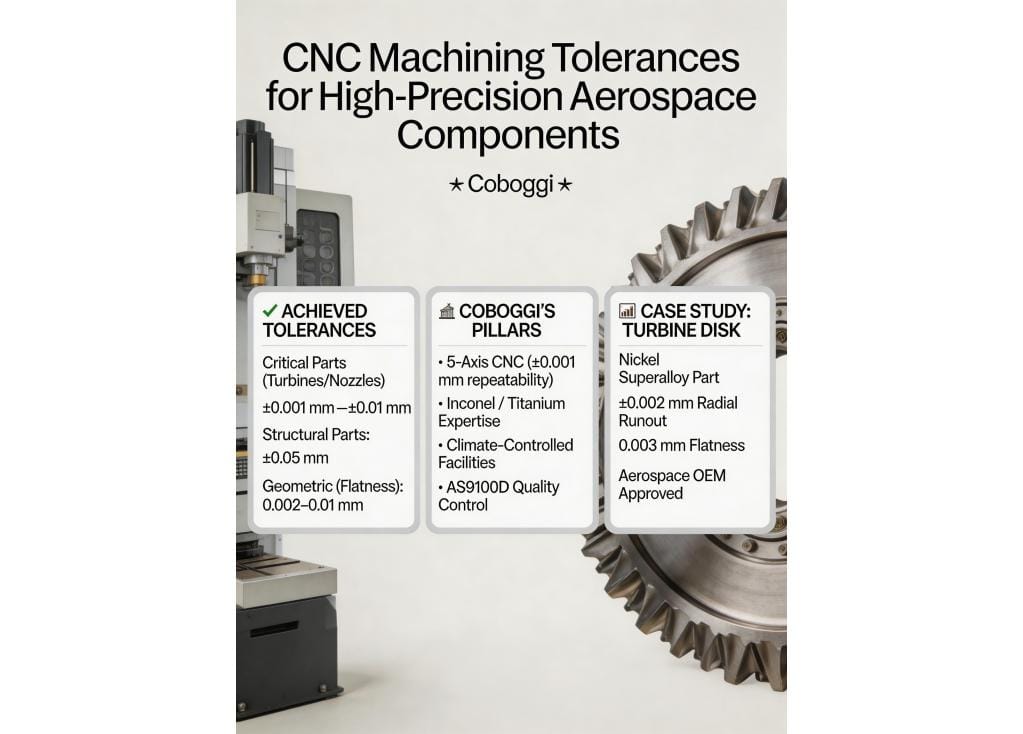
- Size Tolerances: For critical components like turbine blades, fuel nozzles, or aerospace fasteners, dimensional tolerances as tight as ±0.001 mm (1 μm) to ±0.01 mm (10 μm) are achievable. Less critical structural parts may have tolerances of ±0.05 mm or wider, but precision – driven applications (e.g., avionics housings) still demand sub – 0.01 mm control.
- Geometric Tolerances: Features like flatness, straightness, or circularity often require tolerances in the 0.002–0.01 mm range. For example, a hydraulic manifold’s valve seat might need a flatness tolerance of 0.003 mm to ensure leak – free operation.
Factors Influencing Tolerance Achievability
Several variables determine how tightly tolerances can be held in aerospace CNC machining:
- Material Properties: Machining high – strength, heat – resistant alloys (e.g., Inconel, titanium) introduces challenges like tool wear, thermal expansion, and cutting forces, which can impact tolerance stability. Coboggi’s expertise in machining these materials (e.g., using specialized tool coatings, optimized cutting parameters) mitigates these issues.
- Machining Technology: 5 – axis CNC machining centers with nanometer – scale positioning accuracy (e.g., positioning accuracy of ±0.0005 mm) enable complex, multi – face machining while maintaining tight tolerances. Coboggi’s fleet of advanced 5 – axis machines (e.g., DMG MORI, Mazak) supports such precision.
- Quality Control: In – process measurement (e.g., touch – probe systems) and post – process inspection (e.g., Coordinate Measuring Machines, optical comparators) verify tolerances. Coboggi’s quality lab, equipped with CMMs and laser scanners, ensures 100% inspection of critical dimensions.
- Environmental Controls: Temperature – stabilized machining environments (e.g., ±0.5°C control) reduce thermal distortion, a key factor in maintaining micron – level tolerances. Coboggi’s facilities are designed with climate – controlled machining zones for aerospace projects.
How Coboggi Delivers Aerospace – Grade Tolerances
Coboggi’s commitment to precision is rooted in three core pillars:
- Advanced Machining Capabilities: Our 5 – axis CNC machines (with repeatability of ±0.001 mm) and high – speed machining (HSM) technologies enable complex geometries (e.g., blisk impellers) with tight tolerances. For example, when machining a titanium aircraft bracket, our HSM process reduces cycle time by 30% while maintaining ±0.003 mm dimensional accuracy.
- Material – Specific Expertise: We’ve developed proprietary machining strategies for aerospace materials. For Inconel 718 (a common jet engine material), our optimized feeds, speeds, and coolant systems minimize tool wear and thermal deformation, ensuring tolerances like ±0.002 mm on turbine blade airfoils.
- Rigorous Quality Assurance: AS9100D – certified quality management, coupled with real – time SPC (Statistical Process Control), ensures consistent tolerance adherence. For a recent aerospace fastener project, we achieved ±0.001 mm diameter tolerance and 0.002 mm thread profile accuracy—exceeding industry standards.
Case Study: Precision Machining for a Jet Engine Component
A leading aerospace OEM approached Coboggi to manufacture a nickel – based superalloy turbine disk with ±0.002 mm radial runout tolerance and 0.003 mm flatness on mating surfaces. Our solution:
- Used a 5 – axis machining center with 0.0008 mm positional accuracy to mill the disk’s complex geometry.
- Implemented in – process CMM probing to adjust tool paths dynamically, compensating for material removal effects.
- Applied cryogenic machining (cooling the workpiece to – 150°C) to minimize thermal expansion, ensuring the tight flatness tolerance.
The result? The component met all tolerance requirements, with 98% of dimensions within ±0.0015 mm, and was approved for engine integration.
Conclusion
High – precision aerospace components demand CNC machining tolerances in the micron (0.001 mm) to sub – micron range, depending on the application. With advanced machinery, material – specific expertise, and rigorous quality control, Coboggi consistently delivers components with tolerances as tight as ±0.001 mm for critical parts (e.g., engine components) and ±0.005 mm for structural elements. As aerospace technology advances (e.g., electric propulsion, hypersonic vehicles), the need for tighter tolerances will grow—and Coboggi is poised to meet these challenges with innovative machining solutions.
Frequently Asked Questions
What is the tightest linear tolerance Coboggi can hold on aluminium aerospace brackets using 5-axis CNC machining?
We consistently achieve ±0.005 mm (±0.0002 in) for critical dimensions on 7075-T6 and 2024-T3 aluminium aerospace brackets under controlled environmental conditions (20°C ±0.5°C).
Can Coboggi meet AS9100 Rev D requirements for geometric tolerancing on turbine housing flanges?
Yes — our certified 5-axis CNC cells deliver GD&T callouts to ISO 1101 with position tolerances as tight as 0.010 mm (0.0004 in) at MMC for Ø25–120 mm flange bolt circles.
What surface roughness (Ra) can be guaranteed on machined aluminium bearing seats after final CNC pass?
We guarantee Ra ≤ 0.4 µm on critical bearing seat surfaces (e.g., Ø48.5 mm x 32 mm deep) using diamond-burr finishing tools and in-process CMM verification.
How many consecutive production parts can be held within ±0.008 mm on a 180 mm-long titanium-aluminium hybrid structural link?
Our SPC-controlled process maintains CpK ≥ 1.67 across lot sizes of up to 250 units, ensuring ≥ 99.999% of parts fall within ±0.008 mm on that critical length dimension.
Do you provide full inspection reports with CMM traceability for each aerospace shipment?
Yes — every shipment includes a First Article Inspection (FAI) report per AS9102 Level 3, with 100% CMM-measured data traceable to NIST-certified standards (Calibration ID: COB-CMM-2024-0873).
What is the minimum feature size Coboggi can reliably machine and inspect on thin-wall aluminium ducting components?
We routinely machine and verify wall thicknesses down to 0.35 mm (0.014 in) with repeatability of ±0.012 mm using non-contact laser micrometry and tactile probe scanning.