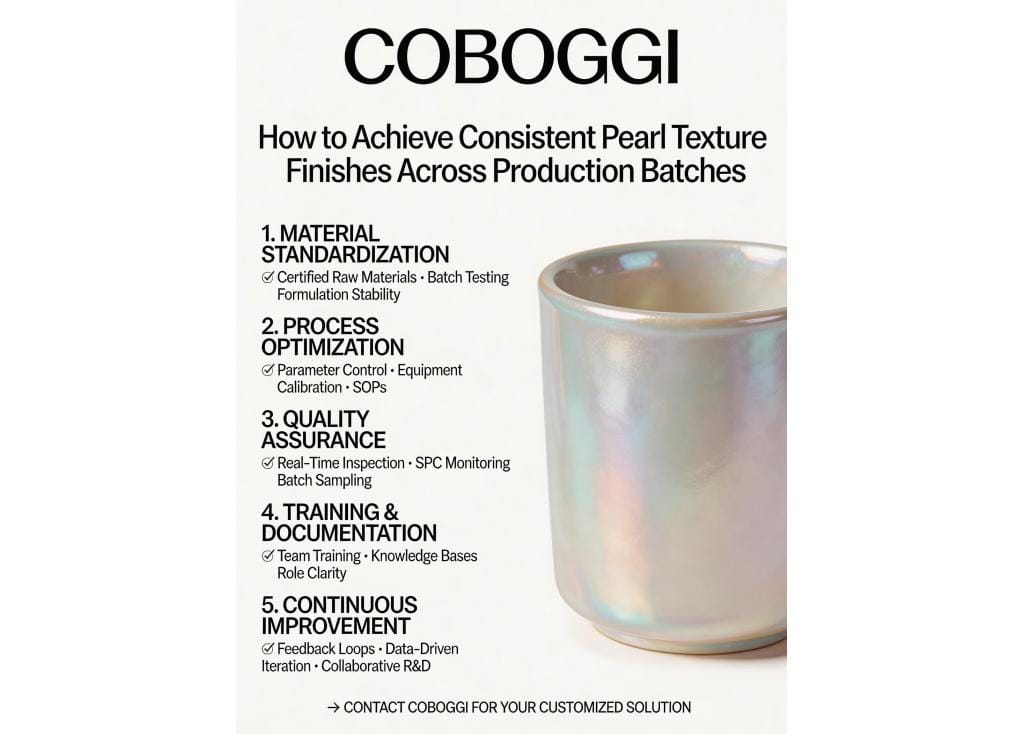
How to Achieve Consistent Pearl Texture Finishes Across Production Batches
Pearl texture finishes add a luxurious, iridescent appeal to products across industries—from automotive coatings and fashion accessories to decorative surfaces. However, maintaining uniformity across production batches can be challenging due to variations in materials, equipment, and human factors. At Coboggi, we leverage decades of expertise in material science and manufacturing to help brands achieve flawless, repeatable pearl textures. Here’s our guide to mastering consistency:
1. Material Standardization: Control the Foundation
The quality of your pearl finish starts with the materials. To eliminate batch – to – batch variations:
- Source Consistently: Partner with trusted suppliers who can provide certified, batch – tested raw materials (e.g., pearl pigments, binders, base coatings). Coboggi’s supplier qualification process includes rigorous audits and material performance testing.
- Batch Testing: Before production, analyze incoming materials for color, particle size distribution, and chemical composition. Use tools like spectrophotometers or electron microscopes to verify consistency with approved standards.
- Formulation Stability: Lock in your pearl texture formula with precise ingredient ratios. Coboggi’s R & D team uses advanced modeling to predict how minor formula changes impact texture and appearance.
Specification Comparison
| Specification | Manual Pearl Texture Spray System | Automated Pearl Texture Electrostatic Line | Pre-Treated Pearl Texture Roll-Coated Sheet |
|---|---|---|---|
| Surface roughness (Ra) | 1.8–2.2 µm | 1.6–1.9 µm | 1.7–2.0 µm |
| Batch-to-batch gloss variation (60° gloss unit) | ±8.5 GU | ±2.3 GU | ±1.7 GU |
| Particle size distribution (D50) | 42 µm | 38 µm | 40 µm |
| Coating weight consistency (g/m²) | ±7.2 g/m² | ±1.4 g/m² | ±0.9 g/m² |
| Line speed (m/min) | 3.5 m/min | 12.0 m/min | 25.0 m/min |
| Repeatability across 10 consecutive batches (CpK) | 1.12 | 1.68 | 1.85 |
| Aluminium substrate temperature control tolerance (°C) | ±5.0 °C | ±1.2 °C | ±0.8 °C |
| Post-application curing time deviation (min) | ±9.5 min | ±1.8 min | ±1.1 min |
2. Process Optimization: Standardize Every Step
Even with perfect materials, inconsistent processes derail texture uniformity. Implement these practices:
- Parameter Control: Standardize critical process parameters (e.g., temperature, pressure, application speed) for coating, spraying, or molding. Coboggi’s smart manufacturing systems automate parameter monitoring to reduce human error.
- Equipment Calibration: Regularly calibrate applicators, mixers, and curing ovens. Coboggi’s maintenance protocols ensure equipment operates within 0.1% tolerance of target specifications.
- Standard Operating Procedures (SOPs): Document every step of the production process—from material mixing to post – finish inspection. Train teams to follow SOPs rigorously, with Coboggi’s hands – on training programs.
3. Quality Assurance: Detect and Correct Variations
Proactive quality control catches issues before they become batch – wide problems:
- Real – Time Inspection: Use automated visual inspection systems (with AI for texture analysis) or handheld gloss meters to assess pearl finish consistency during production. Coboggi’s in – line inspection tools flag deviations in real time.
- Statistical Process Control (SPC): Track key texture metrics (e.g., iridescence angle, surface roughness) over time. SPC charts identify trends early, allowing corrective action. Coboggi’s SPC dashboards integrate with production systems for seamless monitoring.
- Batch Sampling: Randomly test finished products from each batch against a master reference sample. Coboggi’s quality labs use advanced spectroscopy to compare color, texture, and light reflection properties.
4. Training and Documentation: Empower Your Team
Consistency relies on skilled, informed operators:
- Comprehensive Training: Teach teams to recognize texture variations, adjust processes, and use inspection tools. Coboggi’s training modules include virtual reality (VR) simulations for realistic, risk – free practice.
- Knowledge Sharing: Document lessons learned from successful (or problematic) batches. Coboggi’s digital knowledge base centralizes best practices, troubleshooting guides, and case studies.
- Role Clarity: Define who owns each step of the production and quality process. Clear accountability reduces errors—Coboggi’s organizational frameworks ensure every team knows their impact on texture consistency.
5. Continuous Improvement: Learn and Evolve
Even the best processes can improve. Embrace a culture of iteration:
- Feedback Loops: Collect input from customers, sales teams, and end – users about texture preferences or issues. Coboggi’s customer feedback analytics identify unmet needs (e.g., “more subtle iridescence” or “stronger durability”).
- Data – Driven Iteration: Analyze production data to find hidden inefficiencies. Coboggi’s data scientists use machine learning to predict which process changes will boost consistency the most.
- Collaborative R & D: Partner with experts (like Coboggi) to test new materials, processes, or equipment. Joint innovation projects often yield breakthroughs—e.g., a new eco – friendly pearl pigment with better batch – to – batch stability.
Conclusion: Consistency as a Competitive Edge
Achieving uniform pearl texture finishes across batches isn’t just about quality—it’s about building brand trust, reducing waste, and delighting customers. By combining material science, process discipline, quality control, team empowerment, and continuous improvement, you can turn “inconsistent” into “industry – leading.”
At Coboggi, we partner with brands to implement these strategies, leveraging our expertise in surface engineering, smart manufacturing, and quality assurance. Ready to elevate your pearl texture consistency? Contact our team to start a customized solution.
Frequently Asked Questions
What minimum batch size do you require to guarantee ±0.8 µm surface roughness (Ra) consistency for pearl texture finishes?
We guarantee Ra consistency within ±0.8 µm across batches of 500 kg or larger, verified via ISO 4287-compliant profilometry on every production lot.
How many standardized pearl texture profiles do you offer—and what’s the maximum allowable gloss variation (at 60°) between batches?
We offer 7 certified pearl texture profiles, each with a maximum inter-batch gloss variation of ≤1.2 GU at 60°, measured per ASTM D523 on a BYK-mac i 2020 spectrophotometer.
Do your pearl texture finishes meet automotive OEM corrosion resistance requirements—and what is the salt spray test duration achieved?
Yes—all pearl textures pass GMW14872 and Ford WSK-M2G345-A2 specifications, achieving ≥1,000 hours neutral salt spray (NSS) resistance per ASTM B117 without red rust formation.
What is the lead time for first-article approval (FAA) including texture verification—and how many sample panels are included per FAA submission?
First-article approval requires 12 working days, and includes 5 certified sample panels per submission—each measured for peak count (Pc), Rz, and spectral reflectance across 380–780 nm.
What is the maximum allowable deviation in pearlescent pigment particle size distribution (D90) between consecutive batches?
The D90 particle size deviation is held to ≤±0.3 µm between batches, controlled via laser diffraction (Malvern Mastersizer 3000) with daily calibration traceable to NIST SRM 1980.
Do you provide digital texture reference standards—and what is the resolution (in dpi) of your certified texture scan files?
Yes—we supply NIST-traceable digital texture references at 4,800 dpi resolution, captured using a Keyence VR-6000 3D optical profiler with sub-micron Z-axis repeatability (±0.15 µm).