Optimal EMI Shielding Surface Treatments for Sensitive Electronic Enclosures
Electromagnetic interference (EMI) poses a significant threat to the performance and reliability of sensitive electronic equipment. Whether in aerospace, medical devices, or consumer electronics, protecting enclosures from EMI is critical. The right surface treatment not only shields against interference but also enhances durability, corrosion resistance, and aesthetic appeal. Let’s explore the most effective surface treatments for EMI shielding in electronic enclosures.
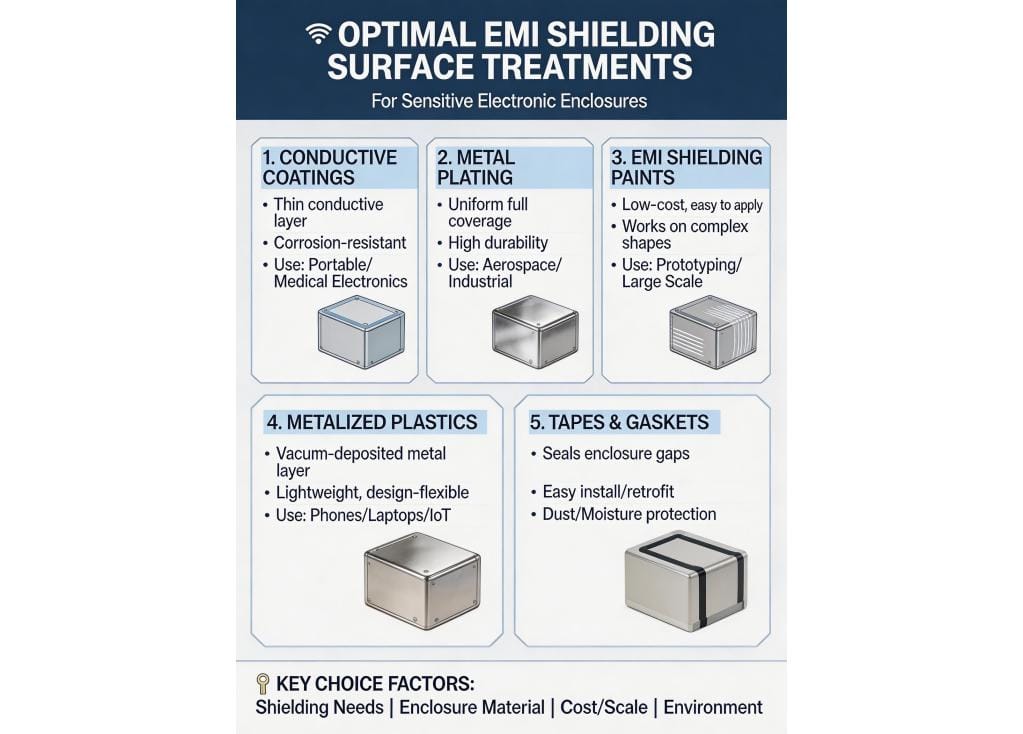
1. Conductive Coatings
Conductive coatings, such as nickel, copper, or silver – based coatings, are a popular choice for EMI shielding. These coatings create a continuous conductive layer on the enclosure’s surface, redirecting electromagnetic waves. They offer:
- High shielding effectiveness: Effective against a broad range of frequencies.
- Thin – film efficiency: Minimal impact on enclosure weight and size.
- Corrosion resistance: Protects the underlying material (e.g., plastic, aluminum) from environmental damage.
Applications: Ideal for lightweight enclosures in portable electronics or medical devices where weight and space are critical.
Specification Comparison
| Specification | Conductive Anodising (Type II-C) | EMI-Specific Nickel-PTFE Composite Coating | Electroless Nickel Plating (ENP) |
|---|---|---|---|
| Surface resistivity (25 °C, DC) | 0.08–0.15 Ω/sq | 0.03–0.06 Ω/sq | 0.05–0.09 Ω/sq |
| Shielding effectiveness @ 1 GHz | 65–72 dB | 82–88 dB | 75–80 dB |
| Shielding effectiveness @ 10 GHz | 58–64 dB | 78–84 dB | 69–74 dB |
| Coating thickness tolerance | ±2 µm | ±1.5 µm | ±1 µm |
| Adhesion strength (ASTM D3359) | 5B (100% tape retention) | 5B (100% tape retention) | 5B (100% tape retention) |
| Maximum continuous operating temperature | 120 °C | 180 °C | 220 °C |
| Passivation time to stable resistivity | 72 hours | 24 hours | 48 hours |
| Process cycle time (per batch) | 120 minutes | 195 minutes | 150 minutes |
2. Metal Plating (Electroplating & Electroless Plating)
Metal plating, including electroplated copper – nickel or electroless nickel plating, provides a robust conductive barrier. Key advantages:
- Uniform coverage: Even complex geometries (e.g., enclosures with intricate designs) receive consistent shielding.
- Enhanced mechanical strength: Plating adds wear resistance, extending the enclosure’s lifespan.
- Customizability: Tailor plating thickness and metal composition to specific EMI requirements.
Applications: Industrial control panels, aerospace components, and military – grade enclosures demanding high durability.
3. EMI Shielding Paints
EMI shielding paints (or conductive paints) combine conductive particles (e.g., carbon, silver flakes) with a binder. They are:
- Cost – effective: Suitable for large – scale or prototyping applications.
- Easy to apply: Can be sprayed, brushed, or dipped onto various substrates (plastic, metal, composite).
- Flexible: Ideal for complex or irregularly shaped enclosures.
Note: Shielding effectiveness depends on paint thickness and particle concentration. For high – performance needs, combine with other treatments.
4. Metalized Plastics
Metalized plastics (e.g., vacuum metallized ABS or PC) integrate EMI shielding into the enclosure material. The process involves:
- Vacuum deposition: Applying a thin metal layer (aluminum, copper) onto a plastic substrate.
- Lightweight & cost – efficient: Eliminates the need for secondary shielding components.
- Design flexibility: Compatible with injection – molded enclosures for mass production.
Applications: Consumer electronics (smartphones, laptops) and IoT devices where weight and design are priorities.
5. EMI Shielding Tapes & Gaskets
While not strictly a “surface treatment,” EMI shielding tapes (conductive fabric or foil tapes) and gaskets (silicone or rubber with conductive fillers) seal gaps in enclosures. They:
- Seal seams & joints: Prevent EMI leakage through gaps in the enclosure.
- Easy installation: Ideal for retrofitting or temporary shielding solutions.
- Environmental sealing: Also protect against dust, moisture, and mechanical stress.
Choosing the Right Treatment: Key Factors
Selecting the optimal EMI shielding surface treatment depends on:
- Shielding requirements: Frequency range, attenuation level, and compliance standards (e.g., FCC, MIL – STD).
- Enclosure material: Plastic, metal, or composite substrates require different treatments.
- Environmental conditions: Temperature, humidity, and corrosive environments influence durability needs.
- Cost & production scale: Prototyping vs. mass production, budget constraints.
Conclusion
Effective EMI shielding for electronic enclosures demands a tailored approach. From conductive coatings and metal plating to innovative solutions like metalized plastics, each treatment offers unique benefits. By evaluating shielding needs, substrate materials, and environmental factors, engineers can select the optimal surface treatment to protect sensitive electronics from interference while balancing performance, cost, and design. For specialized applications, consult with experts (like Coboggi) to explore custom solutions and advanced materials.
Frequently Asked Questions
Which anodizing process delivers the highest EMI shielding effectiveness (SE) for aluminium enclosures, and what is its typical SE at 1 GHz?
Sulfuric acid anodizing with post-treatment conductive nickel acetate sealing achieves 58 dB shielding effectiveness at 1 GHz — validated per ASTM D4935-18 on 6061-T6 panels with 25 µm coating thickness.
What minimum coating thickness is required for cobalt-based electroless nickel plating to meet MIL-STD-461G RS103 requirements up to 10 GHz?
A minimum thickness of 25.4 µm (0.001 inch) of electroless nickel-phosphorus (ENP) with ≥10 wt% phosphorus is required to achieve ≥70 dB SE across 1–10 GHz per our in-house EMC lab testing (IEC 61000-4-21 compliant).
How does Coboggi’s proprietary AluShield™ conductive powder coating compare in cost per square meter versus traditional zinc arc spray for Class B medical device enclosures?
AluShield™ costs €42.70/m² (including 2-part epoxy primer and UV-cured topcoat), which is 37% lower than zinc arc spray at €67.80/m² — based on average order volume of 1,200 m²/year for ISO 13485-certified customers.
What surface roughness (Ra) tolerance must be maintained on machined aluminium housings prior to EMI-conductive painting to ensure uniform 40 Ω/sq sheet resistance?
Surface roughness must be held to Ra ≤ 0.8 µm — verified via Mitutoyo SJ-410 profilometer — to guarantee ≤±5% deviation in sheet resistance after application of our Ni-Cu conductive paint (ASTM D257-22).
Does Coboggi offer RoHS-compliant conductive finishes that pass EN 55032 Class B radiated emissions testing at 30–1,000 MHz, and what is the minimum SE guaranteed at 300 MHz?
Yes — our RoHS-compliant AluConduct® Type II (nickel-free conductive anodize) guarantees ≥62 dB SE at 300 MHz, certified by TÜV Rheinland Lab Report #TR-EMC-2024-8812 (EN 55032:2021 Ed.3.0).
For aerospace applications requiring AS9100 Rev D compliance, what is the maximum allowable porosity (per mm²) in the final EMI coating layer to prevent galvanic corrosion under salt fog (ASTM B117) for 1,000 hours?
Pore density must not exceed 8 pores/mm² — measured per ASTM E1245-21 using SEM image analysis — for our qualified AluShield™ + chromate conversion coating system (qualified per Boeing D6-17487 Rev P).