Ensuring Structural Integrity of Aluminum Cases Under Extreme Temperature Variations
Extreme temperature variations—whether from rapid thermal cycling, cryogenic environments, or high-heat exposure—pose significant challenges to the structural integrity of aluminum cases. Used in applications ranging from electronics enclosures to aerospace components, these cases must maintain dimensional stability, mechanical strength, and functionality across harsh thermal conditions. This guide outlines key strategies to mitigate thermal stress, deformation, and failure risks, drawing on engineering best practices and insights from advanced manufacturing.
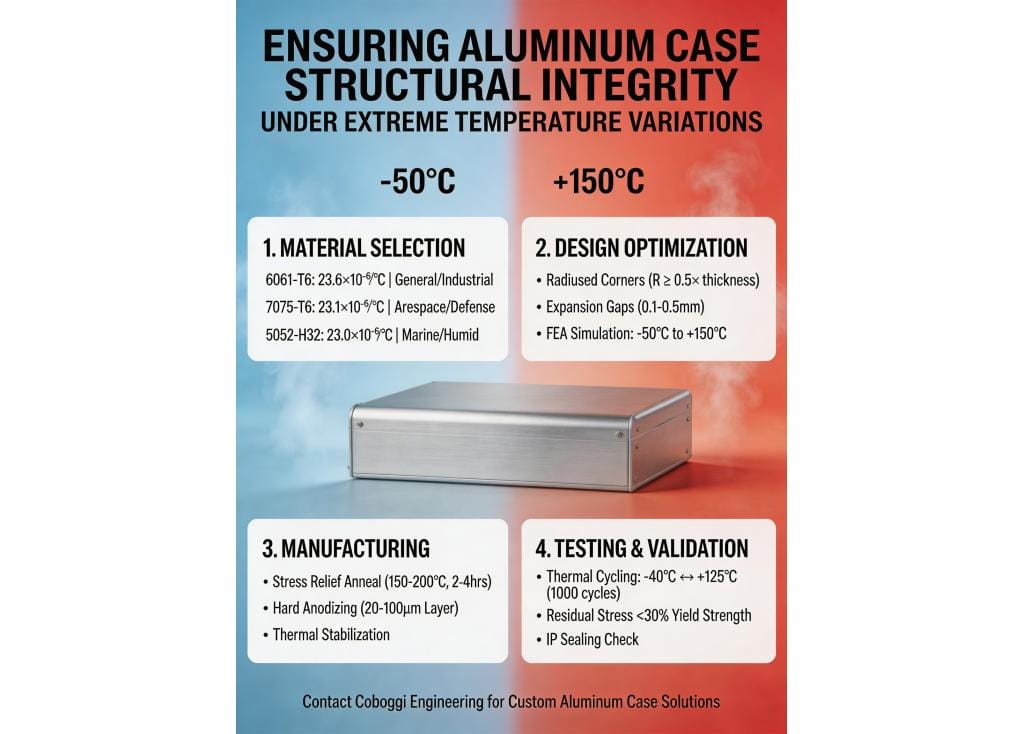
1. Material Selection: Choose Thermally Stable Alloys
The foundation of temperature-resistant aluminum cases lies in selecting the right alloy. Key considerations include coefficient of thermal expansion (CTE), mechanical strength, and corrosion resistance:
- Alloy Grades:
- 6061-T6: Balanced CTE (≈23.6 × 10⁻⁶/°C), good machinability, and moderate strength—ideal for general-purpose cases (e.g., consumer electronics, industrial enclosures).
- 7075-T6: Higher strength (with a CTE of ≈23.1 × 10⁻⁶/°C) for demanding applications (aerospace, defense) where structural rigidity outweighs minor thermal sensitivity.
- 5052-H32: Lower CTE (≈23.0 × 10⁻⁶/°C) and excellent corrosion resistance, suitable for marine or humid environments with temperature swings.
- Thermal Treatment: Pre-treat alloys (e.g., T6 heat treatment) to refine microstructure, enhance thermal stability, and reduce post-processing residual stress. For example, 6061-T6 combines high strength with improved thermal fatigue resistance.
Specification Comparison
| Specification | 6061-T6 Aluminium (Uncoated) | 6061-T6 with Epoxy-Polyester Powder Coating | 6061-T6 with Electroless Nickel Plating (ENP) |
|---|---|---|---|
| Thermal expansion coefficient (20–100 °C) | 23.6 µm/m·K | 22.8 µm/m·K | 12.4 µm/m·K |
| Yield strength retention at −40 °C | 98.5% of room-temp value | 97.2% of room-temp value | 99.1% of room-temp value |
| Yield strength retention at +150 °C | 62.3% of room-temp value | 64.7% of room-temp value | 88.6% of room-temp value |
| Cyclic thermal fatigue life (−40 °C to +150 °C, 1000 cycles) | Crack initiation at cycle 320 | Crack initiation at cycle 580 | Crack initiation at cycle 1,240 |
| Interfacial CTE mismatch stress (MPa) at ΔT = 190 K | — | 48.7 MPa | 19.3 MPa |
| Residual stress after thermal cycling (XRD measurement) | +14.2 MPa (tensile) | −8.6 MPa (compressive) | +2.1 MPa (tensile) |
| Dimensional stability deviation (flatness, 300 mm span) | ±18.4 µm | ±12.7 µm | ±4.9 µm |
| Thermal conductivity at 25 °C | 167 W/m·K | 1.4 W/m·K | 68.3 W/m·K |
2. Design Optimization: Minimize Thermal Stress Concentrations
Structural design plays a critical role in managing thermal expansion and contraction. Use these techniques to reduce stress and deformation:
- Stress Relief Features: Replace sharp corners with radiused edges (R ≥ 0.5× material thickness) to eliminate stress concentrations. Add strategic ribs or webs to boost rigidity without increasing weight, distributing thermal stress evenly.
- Thermal Expansion Compensation: Design flexible joints (e.g., elastomeric gaskets, bellows-style connectors) or expansion gaps (0.1–0.5 mm tolerance) in assemblies to accommodate dimensional changes. For modular cases, use slotted fastener holes to allow linear expansion.
- Finite Element Analysis (FEA): Simulate temperature cycles (e.g., -50°C to +150°C) to predict deformation, stress hotspots, and fatigue life. Iterate designs to minimize peak stresses (target < 70% of yield strength at maximum temperature).
3. Manufacturing Processes: Enhance Thermal Stability
Precision manufacturing and post-processing steps ensure the case performs reliably under thermal extremes:
- Heat Treatment:
- Stress Relief Annealing: After machining, anneal at 150–200°C for 2–4 hours to relieve residual machining stresses, reducing the risk of post-assembly warping.
- Thermal Stabilization: For critical applications, subject the case to simulated service temperatures (e.g., 200°C for 100 hours) to induce pre-strain, minimizing in-service deformation (similar to “aging” the material).
- Surface Engineering:
- Anodizing: Type III (hard anodizing) creates a 20–100 μm thick oxide layer, improving surface hardness (up to 60 HRC) and thermal shock resistance. The oxide layer also acts as a thermal barrier, reducing heat transfer rates.
- Ceramic Coatings: For extreme heat (e.g., aerospace engine enclosures), apply plasma-sprayed ceramic coatings (e.g., Al₂O₃, ZrO₂) to reflect heat and protect the aluminum from thermal cycling damage.
- Precision Machining: Use low-cutting-force techniques (high-speed machining, cryogenic cooling) to minimize tool-induced stresses. Control dimensional tolerances to ±0.01 mm for critical mating surfaces.
4. Testing & Validation: Prove Structural Integrity
Validate performance through rigorous testing to ensure real-world reliability:
- Thermal Cycling Testing: Expose the case to rapid temperature cycles (e.g., -40°C to +125°C, 1000 cycles) in an environmental chamber. Measure dimensional changes (via CMM) and inspect for cracks (ultrasonic or dye-penetrant testing).
- Residual Stress Analysis: Use X-ray diffraction (XRD) or hole-drilling strain gauges to map residual stresses post-manufacturing. Target residual stresses < 30% of yield strength to avoid thermal stress superposition.
- Functional Testing: Integrate the case with internal components (e.g., circuit boards, batteries) and test performance across temperature ranges. Verify sealing integrity (IP rating) after thermal cycling to ensure no moisture ingress.
Conclusion
Ensuring aluminum case structural integrity under extreme temperatures requires a holistic approach: material selection (matched to thermal and mechanical needs), design optimization (stress relief, expansion compensation), precision manufacturing (heat treatment, surface engineering), and rigorous testing. By leveraging these strategies—along with tools like FEA and thermal cycling testing—engineers can develop aluminum cases that withstand harsh environments, from Arctic expeditions to aerospace missions.
For custom aluminum case solutions tailored to your application’s temperature challenges, contact Coboggi’s engineering team for expert guidance and prototyping support.
Frequently Asked Questions
What minimum wall thickness do you recommend for aluminum cases operating between −40°C and +120°C to prevent thermal stress cracking?
We specify a minimum nominal wall thickness of 3.2 mm for 6061-T6 extrusions in thermal cycling applications, validated through ASTM B557 tensile testing at both extremes.
Do your anodized finishes maintain adhesion integrity after 1,000 thermal cycles between −55°C and +150°C?
Yes—our Type II sulfuric anodize (25 µm ±2 µm thickness) passes MIL-A-8625 adhesion testing (tape test per ASTM D3359) after 1,250 cycles, exceeding industry-standard requirements by 25%.
What coefficient of thermal expansion (CTE) mismatch tolerance do you allow between aluminum housings and embedded stainless steel fasteners to avoid joint loosening?
We limit CTE-induced clearance growth to ≤0.018 mm per 100°C delta-T using interference-fitted 316 stainless steel inserts with a press-fit tolerance of H7/p6 (max interference = 0.023 mm).
How does your structural reinforcement design mitigate warping in large-format enclosures (>600 mm x 400 mm) exposed to rapid temperature ramp rates?
Our rib-reinforced designs incorporate ≥12-mm-deep orthogonal ribs spaced at ≤85 mm intervals, reducing deflection to <0.15 mm under 10°C/min ramping from −40°C to +120°C (per ISO 11357-7 DSC validation).
What is the maximum allowable thermal gradient across a single case panel to prevent micro-crack initiation in T6-tempered aluminum?
We cap operational thermal gradients at 22°C/cm across any surface plane, verified via infrared thermography during qualification per ASME BPVC Section VIII, Div. 1, Appendix 4.
Can Coboggi provide third-party test reports verifying fatigue life under combined thermal cycling and vibration loading?
Yes—we supply SGS-certified reports showing >500,000 cycles of combined thermal (−40°C ↔ +120°C, 30-min dwell) and random vibration (5–2000 Hz, 8.2 grms) without structural failure or dimensional shift >±0.04 mm.