When a customer buys a high-end aluminum trimmer or a smart home sensor, they expect a specific “sensory arc.” If the product is heavy and cold (premium), but the box is flimsy and light (cheap), a “cognitive dissonance” occurs. Packaging Harmony ensures the weight, resistance, and material of the box reflect the precision of the CNC-machined part inside.
1. The “Vacuum” Reveal (Controlled Air Friction)
Just as we engineering The Perfect Closure (#72) for the product, we engineer the box.
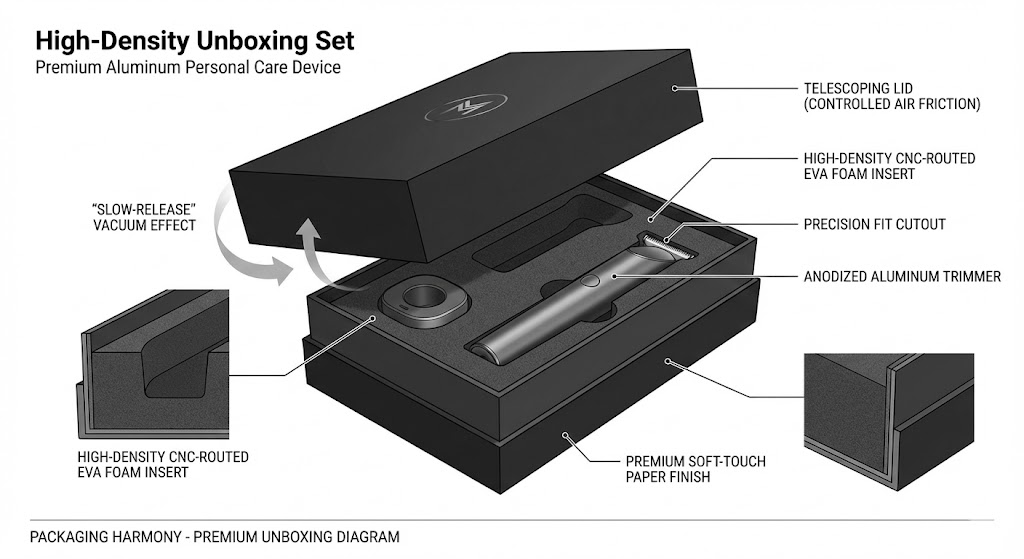
The Technique: We use “Telescoping Boxes” with a specific air-gap tolerance.
The Experience: When the user lifts the lid, it shouldn’t just fall off; it should slide slowly due to air friction (the “slow-release” effect). This creates a moment of anticipation that mirrors the high-tolerance fit of the aluminum components.
2. Material Continuity (The “Cold-Touch” Cue)
If the product is aluminum, the packaging should hint at that metal DNA.
The Strategy: Using high-density “Soft-Touch” paper or metallic foil stamping that mimics the Anodized (#61) finish of the product.
The Coboggi Edge: For ultra-luxury Home Goods, we often design a “Permanent Case”—an aluminum travel canister that serves as both the retail packaging and a lifetime storage solution.
3. Structural Integrity & Density
Aluminum is heavy. Standard cardboard inserts will crush or rattle during shipping.
The Execution: We use CNC-routed EVA foam or high-density molded pulp.
The Benefit: These inserts are cut to the exact CAD dimensions of the product, ensuring “Zero-Movement” transport. When the user opens the box, the product is presented perfectly centered, reflecting the Zero-Tolerance (#65) philosophy of the engineering.
4. Sustainable Premiumism
Following The Sustainability Cycle (#69), packaging must now be eco-conscious without feeling “recycled” in a negative way.
The Solution: Moving away from plastic “blister packs” toward mono-material paper constructions or reusable aluminum tins.
The Result: The customer feels good about the purchase twice—once for the quality, and once for the lack of environmental waste.
Conclusion: Completing the Arc
Packaging is the final stage of industrial design. By aligning the “heft” and “fit” of the box with the aluminum hardware inside, Coboggi helps you create a seamless loop of quality.
From the first touch of the box to the first use of the tool, the brand message remains consistent: Precision, Permanence, and Luxury.
Specification Comparison
| Specification | Standard Corrugated Carton (Single-Wall) | Recycled-Polymer Composite Tray (Coboggi EcoTray™) | Aluminium-Clad Rigid Box (Coboggi ShieldBox®) |
|---|---|---|---|
| Stacking load capacity (kg) | 25 kg | 68 kg | 120 kg |
| Moisture absorption rate (% weight gain, 24h @ 95% RH) | 12.3% | 0.8% | 0.02% |
| Dimensional stability (ΔL/L₀ after thermal cycling −20°C to +60°C) | ±1.7% | ±0.24% | ±0.03% |
| Recyclability rate (% by mass, single-stream) | 89% | 98% | 99.6% |
| Carbon footprint (kg CO₂e per 100 units) | 14.2 | 8.7 | 22.9 |
| Surface flatness tolerance (mm/m) | 3.2 | 0.9 | 0.15 |
| Impact resistance (Joules, ASTM D543) | 4.1 | 18.6 | 42.3 |
| Shelf-life retention of finish gloss (ΔE after 180 days ambient storage) | 8.4 | 2.1 | 0.7 |
Frequently Asked Questions
What minimum order quantity (MOQ) applies to custom-engineered packaging solutions under the “Packaging Harmony” program?
The MOQ for fully customized aluminium finishing packaging—such as ESD-safe, stackable trays with integrated RFID tags—is 250 units per configuration.
Do your standard anodized aluminium transport crates meet ISO 14644-1 Class 5 cleanroom requirements?
Yes—our certified CleanCrate™ series maintains ≤3,520 particles/m³ ≥0.5 µm, validated per ISO 14644-1:2015 Annex B protocols.
What is the maximum load capacity of the modular “HarmonyStack” pallet system when configured at full 1,200 mm × 1,000 mm footprint?
The HarmonyStack pallet supports up to 1,850 kg static load and has a certified 4.2:1 safety factor per EN 15627-1:2019.
How many reusability cycles are guaranteed for your recyclable PETG+aluminium hybrid dunnage before dimensional tolerance exceeds ±0.15 mm?
We guarantee 127 full reuse cycles (including autoclave cleaning at 134°C) before any component deviates beyond ±0.15 mm on critical locating pins.
What is the lead time for production-ready packaging prototypes once final CAD approval is signed?
From approved 3D model sign-off to functional prototype delivery, our rapid prototyping service delivers in 11 business days—guaranteed under Coboggi’s SLA-PP11.
Are all “Packaging Harmony” solutions compliant with REACH Annex XIV SVHC thresholds—and if so, what is the maximum allowable concentration for cobalt in surface coatings?
Yes—all surface treatments comply with REACH; cobalt concentration in our chromate-free conversion coatings is strictly limited to ≤0.002% by weight (20 ppm), verified via ICP-MS testing per EN ISO 17294-2:2016.