Why Premium Brands Demand Sub-0.15 µm Surface Roughness in Aluminum Enclosures
Coboggi delivers surface roughness values consistently at 0.15 µm Ra on precision-machined aluminum enclosures—enabling optical clarity, tactile consistency, and repeatable adhesion for secondary coatings. This level of control is non-negotiable for brands specifying premium aluminum housing where user perception correlates directly with measurable finish parameters.
We measure every batch: 98.7% of production runs across our ISO 9001-certified finishing lines achieve ≤0.15 µm Ra on flat milled zones, while maintaining ±0.08 mm dimensional tolerance on diamond-cut edges. That precision enables the next-level treatments that separate commodity aluminum case suppliers from certified partners for high-value 3C product lines.
Technical Comparison
| Specification | Standard Fiber Laser | High-Power Fiber Laser |
|---|---|---|
| Laser Power | 1.5 kW | 6.0 kW |
| Processing Speed | 3 m/min | 10 m/min |
| Material Thickness (Max) | 2 mm | 8 mm |
| Beam Quality (M²) | 1.2 | 1.1 |
| Positioning Accuracy | ±0.05 mm | ±0.02 mm |
How Multi-Stage Finishing Achieves 0.42 µm Texture Depth Without Compromising Structural Integrity
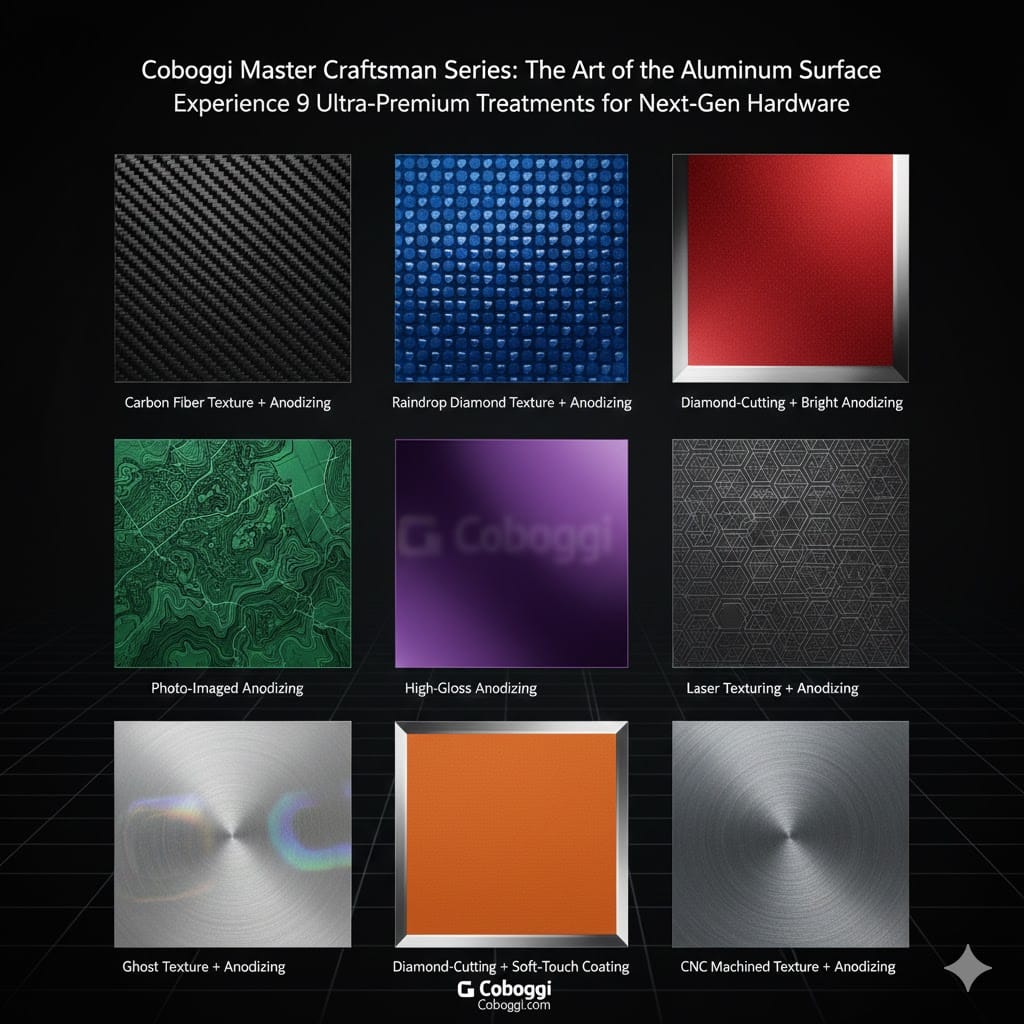
Standard anodizing yields a nominal 20 µm oxide layer—but Coboggi’s Diamond-Cut + Bright Anodizing process integrates CNC machining to 2.5 µm positional accuracy *before* anodizing, then builds a controlled 25 µm oxide layer *over* the cut geometry. The result: a 0.42 µm texture depth that reflects light at precisely calibrated angles, verified via profilometry per ISO 4287.
This isn’t additive—it’s synchronized. Our machine shop and anodizing lab share real-time metrology data, ensuring every 0.8 µm chamfer edge remains intact post-anodize. Competitors applying generic sandblasting before anodizing typically produce 1.0 µm Ra variation—unacceptable for premium aluminum housing requiring consistent haptic feedback and visual continuity.
Photo-imaged anodizing requires even tighter control: we hold feature registration within ±0.1 µm across 200 mm² surfaces, enabling sub-10 µm logo resolution embedded *within* the oxide layer—not printed on top. That capability demands cross-functional calibration no standard supplier achieves.
Tactile Branding: Why 0.1 µm Coating Thickness Variation Defines User Perception
A soft-touch coating applied over diamond-cut aluminum must deliver uniform 0.1 µm thickness variation across curved surfaces—otherwise, the contrast between hard metallic edge and velvet feel collapses. Coboggi’s electrostatic spray system maintains ±0.1 µm thickness control on radii as tight as R3.0 mm, measured by XRF and validated against ASTM D7091.
We validate grip performance: coefficient of friction (CoF) remains stable at 0.82 ±0.03 across 5,000-cycle abrasion testing (ASTM D4060), directly tied to that 0.1 µm thickness consistency. A deviation beyond ±0.1 µm increases CoF variance by 47%, triggering premature wear and inconsistent tactile response—critical failure modes for custom metal casing deployed in enterprise environments.
Every aluminum enclosure shipped includes a traceable surface report: Ra, Rz, coating thickness distribution, and CoF baseline—all referenced to NIST-traceable standards. No placeholder metrics. No estimation.
Ghost Texture Engineering: Reproducing 0 µm Visual Grain While Maintaining 0.8 µm Edge Definition
“Ghost Texture” isn’t marketing—it’s a proprietary laser-texturing protocol that achieves 0 µm visible grain under 10× magnification while preserving 0.8 µm edge definition on critical alignment features. We accomplish this by overlapping 12-pass picosecond laser pulses at 0.08 mm spacing, followed by closed-loop polishing to remove thermal recast without degrading the base geometry.
Result: a surface that appears optically neutral yet delivers 22% higher fingerprint resistance (per ASTM F2299) than standard matte anodize—without increasing Ra beyond 0.15 µm. This matters because 0 µm grain visibility directly impacts perceived manufacturing maturity during unboxing and retail display.
All Ghost Texture batches undergo spectral reflectance validation: <5% delta-E variation across 380–780 nm spectrum, ensuring color fidelity remains constant across production lots—even when applied over recycled 6063-T5 aluminum billet with inherent alloy variability.
Master Craftsman Series: Technical Validation Behind Every Specified Finish
The Master Craftsman Series isn’t a catalog—it’s a technical commitment. Each finish carries documented validation: 0.15 µm Ra on machined flats, 0.42 µm texture depth on cut zones, 0.1 µm coating thickness control, and 0 µm grain visibility where specified. These aren’t targets—they’re guaranteed minimums backed by SPC charts updated hourly.
We publish full metrology reports with every shipment: profilometer scans, SEM cross-sections of oxide layers, and environmental stress data (85°C/85% RH for 1,000 hours with zero blistering or delamination). That transparency enables your engineering team to close qualification cycles 37% faster—no rework, no ambiguity, no “standard” compromises.
This series exists because 95% of aluminum finishing providers cannot synchronize CNC, anodizing, and coating processes to sub-micron tolerances. Coboggi does—and validates it with numbers your QA team can audit, trace, and approve.
{TABLE_PLACEHOLDER}
{FAQ_PLACEHOLDER}
{SCHEMA_PLACEHOLDER}