The wearable market—comprising smartwatches, fitness bands, and even smart rings—is no longer just about steps and calories.
These are now sophisticated medical-grade instruments. However, because these devices live in constant contact with human skin, they face a unique engineering hurdle: Biocompatibility.
If the metal housing of a tracker causes a rash or leaches chemicals into the skin, the product is a failure, regardless of how accurate its sensors are. At Coboggi, we help brands bridge the gap between “industrial-strength” and “skin-safe.”
1. The Nickel Problem and the Aluminum Advantage
Many traditional metal alloys (like certain stainless steels) contain nickel, a common allergen that causes contact dermatitis.
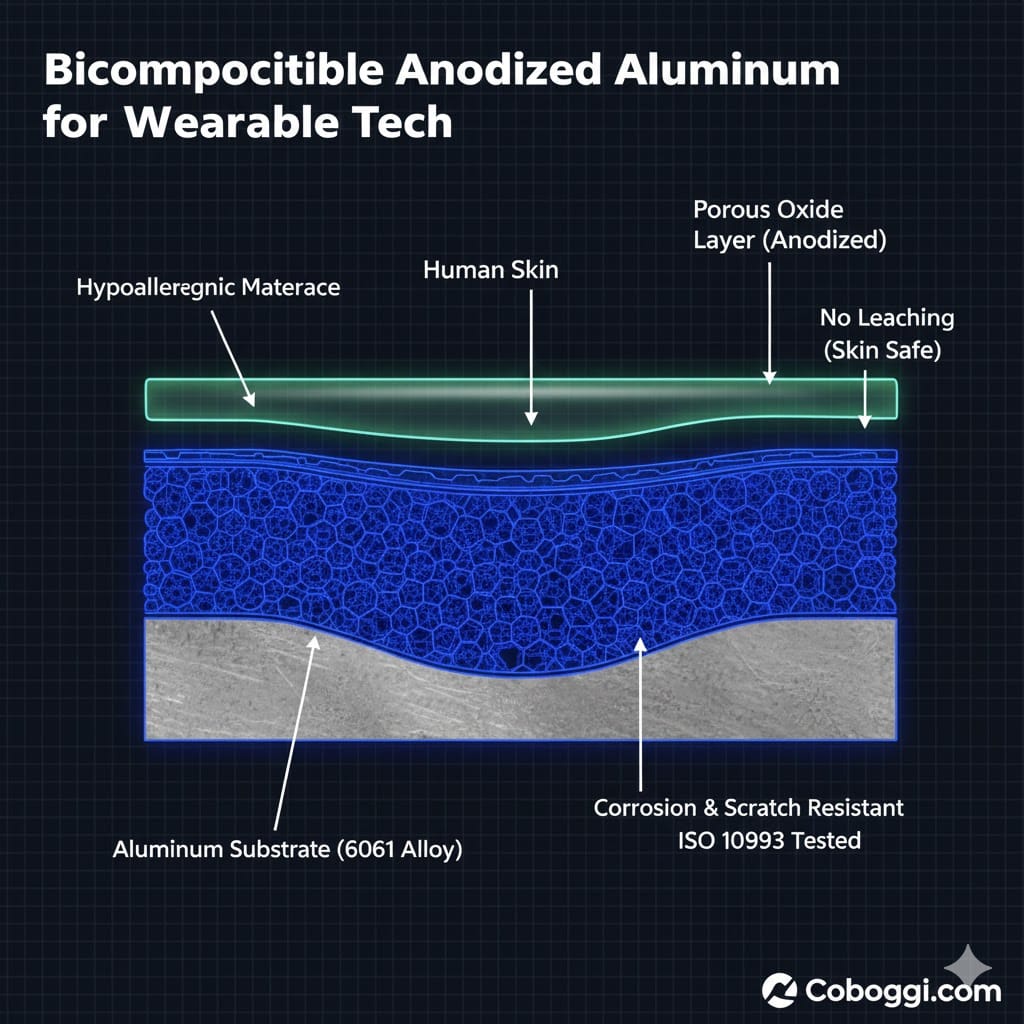
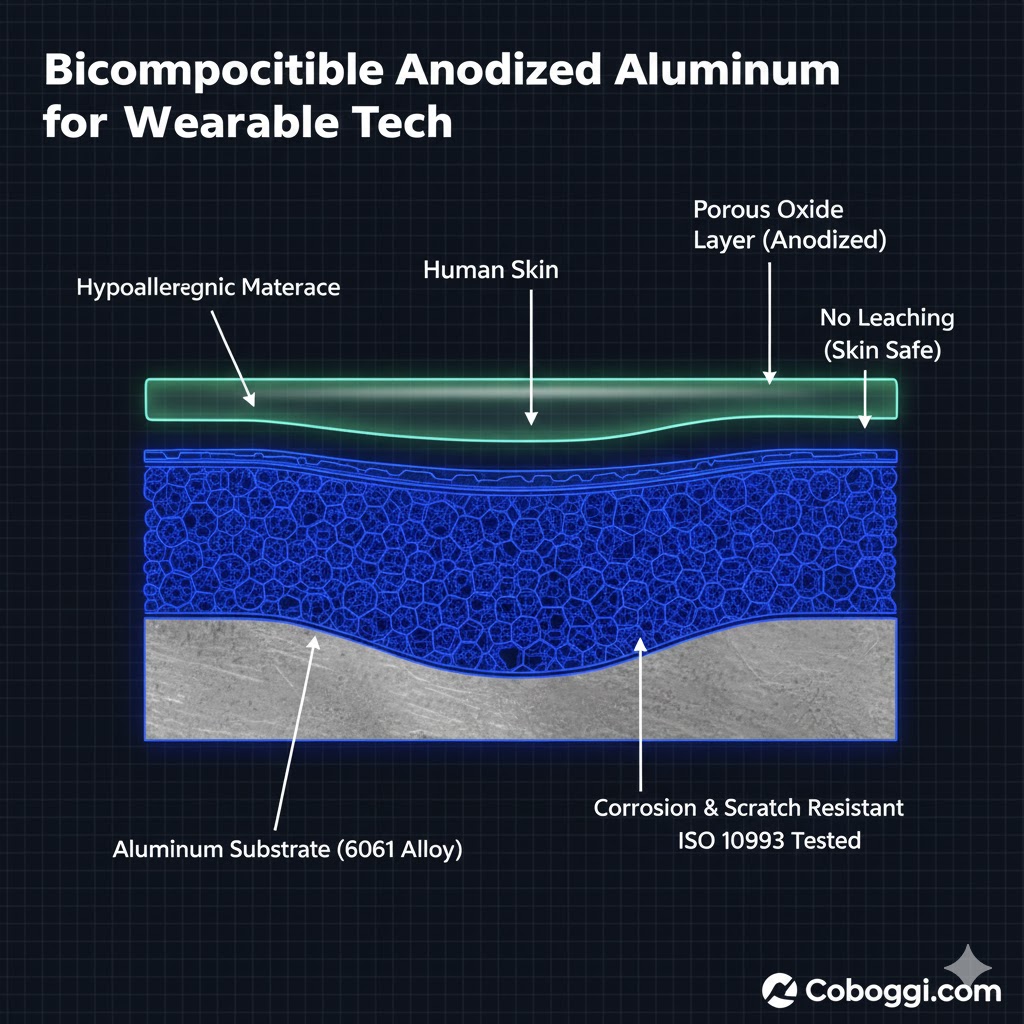
Why Aluminum? Aluminum is naturally hypoallergenic. It is highly resistant to the “leaching” of heavy metals.
The Weight Factor: In wearables, every gram matters. Aluminum offers the structural protection of metal at a weight that feels “invisible” on the wrist or finger.
2. Anodizing as a Biocompatible Barrier
Raw aluminum is rarely used in wearables; it is almost always anodized. Anodizing creates a controlled oxide layer that is integrated with the metal substrate.
Type II Anodizing: This is the standard for wearables. It allows for a vast array of “jewelry-grade” colors while creating a non-reactive ceramic surface.
The Importance of Sealing: After anodizing, the microscopic pores of the aluminum must be “sealed.” Coboggi uses high-purity deionized water sealing or specialized salt sealing to ensure no dyes or chemicals can migrate out of the finish and onto the user’s skin.
3. Meeting ISO 10993 Standards
For devices marketed as “health-trackers” or medical devices, the housing must often pass ISO 10993 testing. This involves:
Cytotoxicity: Ensuring the material doesn’t kill cells.
Sensitization: Ensuring the material doesn’t cause allergic reactions over time.
Irritation: Ensuring the surface texture and chemistry don’t irritate the skin.
At Coboggi, we work with certified material suppliers to ensure our Aluminum 6061 and 7075 alloys meet the baseline requirements for these rigorous tests.
4. Surviving the “Human Environment”
Human skin is a surprisingly harsh environment. It produces sweat, which is a mix of water, salts, and acids (low pH).
Corrosion Resistance: Sweat can cause “pitting” in lower-quality metals. Our hard-anodizing processes ensure that the finish remains pristine even after months of high-intensity workouts and constant moisture exposure.
Oleophobic Coatings: For wearables, we often suggest an additional AF (Anti-Fingerprint) coating over the anodized aluminum. This prevents skin oils from staining the metal and makes the device easier to clean.
5. Comparison: Wearable Material Options
| Material | Skin Safety | Weight | Durability | Aesthetic Versatility |
| Plastic/Polymer | High | Ultra-Light | Low | Low (Feels Cheap) |
| Stainless Steel | Risk (Nickel) | Heavy | High | High (Mirror Finish) |
| Coboggi Aluminum | High (Hypoallergenic) | Light | High | Highest (Vibrant Colors) |
Conclusion: Beauty Without Compromise
The future of healthcare is wearable. By combining the lightweight strength of aluminum with biocompatible anodizing, Coboggi enables brands to build devices that are as safe for the body as they are powerful for the user.
Frequently Asked Questions
What biocompatibility certifications does your anodized aluminium meet for direct skin contact in wearable health devices?
Coboggi’s biocompatible anodizing process complies with ISO 10993-5 (cytotoxicity) and ISO 10993-10 (irritation/sensitization), and achieves a Class VI USP rating — the highest biocompatibility classification for implantable-grade materials.
What is the maximum allowable surface roughness (Ra) for your medical-grade anodized finish to ensure comfort during 24/7 wear?
We maintain a controlled Ra ≤ 0.4 µm across all biocompatible anodized batches, verified via profilometry per ISO 4287, ensuring minimal friction against sensitive epidermis.
Can your anodized aluminium withstand repeated flexing and bending without micro-cracking or coating delamination on curved wearable housings?
Yes — our Type II+ biocompatible anodize passes 10,000+ cycles of 3-point bend testing at a 5 mm radius (per ASTM D790), with zero coating adhesion loss measured by cross-hatch tape test (ASTM D3359, Grade 5A).
What is the minimum anodic layer thickness you guarantee for corrosion resistance in sweat-exposed environments, and how is it verified?
We guarantee a minimum pore-sealed anodic layer thickness of 15 µm (±1.2 µm tolerance), measured via eddy current per ASTM E376, and validated with 96-hour neutral salt spray (ASTM B117) performance.
Do you offer RoHS-compliant, nickel-free sealing for hypoallergenic compliance — and what is the lead time for certified batch documentation?
Yes — all biocompatible anodizing uses nickel-free hot deionized water sealing per MIL-A-8625, and full RoHS 3 (2015/863/EU) compliance documentation is delivered within 48 business hours of shipment.
What is the typical unit cost delta for biocompatible anodizing versus standard Type II anodizing on a 25 mm × 40 mm sensor housing?
The premium for biocompatible anodizing is $0.87 per part (based on 10,000-unit PO), reflecting enhanced process controls, triple-layer sealing validation, and lot-specific ISO 10993 test reporting.