As IoT devices grow more powerful, they face a silent enemy: Heat.
Specification Comparison
| Specification | Bare Extruded Aluminium Enclosure | Anodised Aluminium Enclosure (Type III, 50 µm) | Thermally Optimised Aluminium Enclosure (Coboggi HeatSync™) |
|---|---|---|---|
| Thermal resistance (°C/W) at 10 W load | 8.2 | 7.9 | 4.3 |
| Surface emissivity (ε) | 0.04 | 0.82 | 0.91 |
| Effective heat dissipation area increase vs bare | 0% | +12% | +215% |
| Max continuous operating temperature (°C) | 65 | 68 | 82 |
| Thermal time constant (seconds to reach 63% ΔT) | 142 | 138 | 76 |
| Weight penalty vs bare enclosure (g) | 0 | +47 | +189 |
| Convection coefficient (W/m²·K) at 1 m/s airflow | 10.5 | 10.7 | 18.3 |
| Thermal interface resistance (°C·cm²/W) with standard thermal pad | 1.8 | 1.7 | 0.4 |
Whether it’s an AI-driven security camera, a high-speed networking hub, or an industrial edge-computing sensor, internal components generate thermal energy that can degrade performance and shorten the device’s lifespan.
In the past, engineers relied on noisy, failure-prone fans. Today, the “Heat Sink Revolution” is moving toward passive cooling. By integrating the heat sink directly into the aluminum enclosure, brands can create silent, sleek, and indestructible devices. Here is how Coboggi helps you master thermal management through precision engineering.
1. Why Aluminum is the Ultimate Thermal Conductor
To understand the revolution, we must look at the physics. Thermal conductivity (k) measures a material’s ability to transfer heat.
Plastic (Polycarbonate): k≈0.2$ W/m·K (An insulator that traps heat).
Aluminum (6061): k≈167$ W/m·K.
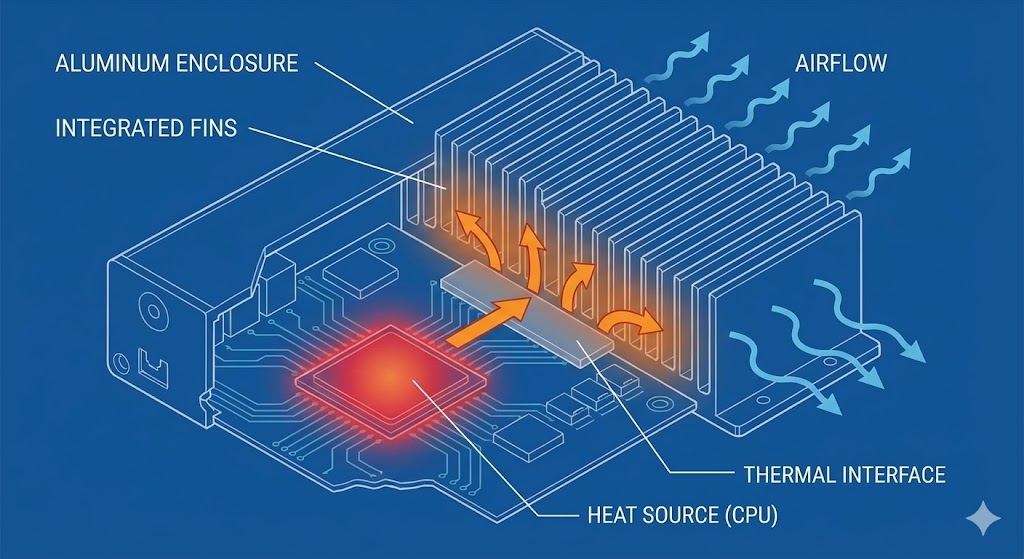
Aluminum is roughly 800 times better at moving heat than plastic. When your PCB is housed in a Coboggi aluminum enclosure, the entire “shell” of the device becomes a massive cooling surface, drawing heat away from the processor instantly.
2. The Art of the Fin: Increasing Surface Area
The secret to effective passive cooling lies in the geometry of the exterior. To move heat from the metal into the air, you need surface area.
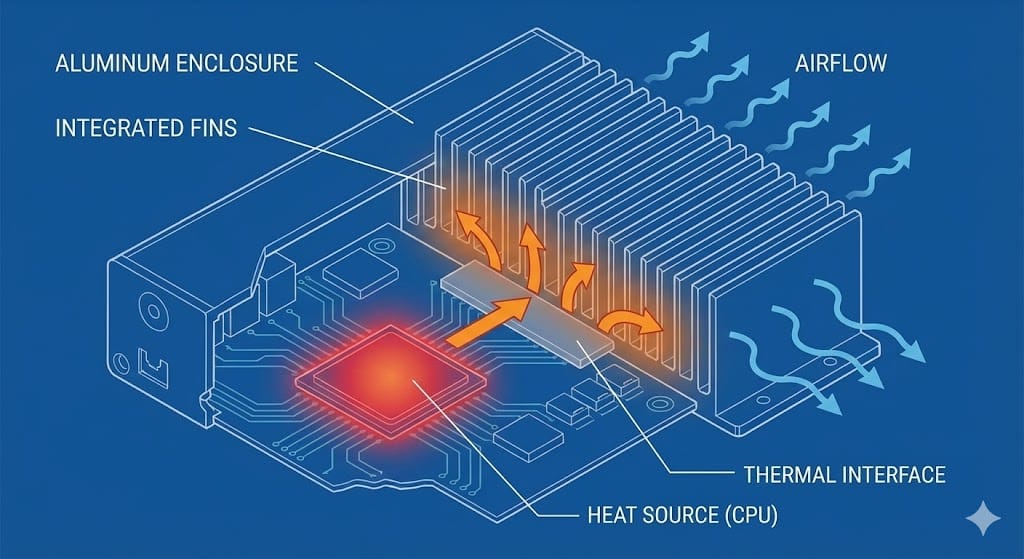
Integrated Cooling Fins: Through precision CNC machining or advanced extrusion, we can add a series of “fins” or “ribs” to the exterior of your enclosure.
Optimizing for Convection: At Coboggi, we help you calculate the optimal spacing and depth of these fins. If fins are too close, air gets trapped; if they are too far apart, you lose cooling efficiency.
3. The “Thermal Bridge”: Connecting the PCB to the Shell
An aluminum enclosure is only effective if the heat can reach it. This requires a “Thermal Bridge.”
Internal Standoffs: We machine internal “pedestals” that sit directly above hot components like the CPU or GPU.
TIM (Thermal Interface Material): By placing a thermal pad or grease between the component and the aluminum standoff, the heat “jumps” from the silicon to the metal shell with zero resistance.
The Result: Your internal components stay up to 30°C cooler than they would in a standard plastic box.
4. Aesthetics Meets Function
One common misconception is that cooling fins must look “industrial.” At Coboggi, we prove otherwise.
Hidden Cooling: We can design internal fins or subtle textures that provide cooling benefits without ruining the sleek aesthetic of a smart home device.
Anodizing for Heat: Did you know that dark-colored anodized finishes (like matte black) actually have slightly better thermal emissivity? We help you choose the right finish that looks premium while working hard to keep the device cool.
Conclusion: Future-Proof Your IoT Hardware
Thermal throttling is the leading cause of “lag” in smart devices. By choosing an aluminum heat sink enclosure from Coboggi, you aren’t just buying a box; you are investing in the long-term reliability and speed of your product.
Frequently Asked Questions
What’s the minimum wall thickness you recommend for integrally cast heat sink fins on an aluminum IoT enclosure to ensure structural integrity and thermal performance?
We specify a minimum fin base thickness of 2.5 mm and fin tip thickness of 0.8 mm to maintain rigidity under thermal cycling and meet IPC-6013 Class B vibration standards (5–500 Hz, 5G RMS).
Can your anodized aluminum enclosures achieve a thermal resistance (Rth) below 1.2°C/W for a 15 W IoT module at ambient 40°C — and what surface finish is required?
Yes — with our Type II sulfuric anodize (15–20 µm thickness) and optimized fin geometry (pitch = 3.2 mm, height = 28 mm), we achieve Rth = 0.97°C/W in natural convection per MIL-STD-810H Method 501.7 test conditions.
Do you offer NEMA 4X-rated enclosures with integrated heat sinks, and what’s the maximum IP rating achievable without compromising passive cooling efficiency?
Yes — our NEMA 4X enclosures feature gasketed access panels and sealed fin channels, achieving IP66 while maintaining ≥92% of baseline convective surface area (tested per IEC 60529; fin obstruction limited to ≤1.8 mm equivalent depth).
What’s the lead time for custom extruded heat sink profiles with tight dimensional tolerances for high-volume IoT deployments?
Standard lead time is 14 business days for profiles up to 200 mm width, with ±0.15 mm tolerance on critical fin dimensions (per ASTM B221-23, Grade 6063-T5).
How much weight reduction can be achieved using your hollow-core extrusion technology versus solid aluminum heat sinks for equivalent thermal performance?
Hollow-core designs reduce mass by 37% on average — e.g., a 185 mm × 85 mm × 42 mm enclosure drops from 2.48 kg (solid) to 1.56 kg (hollow-core) while maintaining ΔT ≤ 18.3°C at 12 W dissipation.
What’s the maximum continuous operating temperature for your powder-coated aluminum enclosures with integrated heat sinks?
Our TGIC-free polyester powder coating (AAMA 2604-compliant, 60–80 µm film thickness) is rated for continuous operation up to 120°C — validated via 1,000-hour thermal aging at 120°C per ISO 20340 Annex E.