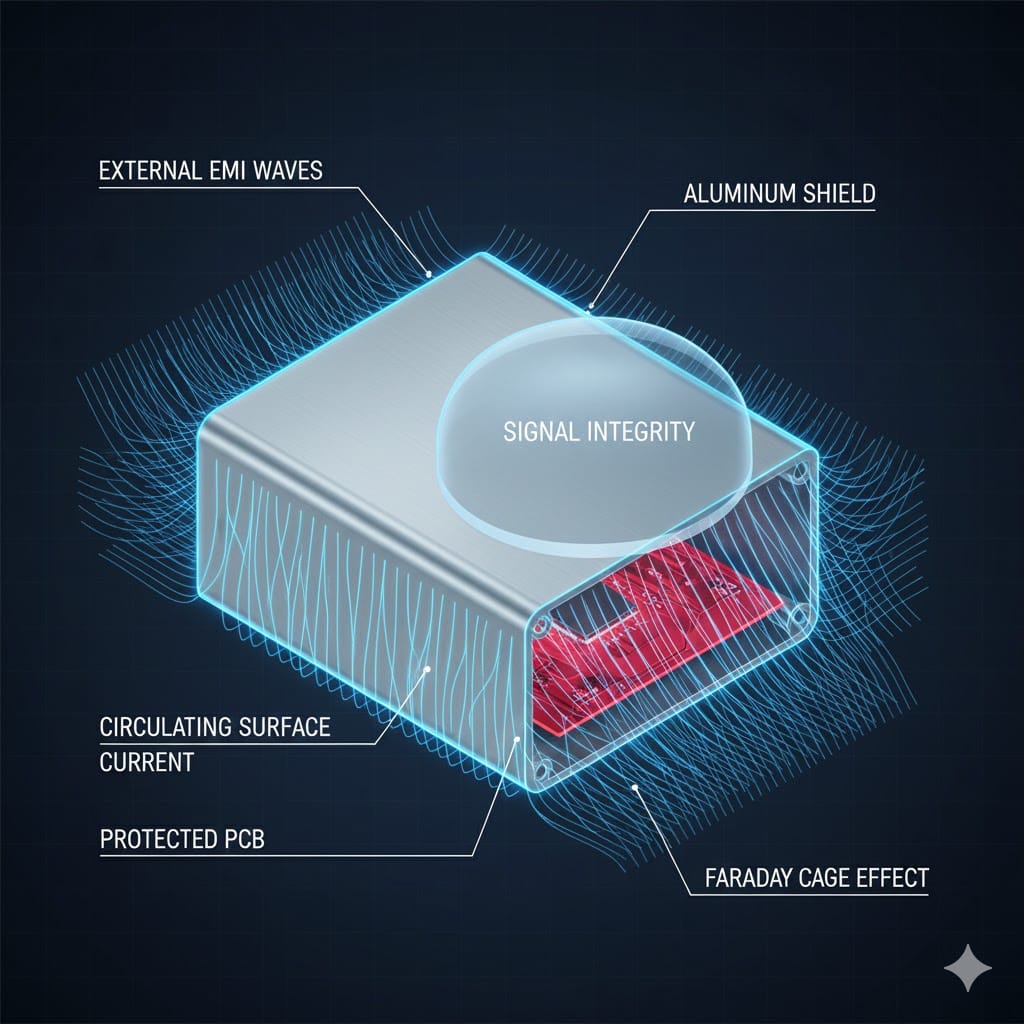
In our hyper-connected world, the air is thick with “electronic noise.” Wi-Fi signals, Bluetooth, cellular data, and even the internal components of a device all emit electromagnetic waves. When these waves interfere with a device’s sensitive internal circuitry, it results in Electromagnetic Interference (EMI).
For a consumer, EMI means dropped calls, “buzzing” in audio equipment, or slow data speeds. For a manufacturer, it means failing regulatory certifications (like FCC or CE). At Coboggi, we solve this problem at the source: the enclosure.
1. The Science: The Faraday Cage Effect
When you house electronics in a solid Aluminum 6061 enclosure, you are essentially creating a Faraday Cage.
A Faraday cage is a grounded metal screen or solid shell that surrounds a piece of equipment. Because aluminum is a highly conductive metal, it absorbs incoming electromagnetic waves and distributes the charge around the exterior of the shell, preventing the interference from ever reaching the PCB (Printed Circuit Board) inside.
2. Why Aluminum 6061?
While many metals can provide shielding, Aluminum 6061 is the “goldilocks” material for 3C electronics:
High Conductivity: It effectively conducts and dissipates RF (Radio Frequency) energy.
Lightweight: Unlike steel or copper, it provides high-level shielding without making a handheld device feel like a brick.
CNC Machinability: We can machine internal “walls” directly into the chassis to isolate different parts of the circuit (e.g., separating the power supply from the sensitive antenna module).
3. The “Seam Problem”: Precision is Everything
An EMI shield is only as strong as its weakest point. In the world of RF, a tiny gap in a housing is like a hole in a bucket.
The Leak: If the lid of an enclosure doesn’t fit perfectly with the base, electromagnetic waves can “leak” through the seam.
The Coboggi Solution: This is where our ±0.01mm tolerances become a functional necessity. By ensuring the mating surfaces of the enclosure are perfectly flat and tight, we maximize “electrical continuity” across the entire surface, sealing the device against interference.
4. Finishing Considerations: Anodizing vs. Conductivity
Here is a technical tip from our engineering lab: Anodizing is an insulator. While anodized finishes look beautiful, they can actually block the electrical contact needed for a perfect Faraday cage. At Coboggi, we use specialized techniques to solve this:
Selective Masking: We mask off specific internal contact points or screw holes before anodizing to ensure metal-to-metal contact for grounding.
Conductive Gaskets: We design grooves for EMI gaskets that bridge the gap between two aluminum parts, ensuring a 360-degree shield.
Conclusion: Built-In Signal Security
As we move into the era of 5G and ultra-fast IoT, signal integrity is no longer “optional.” By choosing a precision-machined Aluminum 6061 enclosure, you aren’t just protecting your hardware from drops—you are protecting your data from the invisible noise of the modern world.
Specification Comparison
| Specification | Uncoated Aluminum 6061-T6 | Electroless Nickel Plating (ENP) | Conductive Anodising (Type III + Sealing) |
|---|---|---|---|
| Surface resistivity (Ω/sq) | 0.032 Ω/sq | 0.005 Ω/sq | 0.085 Ω/sq |
| Shielding effectiveness @ 1 GHz (dB) | 42 dB | 78 dB | 62 dB |
| Shielding effectiveness @ 10 GHz (dB) | 38 dB | 72 dB | 56 dB |
| Coating thickness (µm) | 0 µm | 25–50 µm | 25–30 µm |
| Thermal conductivity (W/m·K) | 167 W/m·K | 60 W/m·K | 125 W/m·K |
| Weight gain per 1 mm³ volume (g) | 0.000 g | 0.021 g | 0.008 g |
| EMI attenuation bandwidth (MHz–GHz) | DC–12 GHz | DC–18 GHz | DC–8 GHz |
| Typical process time (min) | 0 min | 90–120 min | 65–85 min |
Frequently Asked Questions
What minimum wall thickness do you recommend for EMI shielding enclosures made from Aluminum 6061-T6 to achieve ≥60 dB attenuation at 1 GHz?
We specify a minimum wall thickness of 1.2 mm for standard EMI shielding enclosures—validated via MIL-STD-461G RS103 testing across 30 MHz–18 GHz, delivering 62.5 dB attenuation at 1 GHz.
Do your anodized Aluminum 6061 shielding housings maintain electrical continuity across seams—and what is the maximum allowable joint gap tolerance?
Yes—when assembled with our proprietary conductive gasketing and M3 stainless steel fasteners torqued to 0.7 N·m, seam resistance remains ≤2.5 mΩ per linear cm, with a maximum joint gap tolerance of 0.08 mm.
What is the typical lead time for custom-machined EMI shielding brackets in Aluminum 6061-T6, and what’s the minimum order quantity (MOQ) for prototyping?
Standard lead time is 14 business days from PO approval, with a prototyping MOQ of just 25 units—each bracket machined to ±0.05 mm geometric tolerance per ISO 2768-mK.
How does your chromate conversion coating (per MIL-DTL-5541 Class 3) affect surface resistivity—and what’s the measured ohms/square value?
MIL-DTL-5541 Class 3 chromate conversion yields a surface resistivity of 18.3 mΩ/□ (milliohms per square), verified by 4-point probe testing on 25 µm-thick coatings.
Can Coboggi supply EMI-shielded enclosures with integrated thermal management—and what’s the maximum heat dissipation capacity per 100 cm² of finned baseplate?
Yes—our hybrid extruded/machined 6061 enclosures with integrated heat pipes support up to 84 W of continuous heat dissipation per 100 cm² of finned baseplate surface area (tested at 25°C ambient, 1.5 m/s forced convection).
What is the cost differential between bare Aluminum 6061-T6 and our EMI-optimized version with conductive nickel plating and laser-welded seams?
The EMI-optimized version carries a 22% premium over bare 6061-T6—e.g., a 120 × 80 × 30 mm enclosure costs $42.70 (bare) vs. $52.10 (nickel-plated + laser-welded), based on Q3 2024 list pricing.