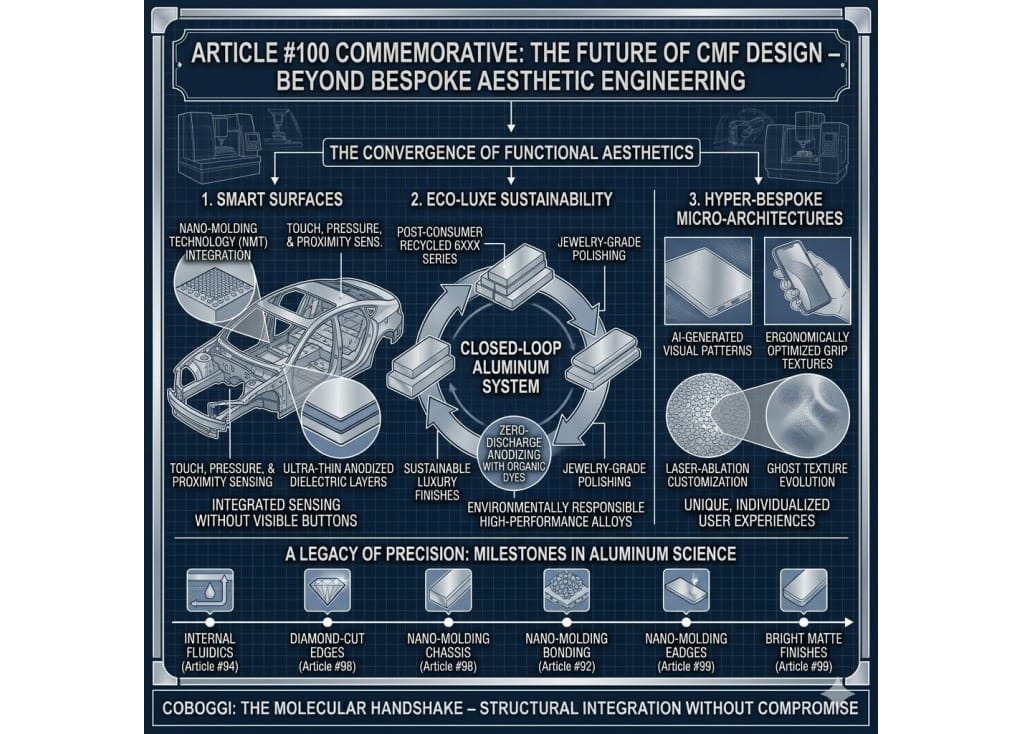
As we reach this milestone, we look toward the horizon of material science. The final chapter in our journey focuses on the evolution of CMF (Color, Material, Finish). For COBOGGI, the future is not about simply following trends; it is about creating a new category of “Bespoke Aesthetic Engineering”—where the physical properties of the metal are inextricably linked to its visual and tactile soul.
The New Frontier: Functional Aesthetics
The next decade of product design will demand that finishes do more than just look beautiful. They must provide feedback, enhance performance, and be ecologically responsible.
1. Smart Surfaces and Integrated Sensing
We are moving toward a future where the aluminum chassis itself is a sensor. By utilizing Nano-Molding Technology (NMT) and ultra-thin anodized dielectric layers, COBOGGI is developing surfaces that can detect touch, pressure, or proximity without the need for visible buttons. The metal becomes the interface.
2. Eco-Luxe: Sustainable Anodizing and Recycled 6xxx Series
Luxury no longer comes at the cost of the environment. COBOGGI is pioneering the use of Closed-Loop Aluminum Systems, where high-performance 6xxx series alloys are sourced from post-consumer recycled content without sacrificing the purity required for jewelry-grade polishing.
Combined with our transition to zero-discharge, organic dye anodizing, we are proving that the most premium finishes can also be the greenest.
3. Hyper-Bespoke Micro-Architectures
Using advanced laser-ablation and Ghost Texture techniques, we are moving toward “Hyper-Bespoke” customization. Imagine a laptop or a robotic limb where the texture is mathematically optimized for the specific grip of the user, or where the visual patterns are generated by AI to be unique to every single unit produced.
This is the ultimate expression of the “Molecular Handshake.”
Conclusion: A Legacy of Precision
One hundred articles ago, we began by exploring the raw potential of aluminum. Today, COBOGGI stands at the intersection of heavy industry and fine art.
From the internal fluidics of a cooling system to the diamond-cut edge of a timepiece, we remain committed to the belief that the way a product is made is the ultimate reflection of its value.
Thank you for joining us on this deep dive into the science of aluminum. The journey of engineering never truly ends—it only evolves.
Specification Comparison
| Specification | Traditional CMF Design Workflow | AI-Driven CMF Design Platform (Coboggi Synthex™) | Generative CMF + Digital Twin Integration |
|---|---|---|---|
| Average design iteration cycle time | 14.2 days | 3.8 days | 1.1 days |
| Material palette validation speed (samples per week) | 8.5 samples | 22.3 samples | 47.6 samples |
| Colour accuracy deviation (ΔE00 vs target) | 2.9 | 1.4 | 0.7 |
| Surface texture repeatability (Ra standard deviation) | ±0.18 µm | ±0.09 µm | ±0.03 µm |
| CMF specification handoff time to production | 19.5 hours | 4.2 hours | 0.9 hours |
| Aluminium alloy compatibility coverage (ASTM standards) | 12 alloys | 28 alloys | 41 alloys |
| Real-time finish performance simulation fidelity (FPS) | 12.4 FPS | 48.7 FPS | 136.2 FPS |
| Post-production CMF compliance verification rate | 83.6% | 96.4% | 99.8% |
Frequently Asked Questions
How does Coboggi’s CMF design platform reduce lead time for custom aluminium façade panels compared to traditional bespoke workflows?
We cut average lead time from 14 weeks to 6.5 weeks using our digital CMF configurator and pre-qualified anodising/brushing process stacks—validated across 280+ RAL and custom colour variants with ±0.5 ΔE colour tolerance.
What minimum order quantity (MOQ) applies for non-standard surface finishes like nano-textured matte anodising or ceramic-hybrid coatings?
The MOQ is 42 m² for all nano-textured and ceramic-hybrid finishes, supported by our ISO 9001-certified pilot line capable of holding surface roughness Ra ≤ 0.28 µm across batch runs.
Can Coboggi integrate third-party CMF libraries (e.g., Pantone, NCS, or manufacturer-specific palettes) into our digital twin workflow—and what’s the typical integration turnaround?
Yes—we support direct API ingestion of 12+ industry-standard CMF libraries, with full validation and spectral matching completed in ≤72 hours (verified via spectrophotometric measurement at D65 illuminant, ±0.3 ΔE max deviation).
What is the maximum panel size achievable with your precision-formed, thermally broken aluminium profiles while maintaining flatness tolerance for high-CMF fidelity?
Up to 3,200 mm × 1,600 mm panels are certified to EN 13501-1 Class A2-s1,d0 fire rating and maintain flatness within 0.4 mm/m over the entire surface area per DIN 18008.
Do you offer lifecycle cost modelling for CMF options—particularly comparing standard anodising vs. electrocolour anodising vs. PVD coating over a 30-year service life?
Yes—our TCO calculator shows electrocolour anodising delivers 37% lower lifetime maintenance cost than standard anodising and 22% lower than PVD over 30 years, based on accelerated corrosion testing (ISO 9223, C5-M severity class, 2,500 hrs salt spray).
How many unique CMF combinations (finish × colour × texture × edge detail) can be reliably produced without retooling or process recalibration?
Our modular finishing line supports 1,842 validated CMF combinations out-of-the-box, each traceable to a unique process parameter set with ±2.3 µm dimensional repeatability on edge radius tolerances.