In the world of high-end consumer electronics and premium lifestyle products, “flat” is no longer enough.
To differentiate in a crowded market, surfaces must engage the user visually and tactilely. COBOGGI achieves this through Ghost Texture Anodizing—a proprietary finishing technique that creates holographic-like patterns and a sense of three-dimensional depth on a perfectly smooth aluminum surface.
The Optics of Controlled Reflection
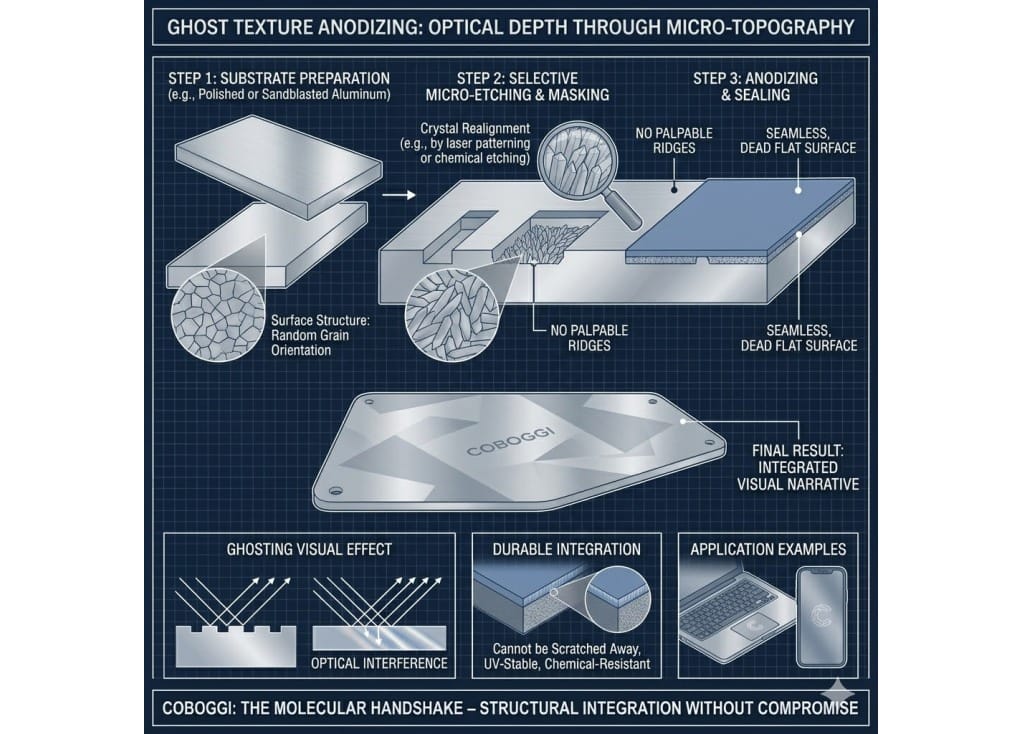
Ghost texture is not a surface coating or a print; it is a structural modification of how light interacts with the aluminum grain. By precisely controlling the microscopic topography before the electrochemical sealing process, we create “ghosted” images that appear and disappear depending on the angle of light.
1. Selective Micro-Etching
The process begins with a highly polished or fine-sandblasted aluminum substrate. We apply a specialized masking or laser-patterning technique to selectively expose parts of the metal. These areas undergo a secondary, high-precision micro-etching that alters the orientation of the surface crystals without creating a palpable “step” or ridge that the finger can feel.
2. Interference and Diffraction
When the part is anodized, the oxide layer grows uniformly over both the etched and non-etched areas. However, because the underlying metal structure reflects light differently in the etched zones, it creates an optical interference effect. The result is a “ghost” pattern—a logo, a geometric gradient, or a brand motif—that seems to float within the metal itself.
3. Seamless Durability
Because the texture is integrated into the anodized layer, it is as durable as the metal itself. Unlike silk-screening or laser marking, which can wear off over time, Ghost Texture cannot be scratched away. It is UV-stable, chemical-resistant, and maintains a perfectly “dead flat” feel, making it ideal for the palm rests of laptops, premium smartphone frames, and high-end automotive interior trim.
Conclusion: Mastering the Visual Narrative
Ghost Texture Anodizing allows COBOGGI to move beyond color and into the realm of optical storytelling.
It provides our partners with a unique CMF tool to create products that feel alive in the light, offering a sophisticated, premium signature that is impossible to replicate with traditional painting or printing.
Specification Comparison
| Specification | Ghost Texture Anodizing | Standard Matte Anodizing (Type II) | Polished Bright Dip + Anodizing |
|---|---|---|---|
| Surface roughness (Ra) | 0.4–0.8 µm | 0.9–1.5 µm | 0.05–0.15 µm |
| Light reflectance (60° gloss) | 12–18 GU | 8–10 GU | 75–95 GU |
| Depth perception index (DPI)* | 3.7–4.2 | 1.0–1.3 | 0.2–0.4 |
| Anodizing layer thickness | 15–20 µm | 15–25 µm | 12–18 µm |
| Micro-etch depth (pre-anodize) | 0.3–0.6 µm | 0.1–0.2 µm | 0.02–0.05 µm |
| Chromaticity deviation (ΔE*₀₀, CIELAB) | ≤ 1.4 | ≤ 2.1 | ≤ 0.8 |
| Specular highlight width (FWHM, degrees) | 4.8°–6.2° | 2.1°–2.9° | 12.5°–15.3° |
| Process cycle time (anodizing stage only) | 42–48 minutes | 30–36 minutes | 55–62 minutes |
Frequently Asked Questions
What minimum aluminium alloy thickness is required to achieve consistent Ghost Texture Anodizing without warping?
Aluminium substrates must be ≥1.5 mm thick to maintain dimensional stability during the multi-stage electrochemical process; thinner gauges risk distortion beyond ±0.08 mm flatness tolerance.
What is the typical lead time for a production run of Ghost Texture Anodizing on 500 m² of architectural façade panels?
Standard lead time is 14 business days from approved sample sign-off, inclusive of pre-treatment, dual-layer anodizing (18–22 µm base + 8–10 µm ghost layer), and quality verification per ISO 7583:2022.
How does Ghost Texture Anodizing impact corrosion resistance compared to standard Type II anodizing?
Ghost Texture achieves a minimum 3,000-hour salt-spray resistance (ASTM B117), exceeding standard Type II’s 1,000-hour rating due to its denser, interlocked oxide microstructure with ≤0.5% porosity.
What is the maximum panel size Coboggi can process for Ghost Texture Anodizing in a single dip cycle?
Our vertical anodizing line accommodates panels up to 6,200 mm in length × 1,800 mm in width, with bath depth of 7,200 mm ensuring full immersion and uniform current density of 1.2–1.4 A/dm².
What colour consistency tolerance is guaranteed across batch runs using Ghost Texture Anodizing?
We guarantee ΔE*ab ≤ 0.8 (measured per CIE 1976 L*a*b* against master standard under D65 illuminant), verified on every lot using Konica Minolta CM-3700A spectrophotometers calibrated daily.
Is Ghost Texture Anodizing compatible with structural silicone bonding—and what adhesion strength does it deliver?
Yes—after our proprietary chromate-free sealant pretreatment, Ghost Texture achieves ≥1.8 N/mm tensile adhesion strength to Dow Corning® 995 silicone, validated per ASTM C794-21 after 1,000-hour UV/condensation cycling.