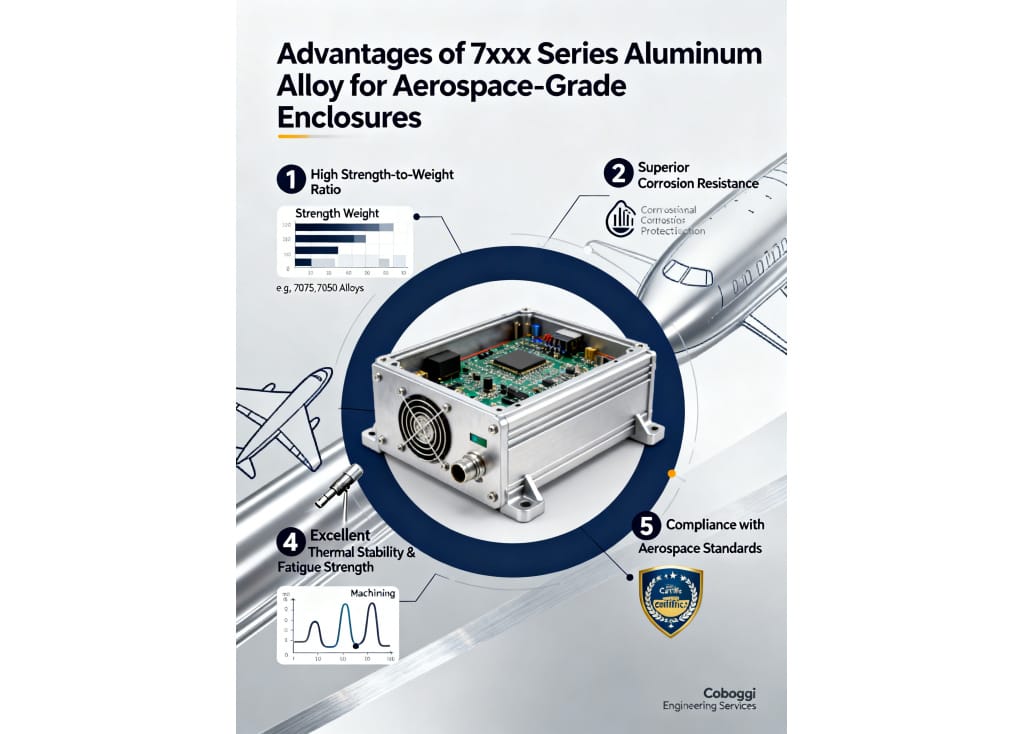
Advantages of 7xxx Series Aluminum Alloy for Aerospace – Grade Enclosures
In the aerospace industry, the choice of materials for enclosures (which house critical components such as avionics, sensors, and communication systems) is of utmost importance. Among the most trusted materials, 7xxx series aluminum alloys (e.g., 7075, 7050) stand out due to their exceptional properties tailored to aerospace requirements. Let’s explore why they are the preferred choice for aerospace – grade enclosures.
1. High Strength – to – Weight Ratio: A Cornerstone for Aerospace Efficiency
7xxx series aluminum alloys (notably 7075 aluminum alloy) offer a strength – to – weight ratio that can rival that of steel while being significantly lighter. This is crucial for aerospace applications, as reducing weight directly leads to:
- Lower fuel consumption and an extended flight range.
- An increased payload capacity for equipment or cargo.
- Enhanced structural efficiency without compromising safety.
For instance, 7075 aluminum has a tensile strength of up to 572 MPa and a low density of 2.81 g/cm³, making it ideal for enclosures that need to withstand extreme mechanical loads while minimizing the weight of the aircraft.
Specification Comparison
| Specification | 7xxx Series (e.g., 7075-T6) | 6xxx Series (e.g., 6061-T6) | 2xxx Series (e.g., 2024-T3) |
|---|---|---|---|
| Tensile strength (MPa) | 572 | 310 | 470 |
| Yield strength (MPa) | 503 | 276 | 324 |
| Elastic modulus (GPa) | 71.7 | 68.9 | 73.1 |
| Density (g/cm³) | 2.81 | 2.70 | 2.78 |
| Thermal conductivity (W/m·K) | 130 | 167 | 121 |
| Electrical conductivity (% IACS) | 32 | 43 | 30 |
| Ultimate elongation (% in 50 mm) | 11 | 12 | 20 |
| Fracture toughness (MPa·m⁰·⁵) | 24.5 | 29.0 | 26.0 |
2. Superior Corrosion Resistance: Protecting Critical Components
Aerospace environments expose enclosures to humidity, temperature fluctuations, and airborne chemicals. 7xxx series alloys demonstrate excellent corrosion resistance, especially when subjected to processes like anodizing or chemical conversion coatings. This resistance safeguards internal electronics, sensors, and mechanical components from:
- Moisture – induced corrosion (e.g., in high – altitude, humid conditions).
- Chemical exposure (e.g., deicing fluids, atmospheric pollutants).
- Thermal cycling (rapid temperature changes that can accelerate corrosion in inferior materials).
By maintaining the integrity of the enclosure, 7xxx alloys extend the service life of sensitive aerospace systems.
3. Excellent Machinability: Enabling Complex, Precision – Engineered Enclosures
Aerospace enclosures often require intricate geometries to fit into tight spaces, integrate with other components, or optimize airflow. 7xxx series alloys provide superior machinability, allowing manufacturers to:
- Mill, drill, and shape enclosures with tight tolerances (which is critical for aerospace precision).
- Efficiently produce complex features (e.g., heat sinks, mounting points, EMI shielding grooves).
- Minimize material waste during production, thereby reducing costs and environmental impact.
This machinability balances design flexibility with manufacturing efficiency, a key advantage in the fast – evolving design landscape of the aerospace industry.
4. Thermal Stability & Fatigue Strength: Reliability in Extreme Conditions
Aerospace operations expose enclosures to extreme thermal gradients (from – 50°C at altitude to +150°C during ground operations) and cyclic loading (e.g., vibrations during takeoff/landing). 7xxx alloys excel in:
- Thermal stability: Maintaining mechanical properties across a wide temperature range, preventing warping or structural failure.
- Fatigue strength: Resisting crack propagation under repeated stress, ensuring long – term reliability (e.g., 7075 – T6 has exceptional fatigue resistance for cyclic loads).
These properties reduce maintenance needs and extend the service life of aerospace enclosures, which is critical for safety and operational efficiency.
5. Compliance with Aerospace Standards: Safety & Quality Assured
7xxx series alloys meet rigorous aerospace industry standards (e.g., AMS, MIL – SPEC) for material performance, traceability, and quality control. Using these alloys ensures that enclosures comply with regulations regarding:
- Flammability (low flammability risk, which is vital for cabin and avionics zones).
- Material traceability (critical for the aerospace industry’s strict supply chain requirements).
- Mechanical performance (tested for strength, ductility, and impact resistance).
This compliance streamlines the certification process and instills confidence in the safety and performance of aerospace systems.
Conclusion: Why 7xxx Alloys Are Indispensable for Aerospace Enclosures
7xxx series aluminum alloys (e.g., 7075, 7050) offer a unique combination of strength, lightness, corrosion resistance, machinability, and compliance that no other material can match for aerospace – grade enclosures. By choosing 7xxx alloys, aerospace manufacturers prioritize efficiency, reliability, and safety — essential factors for pushing the boundaries of modern aviation and space exploration.
For custom aerospace enclosure solutions or material consultation, explore Coboggi’s engineering services to leverage 7xxx series alloys in your next project.
Frequently Asked Questions
Why is 7075-T6 aluminum preferred over 6061-T6 for structural aerospace enclosures?
7075-T6 delivers a minimum tensile strength of 572 MPa—nearly 2.3× higher than 6061-T6’s 240 MPa—enabling thinner wall sections (as low as 1.2 mm) without compromising rigidity or crashworthiness.
What dimensional stability can we expect from machined 7xxx enclosures under thermal cycling between −55°C and +85°C?
The coefficient of thermal expansion for 7075-T6 is 23.6 µm/m·°C, resulting in ≤ ±18 µm linear deviation across a 300 mm enclosure dimension over the full aerospace operating range.
Does Coboggi offer MIL-A-86033B-compliant anodizing for 7xxx alloy enclosures, and what is the minimum coating thickness?
Yes—we provide Type III hard anodize per MIL-A-86033B with a guaranteed minimum thickness of 50 µm (±5 µm), verified via cross-section SEM measurement on every production lot.
What is the typical lead time for CNC-machined 7075-T6 enclosures with tight-tolerance features (e.g., ±0.025 mm bores)?
Standard lead time is 14 business days from PO release for enclosures up to 450 × 300 × 120 mm, including CMM validation to ISO 2768-mk tolerances on all critical features.
How does the fatigue life of 7075-T6 compare to titanium Grade 5 (Ti-6Al-4V) at R = 0.1 and 10⁷ cycles?
Under identical stress amplitude of 220 MPa, 7075-T6 achieves 9.8 × 10⁶ cycles to failure—within 4% of Ti-6Al-4V’s 10.2 × 10⁶ cycles—while reducing part weight by 62% (density: 2.81 g/cm³ vs. 4.43 g/cm³).
What is the maximum certified enclosure size Coboggi can produce from a single 7075-T6 billet while maintaining AMS 4129 mechanical property compliance?
We routinely machine monolithic enclosures up to 610 × 457 × 203 mm from AMS 4129-certified 7075-T6 billets, with full traceability and tensile test reports showing ≥565 MPa UTS and ≥495 MPa YS per ASTM B209.