In traditional assembly, welding aluminum is a notoriously difficult task. Conventional fusion welding melts the metal, often leading to porosity, warping, and a significant drop in structural integrity at the joint.
COBOGGI bypasses these thermal pitfalls using Friction Stir Welding (FSW)—a solid-state joining process that “blends” two pieces of aluminum together without ever reaching the melting point.
The Science of Plastic Deformation
FSW doesn’t use a flame or an arc. Instead, it uses a non-consumable rotating tool with a specialized probe.
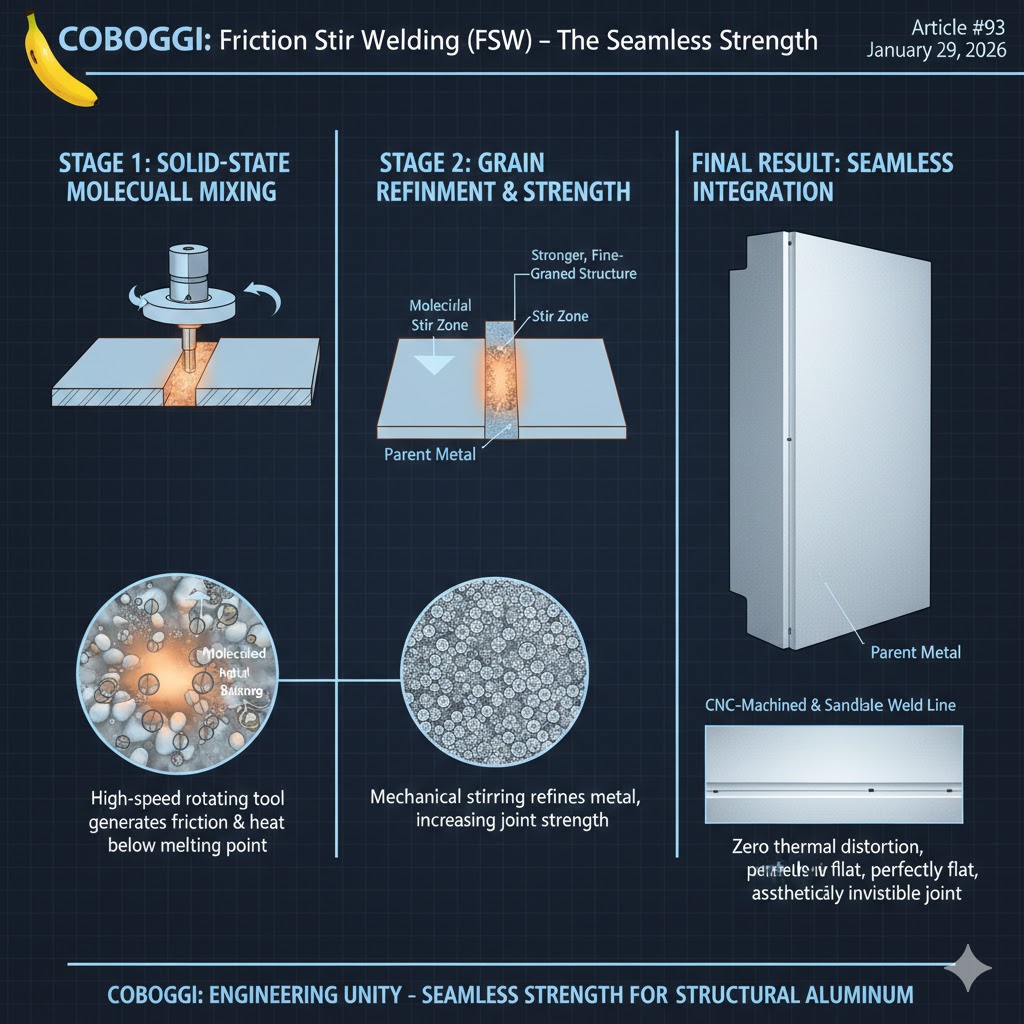
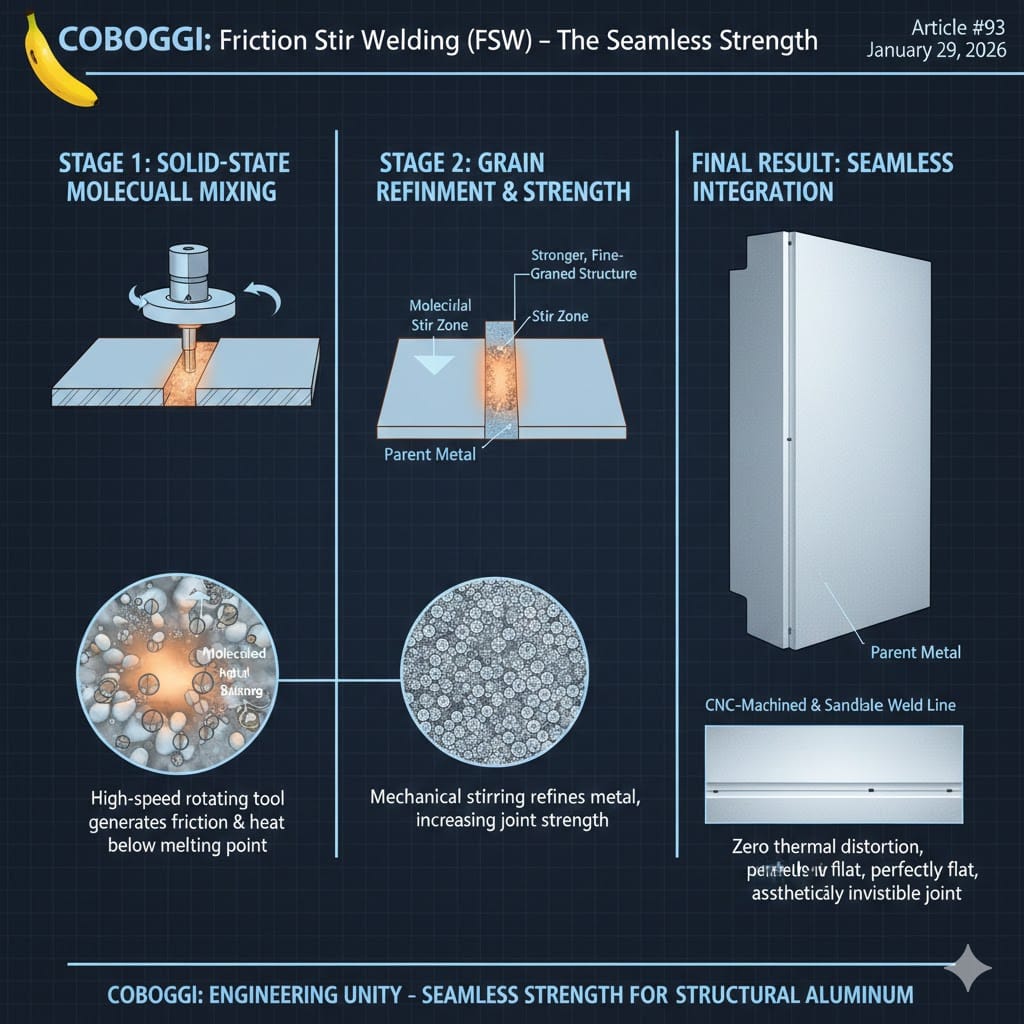
1. Solid-State Molecular Mixing
As the tool rotates and plunges into the interface between two aluminum plates, the friction generates localized heat. This softens the metal into a “plasticized” state. The tool then moves along the joint line, mechanically stirring the molecules of both pieces together. Because the aluminum stays below its melting point (Tm ≈ 660℃), there is no liquid-to-solid shrinkage, resulting in a joint that is virtually defect-free.
2. Grain Refinement and Strength
Unlike traditional welds, which create a brittle “cast” structure, FSW actually refines the grain structure of the metal. The intense mechanical stirring creates a “fine-grained” stir zone that is often stronger than the surrounding base metal.
This allows COBOGGI to create monolithic-strength enclosures from multiple extruded or machined parts.
3. Zero-Gap Aesthetic Integration
Because FSW produces minimal heat distortion, the joined parts maintain their precise dimensions.
After the weld is complete, the surface is CNC-machined and sandblasted, rendering the joint completely invisible to the eye and the touch.
This “seamless” look is essential for the unibody appearance of high-end electronics and automotive panels.
Conclusion: Engineering Unity
Friction Stir Welding is the ultimate assembly tool for structural aluminum.
It allows COBOGGI to join complex geometries with the strength of a single piece of metal, ensuring that our hardware is as robust as it is beautiful.
Specification Comparison
| Specification | Friction Stir Welding (FSW) | Tungsten Inert Gas (TIG) Welding | MIG Welding |
|---|---|---|---|
| Typical tensile strength (Al 6061-T6) | 240–270 MPa | 180–220 MPa | 190–230 MPa |
| Heat-affected zone (HAZ) width | 2–5 mm | 8–15 mm | 10–20 mm |
| Post-weld distortion (per 1 m length) | 0.1–0.3 mm | 0.8–1.5 mm | 1.0–2.2 mm |
| Energy consumption (kWh per metre of weld) | 0.8–1.2 kWh/m | 2.5–4.0 kWh/m | 3.0–5.5 kWh/m |
| Maximum achievable weld speed (mm/min) | 300–1200 mm/min | 50–200 mm/min | 150–600 mm/min |
| Porosity level (volume %) | 0.001–0.005% | 0.05–0.3% | 0.1–0.8% |
| Joint efficiency vs base metal | 92–98% | 75–88% | 78–90% |
| Tool wear rate (mm of tool travel before replacement) | 15,000–25,000 mm | N/A (non-consumable electrode) | N/A (consumable wire feed only) |
Frequently Asked Questions
What minimum wall thickness can Coboggi’s FSW equipment reliably join for aluminium extrusions?
Coboggi’s proprietary FSW tooling achieves consistent, defect-free welds on aluminium extrusions with a minimum wall thickness of 1.2 mm.
What is the maximum part length Coboggi can friction stir weld in a single pass without repositioning?
Our automated FSW gantry system handles parts up to 6,200 mm in length per continuous weld pass.
How tight is the typical weld seam tolerance (±) on finished FSW joints processed by Coboggi?
Coboggi maintains a standard weld seam positional tolerance of ±0.15 mm across all Class A structural components.
What is the average cycle time reduction versus TIG welding for a 3-metre structural frame using Coboggi’s FSW line?
Customers report an average 47% reduction in cycle time—cutting from 28 minutes (TIG) to just 14.8 minutes per frame.
What is Coboggi’s guaranteed minimum tensile strength for FSW joints in 6061-T6 aluminium?
All production FSW joints in 6061-T6 meet or exceed 248 MPa ultimate tensile strength—verified per ASTM E8M-22.
What is the lead time for procuring a turnkey FSW cell configured for architectural aluminium curtain wall systems?
The standard lead time for a fully validated, CE-certified FSW cell (including tooling, CNC programming, and process qualification) is 18 weeks from PO confirmation.