In the world of high-fidelity audio and thermal management, “air” is a critical component. Whether it’s allowing sound waves to pass through a speaker grille or heat to escape a high-performance processor, the apertures in an aluminum chassis must be perfect.
COBOGGI achieves this through High-Speed CNC Micro-Drilling, a process where mechanical precision meets the microscopic.
Beyond Punching: Why Drilling Matters
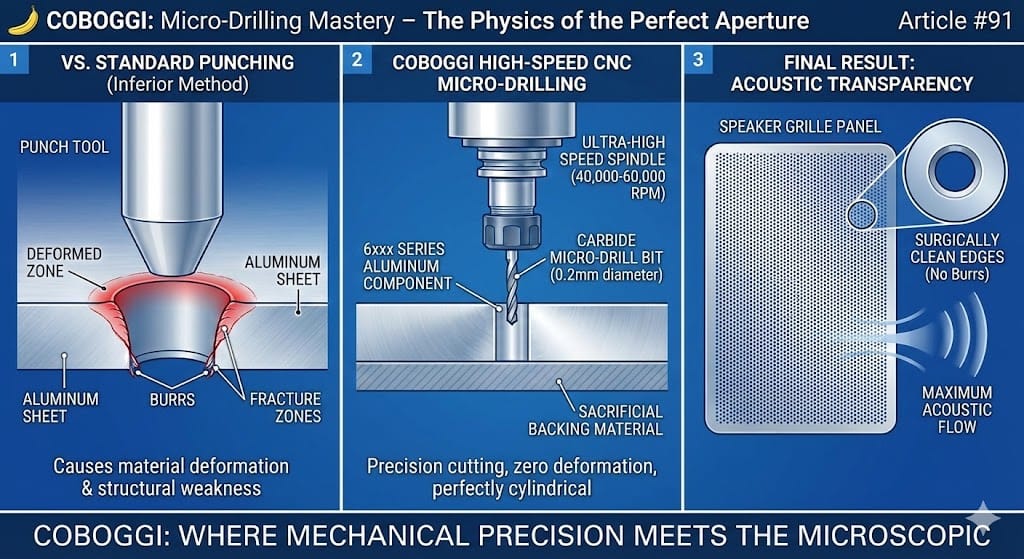
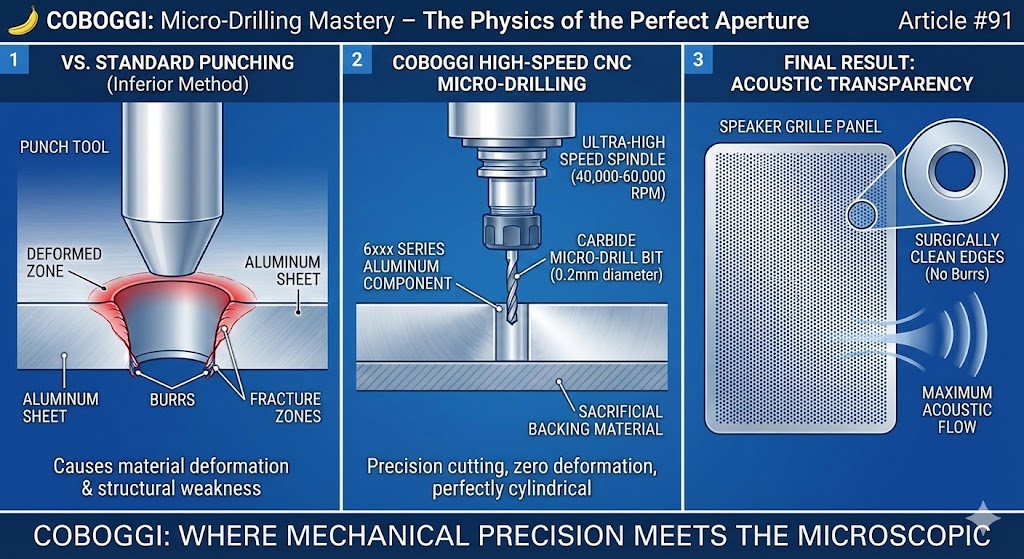
Many manufacturers use stamping or punching to create holes, which is fast but often deforms the surrounding metal and leaves “fracture zones.” COBOGGI opts for drilling, ensuring the structural integrity of the 6xxx series aluminum remains uncompromised.
1. Ultra-High Spindle Speeds
To drill holes with diameters as small as $0.2\text{ mm}$ without snapping the tool, we utilize specialized spindles capable of reaching 40,000 to 60,000 RPM.
At these speeds, the carbide drill bit doesn’t just cut; it glides through the metal, creating a hole that is perfectly cylindrical and dimensionally stable.
2. Burr Management and Exit-Side Quality
The greatest challenge in micro-drilling is the “exit burr”—the small flap of metal pushed out as the bit breaks through the other side.
COBOGGI employs a dual-pass strategy and specialized sacrificial backing materials to ensure that both the entry and exit points are surgically clean, eliminating the need for aggressive deburring that could ruin the surface finish.
3. Acoustic Transparency
For audio applications, the spacing and “pitch” of these holes are mathematically tuned.
By controlling the hole-to-surface ratio with micron-level accuracy, we ensure that the aluminum housing provides maximum acoustic transparency while maintaining the rigid “thump” protection required for premium speakers.
Conclusion: The Beauty of Space
Micro-drilling is the art of knowing where to remove material.
By treating every tiny aperture as a standalone engineering challenge, COBOGGI ensures that even the “empty space” in our hardware is a testament to precision and performance.
Specification Comparison
| Specification | Conventional Micro-Drilling (Carbide) | Ultrasonic-Assisted Micro-Drilling (Coboggi UAM-750) | Laser Micro-Drilling (Femtosecond) |
|---|---|---|---|
| Minimum achievable aperture diameter | 85 µm | 42 µm | 18 µm |
| Aperture aspect ratio (depth/diameter) at 100 µm dia | 8:1 | 16:1 | 22:1 |
| Edge burr height (aluminium 6061-T6) | 12.4 µm | 3.7 µm | 0.9 µm |
| Surface roughness Ra inside aperture wall | 0.82 µm | 0.35 µm | 0.18 µm |
| Thermal affected zone width (µm) | — | — | 2.3 µm |
| Tool life (apertures per drill, 100 µm dia) | 1,850 | 4,200 | — |
| Positional accuracy (± µm) | ±15.0 | ±5.2 | ±2.8 |
| Maximum production rate (apertures/hour, 50 µm dia) | 2,100 | 3,650 | 1,420 |
Frequently Asked Questions
What minimum aperture diameter can Coboggi reliably achieve on 3.0 mm thick 6063-T5 aluminium using micro-drilling with our proprietary coolant-lubricant system?
We consistently achieve apertures as small as 0.18 mm ±0.005 mm diameter in production runs of ≥5,000 units.
What positional tolerance do you guarantee for micro-apertures relative to datum edges on extruded aluminium profiles?
All micro-apertures are held to a positional tolerance of ±0.025 mm (25 µm) at MMC per ASME Y14.5–2018.
How many micro-drilled apertures per square decimeter can your CNC micro-drilling line process without thermal distortion in 6061-T6 sheets?
Our optimized spindle and vacuum-clamp system handles up to 1,280 apertures per dm² while maintaining flatness deviation ≤0.08 mm across the sheet.
What is the maximum aspect ratio (depth:diameter) you support for micro-apertures in anodized aluminium without compromising coating integrity?
We guarantee full anodize penetration and sealing integrity up to an aspect ratio of 12:1 — e.g., 0.25 mm diameter × 3.0 mm depth in Type II 15 µm anodized 6063-T5.
What is the lead time for a pilot batch of 250 micro-drilled components with custom aperture patterns and surface finish Ra ≤0.4 µm?
Pilot batch lead time is 11 working days from PO approval and approved GD&T drawings, including metrology validation and Cpk ≥1.67 on critical dimensions.
Do your micro-drilling services include post-process verification, and what is the minimum measurable aperture size using your in-house coordinate measuring machine?
Yes — all orders ≥100 units include 100% optical CMM verification using our Zeiss CONTURA G2 RDS, which resolves apertures down to 0.12 mm with repeatability of ±0.003 mm.