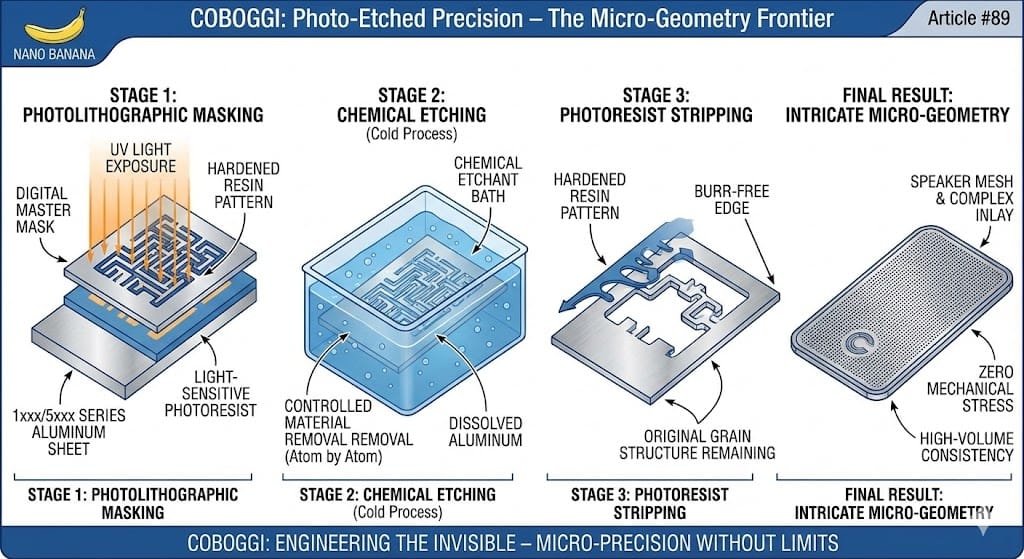
In the quest for extreme miniaturization and intricate detailing, traditional CNC machining eventually reaches its mechanical limits. When a design requires holes smaller than a needle point or patterns too complex for a physical cutting bit, COBOGGI turns to Photo-Chemical Etching (PCE).
This process allows us to “machine” aluminum using light and chemistry, achieving a level of precision that is fundamentally stress-free and burr-free.
The Photolithographic Workflow
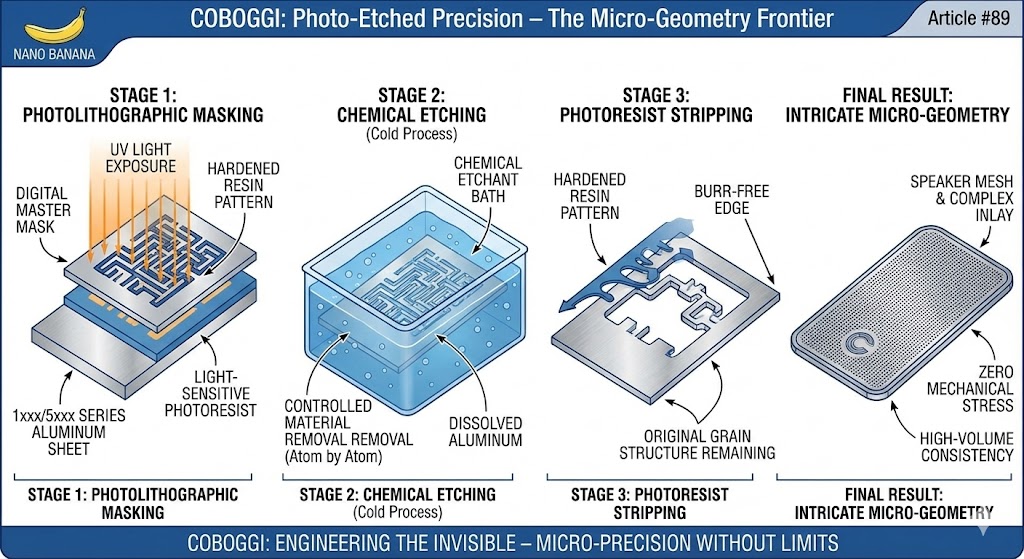
Photo-etching is essentially a high-tech subtractive process that uses a light-sensitive resin (photoresist) to protect specific areas of the aluminum while a chemical etchant removes the rest.
1. The Digital Master Mask
The process begins with high-resolution CAD data, which is converted into a photographic “tool” or mask. Because this tool is optical rather than physical, there is no tool wear.
This ensures that the first part produced is identical to the millionth, making it ideal for high-volume, high-precision components like speaker grilles, micro-meshes, and decorative inlays.
2. Chemical Dissolution vs. Mechanical Cutting
Unlike CNC milling, which can introduce heat-affected zones and mechanical stress into the 1xxx or 5xxx series aluminum, photo-etching is a cold process.
The chemical etchant dissolves the metal atom by atom. This results in parts that remain perfectly flat, with no burrs, sharp edges, or altered grain structures—critical for internal electronic shielding and high-end aesthetic interfaces.
3. Complexity at No Extra Cost
In traditional machining, complexity equals cost. In photo-etching, a sheet with one hole costs the same to etch as a sheet with ten thousand holes. This allows COBOGGI to offer designers total creative freedom.
We can create intricate “lace-like” textures, varying-density apertures, and complex branding elements that would be economically or physically impossible via traditional means.
Integration with Coboggi Finishes
Once the photo-etched geometry is complete, the parts move to our specialized anodizing lines. Because the etched edges are chemically clean, the anodic oxide layer forms with perfect uniformity, ensuring that even the microscopic “walls” of an etched mesh are fully protected against corrosion and wear.
Conclusion: Engineering the Invisible
Photo-etched precision allows COBOGGI to operate at the scale of the microscopic. By combining the accuracy of photography with the durability of aluminum, we provide the essential details that define the next generation of high-performance hardware.
Specification Comparison
| Specification | Conventional Photo-Etching (Standard) | Coboggi Micro-Geometry Etching |
|---|---|---|
| Minimum feature resolution | 50 µm | 8 µm |
| Etch depth tolerance | ±5.0 µm | ±0.8 µm |
| Surface roughness (Ra) | 0.4–0.8 µm | 0.05–0.12 µm |
| Edge acuity (corner radius) | 3–6 µm | 0.3–0.7 µm |
| Depth-to-width aspect ratio | 1:1 max | 3.5:1 max |
| Repeatability (CpK) | 1.33 | 1.92 |
| Maximum part size (etched area) | 600 × 400 mm | 800 × 600 mm |
| Lead time (standard batch) | 12–15 working days | 18–22 working days |
Frequently Asked Questions
What minimum feature size can Coboggi achieve with photo-etching on 0.5 mm thick aluminium alloys?
We consistently achieve features as small as 25 µm (0.025 mm) with ±5 µm geometric tolerance on AA5052 and AA6061 substrates at 0.5 mm thickness.
What is the typical lead time for a production run of 5,000 photo-etched aluminium components with micro-geometry features?
Standard lead time is 14 working days from approved artwork and PO receipt — with rush options available in as little as 7 working days for an additional 18% surcharge.
How does Coboggi ensure dimensional stability across thermal cycling for etched micro-features used in aerospace sensor housings?
All aerospace-grade etched parts undergo post-etch stress-relief annealing at 280°C for 90 minutes, reducing thermal drift to ≤0.8 µm/°C over -55°C to +125°C operating range.
What surface roughness (Ra) is guaranteed on etched cavity walls for fluidic micro-channel applications?
We guarantee Ra ≤ 0.4 µm on vertical sidewalls of etched channels ≥100 µm wide, verified via confocal laser scanning microscopy per ISO 25178-2.
Can Coboggi etch through aluminium with integrated insulation layers (e.g., Al₂O₃), and what’s the maximum aspect ratio achievable?
Yes — our dual-process photo-etch + plasma-assisted oxidation enables clean-through etching of 0.3 mm Al with 120 nm native oxide, achieving aspect ratios up to 12:1 (e.g., 360 µm depth × 30 µm width).
What is the minimum order quantity (MOQ) for custom photo-etched aluminium parts with sub-50 µm feature fidelity?
The MOQ is 250 units per design revision; however, prototype batches of 50 units are available at a fixed setup fee of €1,420 inclusive of DFM review and first-article inspection report.