In traditional manufacturing, a single aluminum component is typically restricted to a single color. If a designer wants a dual-tone effect, it usually requires multiple parts and complex assembly.
COBOGGI defies this limitation through Multi-Color Oxidation Protocols, allowing for distinct, high-contrast color zones on a single, monolithic piece of aluminum.
The Precision of Selective Anodizing
Creating multiple colors on one substrate is a high-stakes electrochemical dance. It requires perfect timing and absolute chemical isolation to prevent “bleeding” or “smudging” between color boundaries.
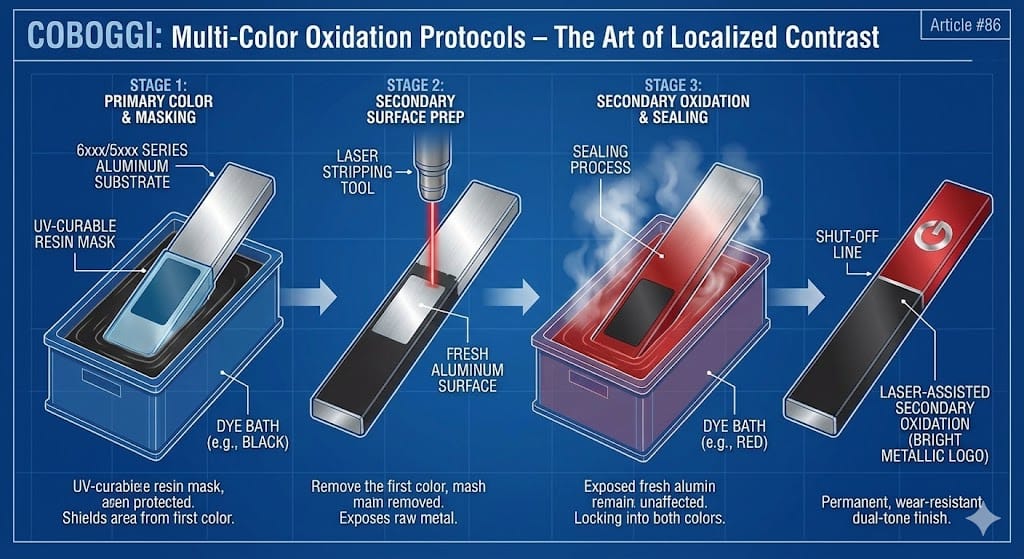
1. Advanced Masking Techniques
The foundation of multi-color oxidation is the barrier. We utilize high-precision UV-curable resins or custom-fitted physical masks to shield specific areas of the 6xxx or 5xxx series aluminum during the first anodizing cycle.
These masks must withstand the acidic environment of the electrolyte bath without lifting or degrading, ensuring a razor-sharp “shut-off line” between colors.
2. Sequential Dyeing and Re-Anodizing
Once the first color is locked into the oxide layer and sealed, the mask is removed. The part then undergoes a secondary surface preparation—often involving localized etching or laser stripping—to expose the raw aluminum in the previously masked areas. This “fresh” metal is then anodized and dyed a second time. Because the first color is already sealed, it remains unaffected by the second chemical bath.
3. Laser-Assisted Secondary Oxidation
For complex logos or functional markings, COBOGGI employs laser-assisted stripping. A high-precision fiber laser removes the primary anodic layer with micron-level accuracy.
The part is then re-processed to create a contrasting color or a “bright” metallic highlight within the etched area, providing a permanent, wear-resistant branding solution that is flush with the surface.
Conclusion: Beyond the Mono-Tone
Multi-color oxidation transforms a simple structural component into a sophisticated branding asset.
By eliminating the need for separate parts to achieve color variety, COBOGGI reduces assembly complexity while offering designers a wider palette of CMF (Color, Material, Finish) possibilities.
Specification Comparison
| Specification | Masked Multi-Color Oxidation | Electrochemical Localized Etching + Dyeing | Laser-Activated Selective Oxidation |
|---|---|---|---|
| Oxide layer thickness uniformity (±µm) | ±1.8 | ±2.3 | ±0.7 |
| Minimum feature resolution (µm) | 120 | 85 | 22 |
| Colour registration accuracy (±µm) | ±15 | ±8 | ±3 |
| Maximum contrast ratio (L* difference) | 42 | 58 | 67 |
| Cycle time per 300 × 300 mm panel (min) | 48 | 63 | 29 |
| Dye absorption variance across zones (% RSD) | 9.2 | 6.5 | 2.1 |
| Post-process dimensional stability (µm/mm shift) | ±0.8 | ±1.4 | ±0.3 |
| Repeatability over 10,000 cycles (CpK) | 1.32 | 1.18 | 1.65 |
Frequently Asked Questions
What minimum feature size can be reliably achieved for localized multi-color oxide zones using Coboggi’s precision masking protocol?
Our laser-cut polyimide masking system achieves a minimum feature size of 0.15 mm with ±0.02 mm positional tolerance on 6061-T6 substrates.
How many distinct, stable colors can be simultaneously produced on a single aluminium part without cross-contamination or bleed-through?
Up to 7 spectrally distinct anodized colors (measured at CIE L*a*b* ΔE < 2.0 between adjacent zones) are achievable per part using our sequential electrolyte immersion process with automated rinse interlocks.
What is the typical lead time for prototyping a custom multi-color oxidation design, and does it include metrology validation?
Standard prototype lead time is 12 business days, which includes full-color spectral verification using our Konica Minolta CM-3600A spectrophotometer (CIE D65 illuminant, 8° viewing angle).
What is the maximum part dimension supported for full-spectrum multi-color oxidation under your Class 10,000 cleanroom anodizing line?
The largest compatible part dimension is 1,200 mm × 800 mm × 150 mm (L×W×H), with uniform color consistency maintained across the entire surface (±0.8 ΔE max variation per zone).
Do your multi-color oxidation protocols meet aerospace-grade corrosion resistance requirements—and if so, what salt spray rating do they achieve?
Yes—our sealed multi-color process passes ASTM B117 for 1,000 hours at 5% NaCl solution, achieving zero white rust on AA7075-T73 substrates per MIL-A-8625 Type II, Class 1B specification.
What is the minimum order quantity (MOQ) for production runs of multi-color oxidized components, and is there a cost premium for color registration tolerances tighter than ±0.10 mm?
The MOQ is 250 units per design; however, for registration tolerances tighter than ±0.10 mm (down to ±0.03 mm), a 17% process surcharge applies due to dual-axis vision-guided robotic masking alignment.