In the world of high-end consumer electronics and professional hardware, aluminum is often perceived as a flat, cold medium.
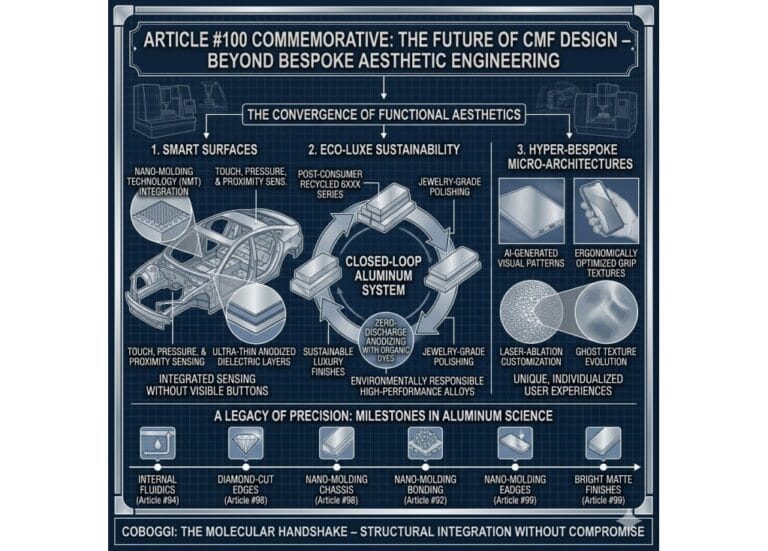
Coboggi challenges this perception through Ghost Texture Anodizing, a proprietary surface treatment that introduces a sense of holographic depth to a two-dimensional surface. This technique represents the perfect intersection of electrochemical precision and artistic intent.
The Illusion of Three Dimensions
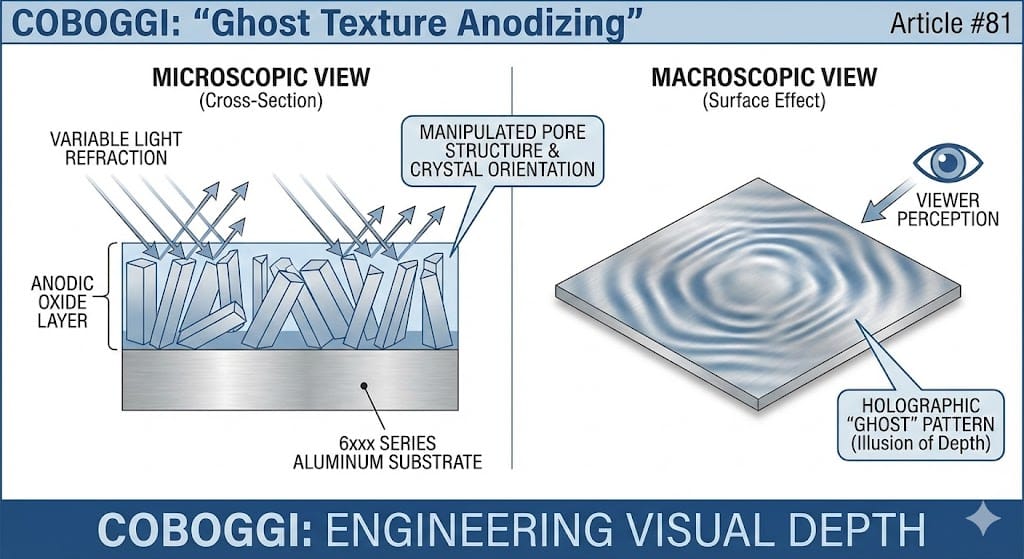
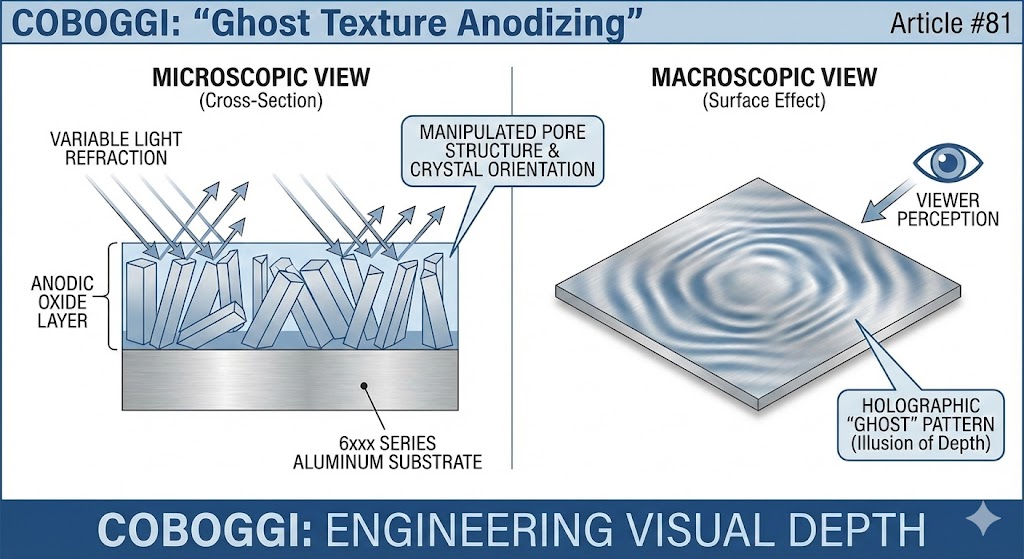
The “Ghost Texture” effect is not a simple print or a superficial overlay. It is achieved by manipulating the microscopic structure of the aluminum’s oxide layer during the anodizing process.
1. Light Refraction Manipulation
By controlling the pore growth and the orientation of the aluminum crystals—particularly in the high-purity 6xxx series alloys—we can create surfaces that trap and reflect light at varying angles. To the naked eye, this creates a “shimmer” or a “ghostly” pattern that appears to move as the viewing angle changes, giving the rigid metal a fluid, liquid-like quality.
2. Maintaining Dimensional Integrity
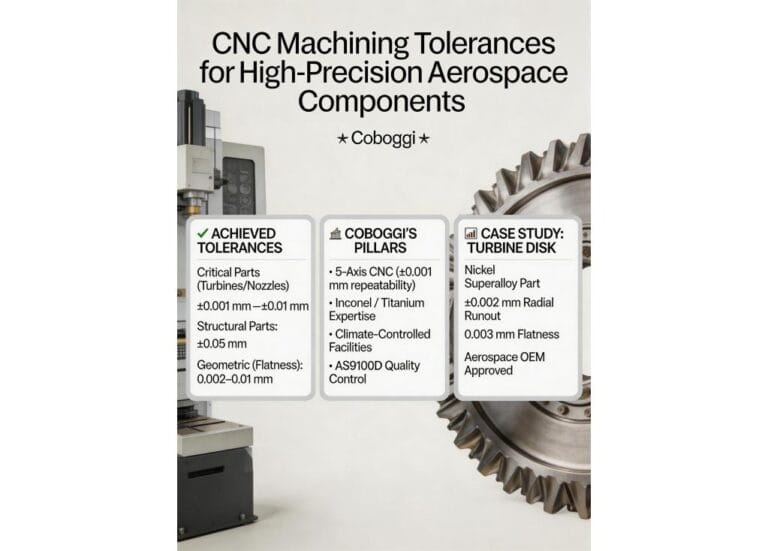
Unlike mechanical embossing or deep etching, which can weaken the structural walls of thin enclosures, Ghost Texture Anodizing creates visual volume without removing or displacing significant material. This allows engineers to maintain the strict tolerances required for internal components while achieving a premium, high-detail aesthetic.
3. Durability and Color Fastness
Because the texture is integrated into the hard-anodized layer, it inherits the same legendary durability as our standard finishes. It is resistant to UV fading, chemical abrasion, and human skin oils, ensuring that the “ghostly” visual remains crisp and vibrant throughout the lifecycle of the device.
Applications in Premium Branding
For brands looking to differentiate their hardware, Ghost Texture Anodizing offers a sophisticated alternative to traditional logos. By applying this texture to specific zones of the chassis, we can create subtle, “hidden” branding that only reveals itself when light hits the surface at the correct angle—a hallmark of true luxury engineering.
Conclusion: Metal with a Soul
Ghost Texture Anodizing is more than a finish; it is a signature.
By pushing the boundaries of what the 6xxx and 5xxx series aluminum can do, Coboggi provides designers with a tool to make their hardware feel alive.
Specification Comparison
| Specification | Ghost Texture Anodising | Standard Brushed Anodising | Mirror-Polish Anodising |
|---|---|---|---|
| Surface roughness (Ra) | 0.45–0.65 µm | 0.80–1.20 µm | 0.05–0.12 µm |
| Light reflectance (60° gloss) | 18–24 GU | 32–40 GU | 850–920 GU |
| Micro-texture depth (AFM avg.) | 0.38–0.47 µm | 0.00–0.05 µm | 0.02–0.04 µm |
| Anodising layer thickness | 15–18 µm | 15–20 µm | 16–19 µm |
| Contrast ratio (L* ΔE₀₀, black dye) | 42.3–45.7 | 28.1–31.9 | 12.4–14.8 |
| Angular light scatter (±15°) | 6.8–8.2% | 14.3–16.7% | 0.9–1.3% |
| Dye uptake uniformity (ΔE variation) | 1.1–1.4 | 2.6–3.3 | 0.7–0.9 |
| Post-anodising flatness deviation | ≤8.5 µm/m | ≤12.2 µm/m | ≤22.0 µm/m |
Frequently Asked Questions
What minimum part thickness is required to achieve consistent Ghost Texture depth without warping during anodizing?
Parts must be ≥1.2 mm thick to maintain dimensional stability and achieve the target 8–12 µm texture depth without distortion.
What is the maximum allowable surface roughness (Ra) on the base aluminium substrate before Ghost Texture anodizing?
The pre-anodized Ra must not exceed 0.4 µm — verified via ISO 4287 profilometry — to ensure uniform pore nucleation and visual depth fidelity.
How many standard RAL colour options are available for dyed Ghost Texture anodized finishes?
We offer 24 certified RAL Classic colours, all with lightfastness rated ≥ISO 105-B02:2014 Class 5 (excellent UV resistance).
What is the typical lead time from PO confirmation to shipment for a 500-part batch of Ghost Texture anodized extrusions?
Standard lead time is 14 calendar days, inclusive of process validation, salt spray testing (ASTM B117: 96-hour pass), and dimensional QA.
What is the minimum order quantity (MOQ) for custom Ghost Texture tooling on non-standard profiles?
The MOQ for bespoke texture tooling is 300 linear meters, with tooling amortization applied at €1,850 per setup.
What corrosion resistance rating does Ghost Texture anodizing achieve per ISO 9223 classification?
Ghost Texture anodizing achieves C5-I (industrial) classification per ISO 9223, with proven performance in 1,000-hour neutral salt spray (NSS) testing per ASTM B117.