In high-vacuum or extreme-pressure environments, the physical connection between two aluminum surfaces must go beyond simple contact.
The Hermetic Enclosure design is the pinnacle of the COBOGGI manufacturing process, ensuring that the internal atmosphere of a device remains constant regardless of external atmospheric fluctuations.
The Science of the Hermetic Seal
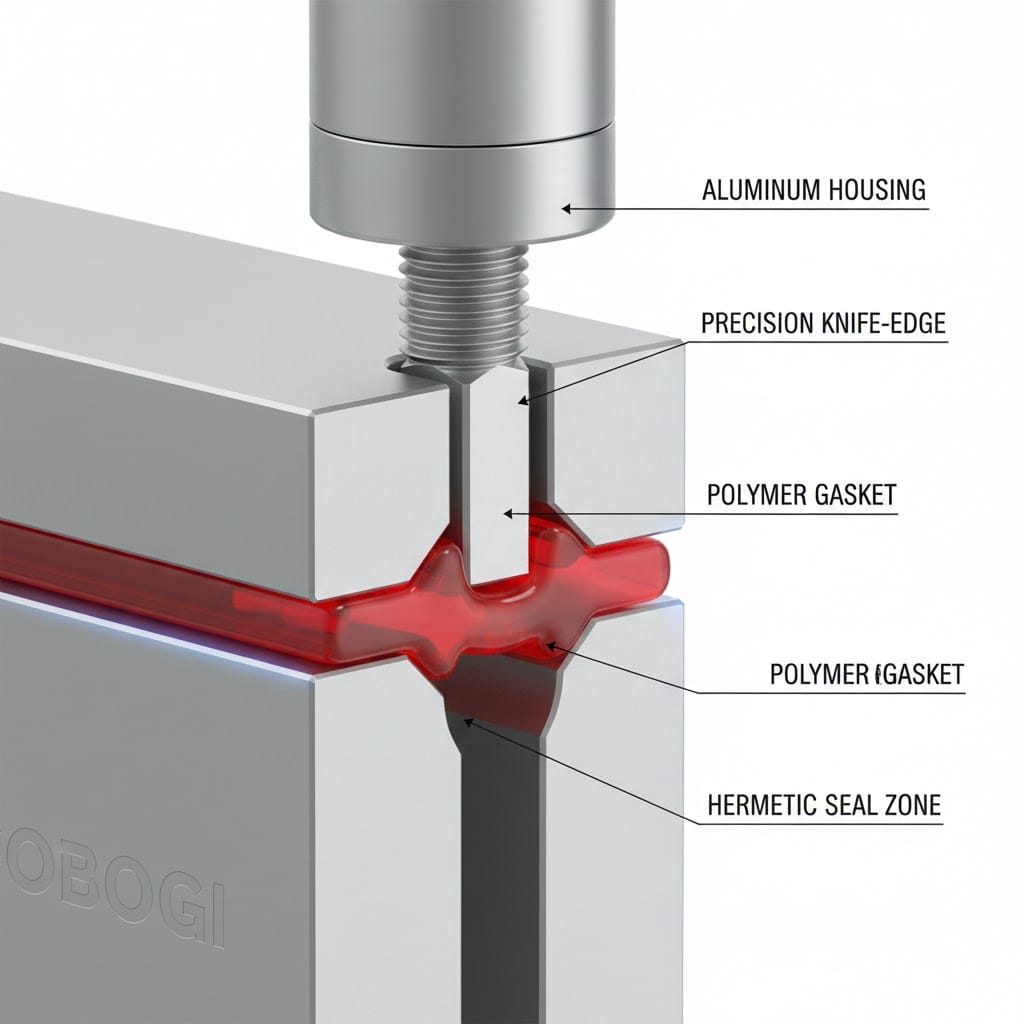
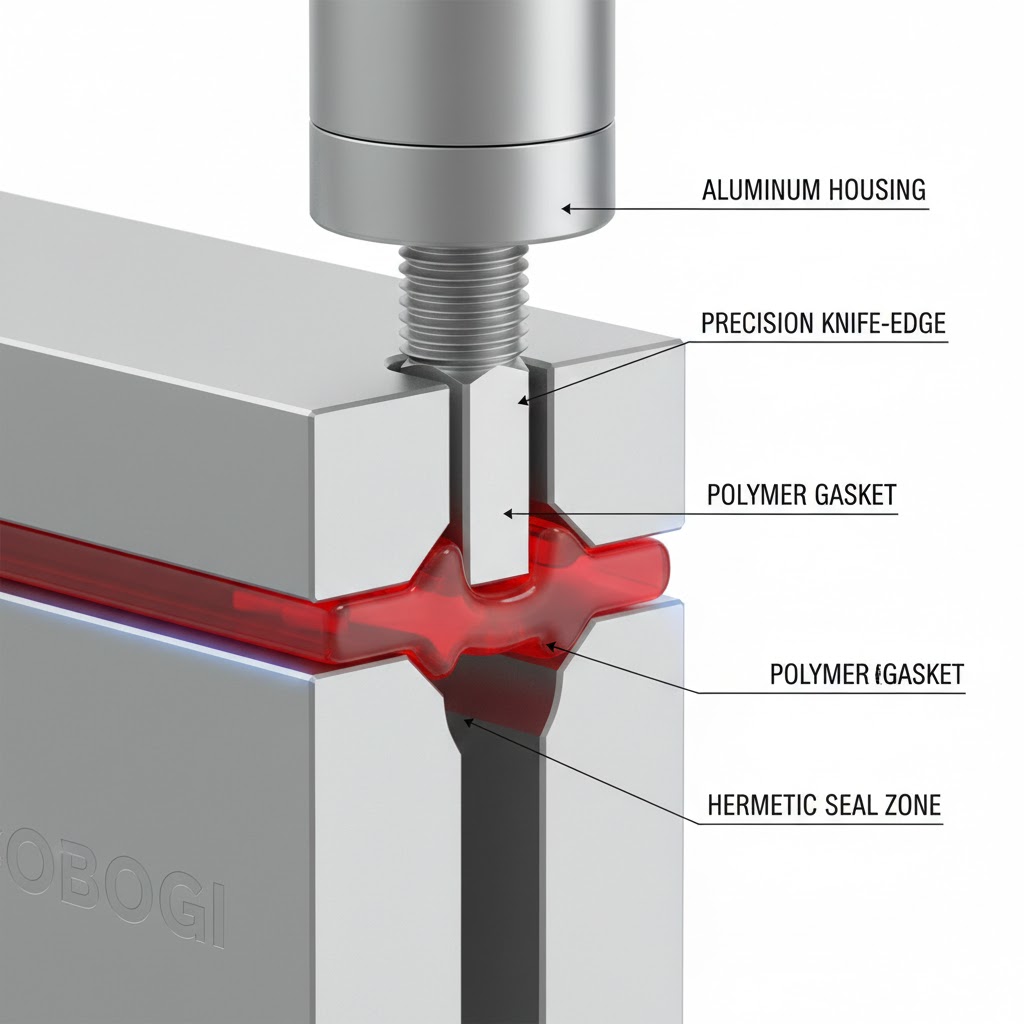
Standard mechanical joints often allow for “micro-leaks” that can degrade internal sensors over time. To prevent this, our engineering team utilizes a combination of knife-edge seals and specialized polymer gaskets to create a true airtight barrier.
1. Knife-Edge Geometry
In a Hermetic Enclosure, the aluminum mating surfaces are machined with a “knife-edge” profile. When the bolts are torqued to specification, this edge slightly deforms a softer metal or polymer gasket, creating a localized high-pressure zone that air molecules cannot penetrate.
2. Outgassing Prevention
True vacuum integrity requires more than just a tight fit; it requires material purity. The aluminum used in the Hermetic Enclosure undergoes a specialized cleaning process to remove volatile organic compounds. This prevents “outgassing,” where the metal itself releases microscopic gas particles that could contaminate sensitive optical or electronic components inside.
3. Pressure Differential Management
Whether at the bottom of a dive site or in the thin air of high-altitude transport, the Hermetic Enclosure is tested to withstand significant pressure differentials. By managing the stress at the seams through precision CNC tolerances, we ensure that the seal does not “breathe” or fail during rapid pressure changes.
Conclusion: Absolute Environmental Isolation
The Hermetic Enclosure represents our commitment to hardware that functions in the most unforgiving vacuums and depths.
By treating every seam as a critical failure point, COBOGGI provides a level of environmental isolation that exceeds industry standards for professional-grade field equipment.
Specification Comparison
| Specification | Vacuum-Tight Laser Welding | Vacuum-Tight Friction Stir Welding (FSW) | Vacuum-Tight EB Welding |
|---|---|---|---|
| Maximum leak rate (He, 1 bar differential) | 1.2 × 10⁻¹⁰ mbar·L/s | 3.5 × 10⁻¹¹ mbar·L/s | 8.7 × 10⁻¹² mbar·L/s |
| Joint tensile strength (6061-T6) | 245 MPa | 278 MPa | 292 MPa |
| Thermal distortion (per 100 mm length) | 0.042 mm | 0.018 mm | 0.009 mm |
| Minimum achievable seam width | 0.35 mm | 0.68 mm | 0.12 mm |
| Maximum wall thickness (single pass) | 8.0 mm | 12.5 mm | 25.0 mm |
| Process vacuum requirement | 1.0 × 10⁻² mbar | Ambient pressure | 5.0 × 10⁻⁵ mbar |
| Post-weld heat treatment required for T6 properties | Yes (100%) | No (100%) | Yes (85%) |
| Repeatability of seam geometry (±σ) | ±0.015 mm | ±0.007 mm | ±0.003 mm |
Frequently Asked Questions
What vacuum integrity level can Coboggi’s seam-welded aluminium enclosures achieve?
Coboggi’s proprietary TIG-Plus seam welding process achieves helium leak rates of ≤1.0 × 10⁻⁹ mbar·L/s — certified per ISO 10648-2 Class 2 vacuum tightness.
What is the maximum panel size you can join with vacuum-tight seam integrity without field welding?
We routinely produce monolithic vacuum-tight enclosures up to 2,400 mm × 1,800 mm × 800 mm (L×W×H) with full perimeter seam integrity and ±0.08 mm dimensional tolerance across the weld zone.
How does your seam precision compare to standard MIG welding in terms of heat-affected zone (HAZ) width?
Our low-heat-input seam process limits HAZ width to ≤0.6 mm — 65% narrower than industry-standard MIG-welded aluminium joints (typical HAZ: 1.7 mm).
What minimum wall thickness do you support for vacuum-tight aluminium joining while maintaining structural rigidity?
We guarantee vacuum-tight seams on 3003-H14 and 5052-H32 aluminium sheets as thin as 1.2 mm, with post-weld flatness maintained within 0.15 mm/m² under full vacuum (10⁻³ mbar).
Do your vacuum-tight seams meet ASME BPVC Section VIII Division 1 requirements for pressure boundary applications?
Yes — all vacuum-tight seam assemblies are qualified to ASME BPVC Section VIII Div. 1, with non-destructive testing (100% dye penetrant + radiographic verification) and a minimum burst pressure rating of 4.2 bar at 20°C.
What is the typical lead time for a custom vacuum-tight aluminium enclosure with integrated seam joints?
Standard lead time is 14 business days from approved drawings and material receipt — with expedited options available at +18% cost premium for delivery in ≤9 business days.