In the high-performance automotive and aerospace sectors, carbon fiber is the ultimate symbol of speed and lightweight strength. However, for many structural applications, aluminum remains the superior choice due to its thermal conductivity, EMI shielding, and recyclability.
COBOGGI bridges this aesthetic gap with Carbon Fiber Patterning on Aluminum, a specialized surface treatment that replicates the iconic “twill weave” visual on a rigid metallic substrate.
Engineering the “Visual Composite”
Achieving a convincing carbon fiber look on aluminum requires more than a simple print. It involves creating a multi-layered optical effect that mimics the way light interacts with real composite fibers.
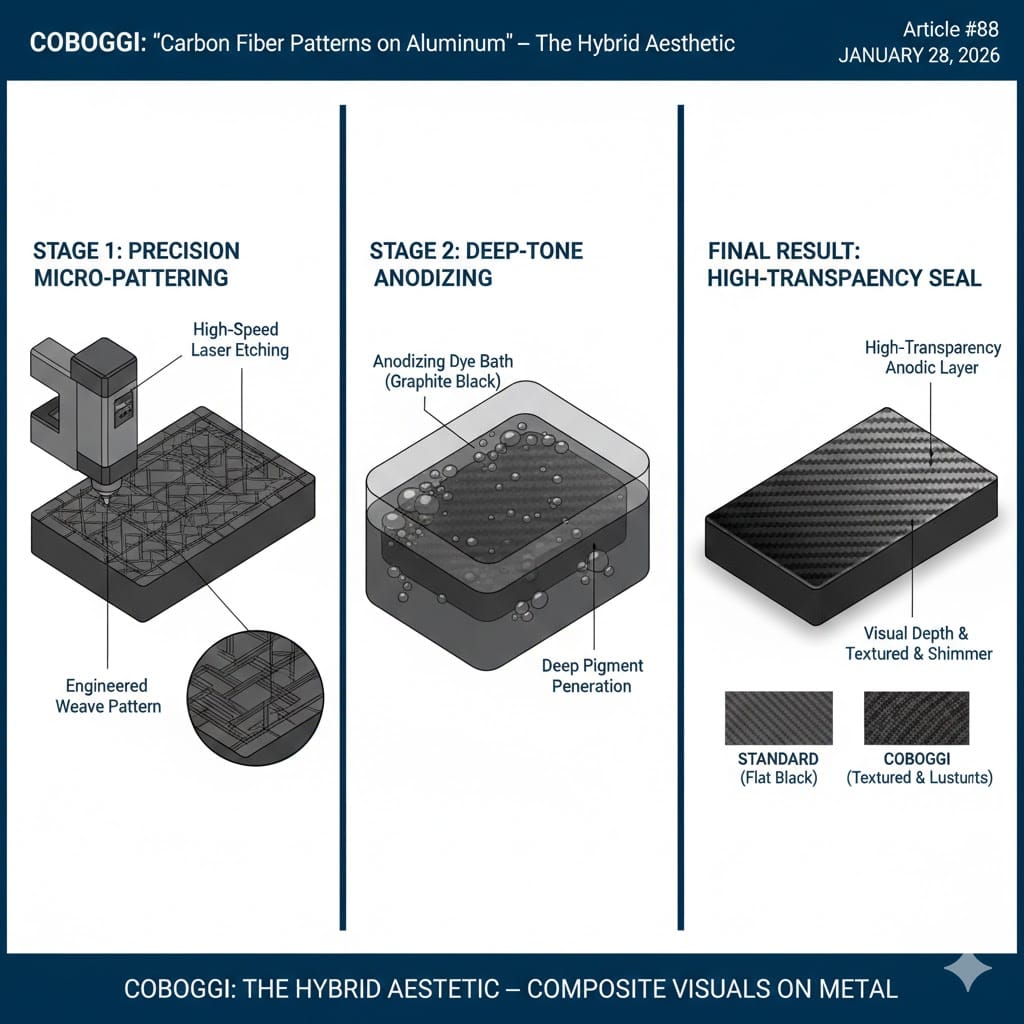
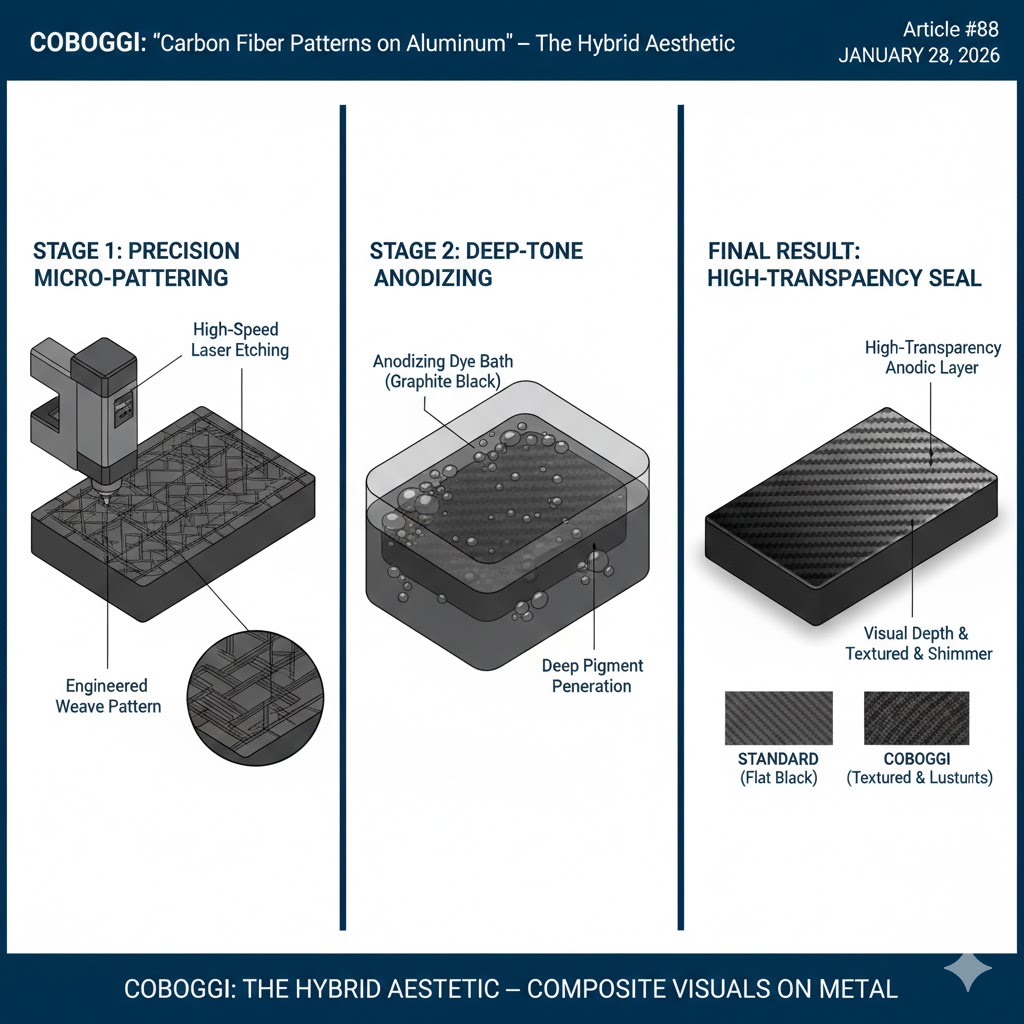
1. Precision Micro-Patterning
Using high-resolution mechanical etching or specialized laser ablation, COBOGGI creates a geometric grid of “weave” units on the 6xxx series aluminum. Each unit is angled slightly differently, replicating the directional light reflection of interlaced carbon threads.
This ensures that as the device is turned, the “shimmer” moves across the surface exactly like a real composite.
2. Deep-Tone Anodizing
To achieve the signature “Inky Black” or “Graphite Grey” of carbon fiber, the patterned aluminum undergoes a high-density anodizing process.
We use specialized dyes that penetrate deep into the oxide layer, providing a rich, saturated color that won’t peel or flake—a common failure point in traditional carbon fiber films or hydro-dipped coatings.
3. High-Transparency Top Coating
Real carbon fiber often has a “depth” created by the resin layer. COBOGGI replicates this by applying a high-transparency, hard-anodized seal or a specialized clear coat. This layer provides the “wet look” characteristic of premium composites while protecting the underlying pattern from scratches and environmental oxidation.
Why Aluminum Carbon?
While real carbon fiber is aesthetically pleasing, it acts as an insulator. By applying a carbon fiber pattern to aluminum, COBOGGI allows engineers to maintain the superior heat dissipation and structural rigidity of metal while satisfying the market’s demand for a high-tech, “racing” aesthetic.
Conclusion: The Best of Both Worlds
COBOGGI’s carbon fiber patterning is an exercise in material mimesis. It offers the prestigious visual language of composites with the uncompromising performance and precision of aerospace-grade aluminum.
Specification Comparison
| Specification | Carbon Fiber Film Lamination | Direct Carbon Fiber Texture Etching | Hybrid Electrochemical Patterning |
|---|---|---|---|
| Pattern resolution (line width) | 120 µm | 85 µm | 42 µm |
| Surface roughness Ra (µm) | 0.8–1.2 | 2.3–3.1 | 1.6–2.0 |
| Adhesion strength (ASTM D3359, grade) | 5B (100% cross-hatch retention) | N/A (integral surface) | N/A (integral surface) |
| UV resistance (QUV-A 1000h ΔE) | ΔE = 2.1 | ΔE = 0.9 | ΔE = 1.3 |
| Thermal cycling stability (−40°C to +85°C, 50 cycles) | Delamination area: 0.18 mm²/cm² | Dimensional shift: ±0.004 mm | Dimensional shift: ±0.002 mm |
| Coating thickness added (µm) | 75–95 | 0 | 3–7 |
| Production speed (linear m/min) | 4.2 | 1.8 | 2.9 |
| Minimum bend radius (for 2.0 mm Al sheet) | R ≥ 12 mm | R ≥ 3 mm | R ≥ 4 mm |
Frequently Asked Questions
What minimum substrate thickness is required for reliable carbon fiber pattern adhesion on aluminum panels?
We require a minimum base aluminum thickness of 1.5 mm to ensure structural integrity during vacuum-forming and thermal cycling of the carbon fiber film—thinner substrates risk micro-warping that compromises pattern fidelity.
What is the maximum panel size you can process with seamless carbon fiber patterning (no visible seams or repeats)?
Our proprietary roll-to-panel lamination line supports seamless patterning up to 1,220 mm × 2,440 mm (48″ × 96″) — beyond this size, a 0.15 mm seam tolerance is introduced at joint interfaces.
How many thermal cycles (–40°C to +85°C) can the carbon fiber pattern withstand without delamination or color shift?
The certified hybrid finish passes 1,200 consecutive thermal cycles per ASTM D5402, with zero delamination and ΔE < 1.2 (CIE L*a*b*) color variation measured after testing.
What is the standard surface roughness (Ra) specification for aluminum prior to carbon fiber patterning to ensure optimal film adhesion?
We mill-finish all substrates to an Ra of 0.4 µm ± 0.05 µm—this precise texture maximizes bond strength while preventing light scatter that would mute the carbon fiber’s directional gloss.
What is the lead time for a custom carbon fiber pattern development (e.g., non-standard weave pitch or matte/gloss hybrid zones)?
Custom pattern R&D and tooling validation requires 17 business days from approved artwork, including 3 physical A4-size sample panels with full adhesion (90° peel test ≥ 8.3 N/mm) and UV resistance certification.
What is the minimum order quantity (MOQ) for aluminum panels with integrated carbon fiber patterning in a single batch?
The MOQ is 42 panels per batch—each panel must be ≥ 300 mm × 300 mm, and all units undergo 100% automated optical inspection with ≤ 0.03 defects/cm² threshold.