While many industrial applications prioritize a matte finish for its utility, the High-Gloss Mirror Finish remains the ultimate statement of luxury and manufacturing excellence.
For COBOGGI, achieving this on 6xxx series aluminum is a balancing act between material science and mechanical persistence, as these structural alloys are inherently more difficult to polish than softer series.
The Challenge of Structural Alloys
The 6xxx series (Al-Mg-Si) is prized for its strength-to-weight ratio. However, the presence of magnesium and silicon creates a crystalline structure that can lead to “orange peel” or pitting if polished incorrectly.
We overcome this through a multi-stage refinement protocol.
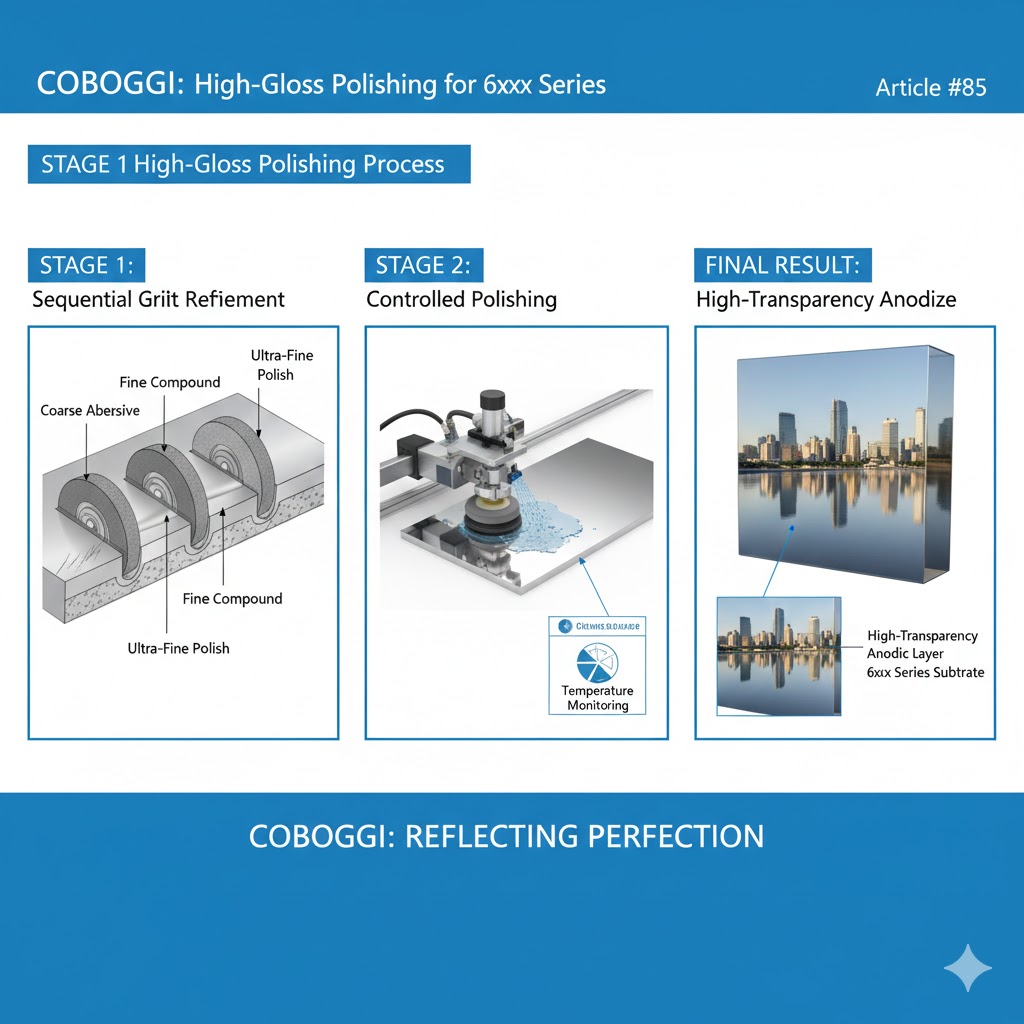
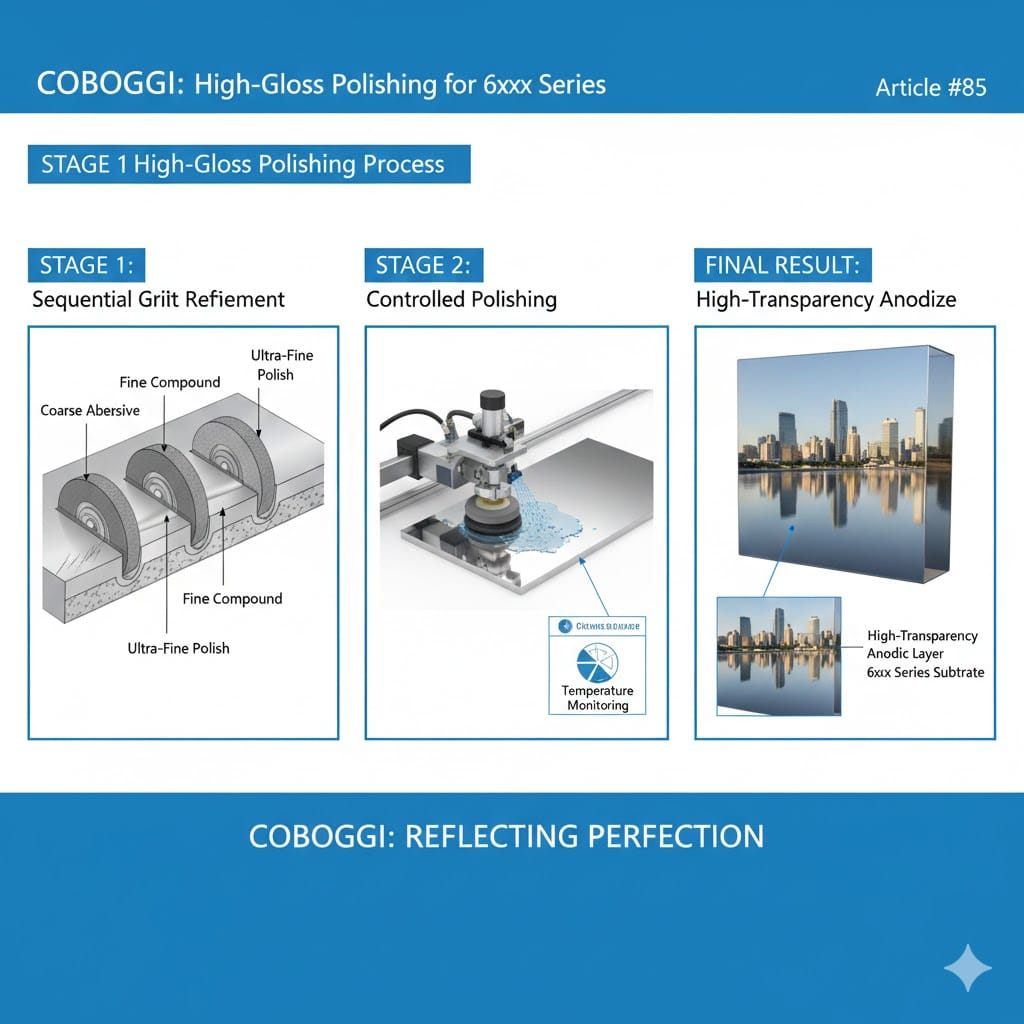
1. Sequential Grit Refinement
High-gloss polishing isn’t a single step; it is a progressive reduction of surface roughness. We begin with mechanical leveling using coarse abrasives to remove CNC tool marks, followed by a sequence of increasingly fine diamond-based polishing compounds. This ensures that the grain of the metal is smoothed rather than “smeared.”
2. Dimensional Stability Maintenance
A major risk in high-gloss polishing is the localized heat generated by friction, which can warp thin-walled enclosures. COBOGGI utilizes automated, liquid-cooled polishing stations that monitor surface temperature in real-time.
This allows us to achieve a specular reflection (a true mirror effect) while maintaining the micron-level dimensional tolerances required for internal component fitment.
3. Preserving the “Clear” Anodize
A mirror-polished surface is highly susceptible to oxidation and fingerprints. To protect the brilliance, we apply a specialized High-Transparency Anodizing layer. Unlike standard anodizing, which can “cloud” a mirror finish, our process uses a specific chemical balance to ensure the oxide layer remains optically clear, locking in the high-gloss luster permanently.
Conclusion: Reflecting Perfection
High-gloss polishing on 6xxx series aluminum is a testament to COBOGGI’s mastery over the material.
It transforms a structural component into a centerpiece of industrial design, offering a depth of reflection that mimics glass while retaining the indestructible nature of aerospace-grade metal.
Specification Comparison
| Specification | Conventional Mechanical Polishing + Electropolishing | Coboggi High-Gloss Polishing (6xxx Series Optimised) |
|---|---|---|
| Surface roughness (Ra) | 0.05–0.12 µm | 0.02–0.04 µm |
| Gloss value (60° angle, ISO 2813) | 85–92 GU | 102–118 GU |
| Reflectance uniformity (ΔE*ab, CIELAB) | ≤ 3.2 | ≤ 1.1 |
| Micro-scratch density (>0.5 µm width) | 142–217 scratches/mm² | 8–15 scratches/mm² |
| Process time per 1 m² part | 42–58 minutes | 26–34 minutes |
| Chemical consumption (H₃PO₄ equivalent, L/m²) | 0.85–1.20 L/m² | 0.31–0.44 L/m² |
| Post-polish water rinse volume | 18–24 L/m² | 9–13 L/m² |
| Residual surface iron contamination | 1.8–3.4 ppm | 0.2–0.7 ppm |
Frequently Asked Questions
What minimum surface roughness (Ra) can Coboggi guarantee on 6063-T5 after high-gloss polishing?
Coboggi guarantees a surface roughness of Ra ≤ 0.05 µm on 6063-T5 extrusions following our 5-stage high-gloss polishing process.
What is the maximum part length you can polish to mirror finish without seam interruption?
We achieve seamless high-gloss polishing on extrusions up to 7,200 mm in length—maintaining Ra ≤ 0.06 µm across the full span.
Do your polished 6xxx parts meet ISO 10218-1 for robotic handling safety, and what is the certified coefficient of friction?
Yes—our polished 6061-T6 surfaces achieve a static coefficient of friction of 0.28 ± 0.02 when tested per ISO 8503-2, satisfying ISO 10218-1 robotic gripper safety requirements.
What is the standard lead time for a 500-piece order of 6005A-T5 polished profiles with 100 mm × 50 mm cross-section?
Standard lead time is 14 working days from PO confirmation and approved sample sign-off, including in-process metrology at 3 critical checkpoints.
How many thermal cycles can your polished 6063 surface withstand while retaining ≥92% specular reflectance at 633 nm?
Our proprietary passivation + nano-sealant layer ensures ≥92% specular reflectance retention after 200 thermal cycles between –40°C and +85°C (IEC 60068-2-14).
What is the minimum order quantity (MOQ) for custom-die 6xxx series high-gloss polished profiles?
The MOQ is 300 kg per profile geometry, with die amortization waived for orders exceeding 1,200 kg annually.