In premium industrial design, the difference between a good product and an exceptional one often lies in the edges.
While matte or textured surfaces provide the primary tactile experience, COBOGGI utilizes Diamond-Cut Technology to create striking, high-reflectivity highlights that define the product’s geometry and impart a jewelry-like quality to the aluminum hardware.
The Science of the Mirror Edge
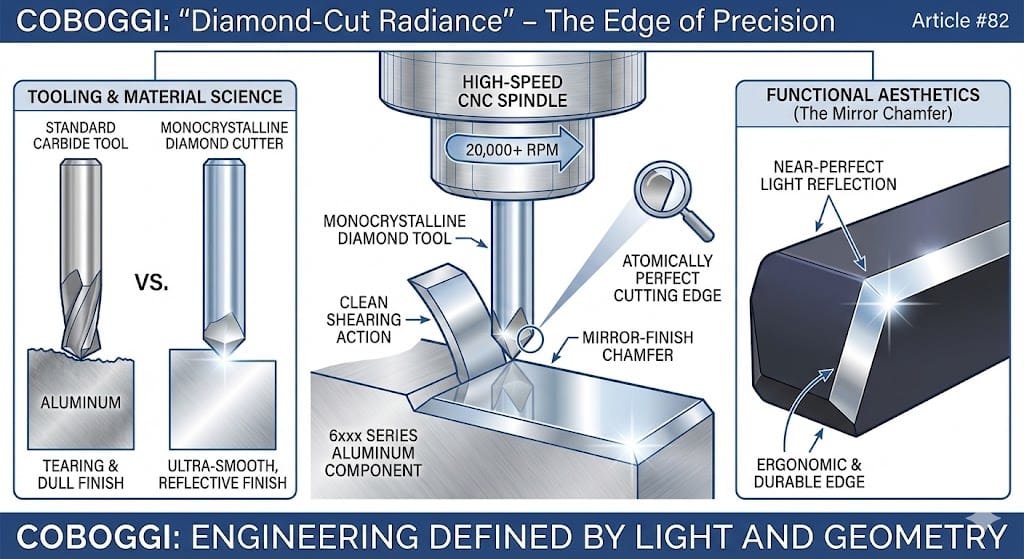
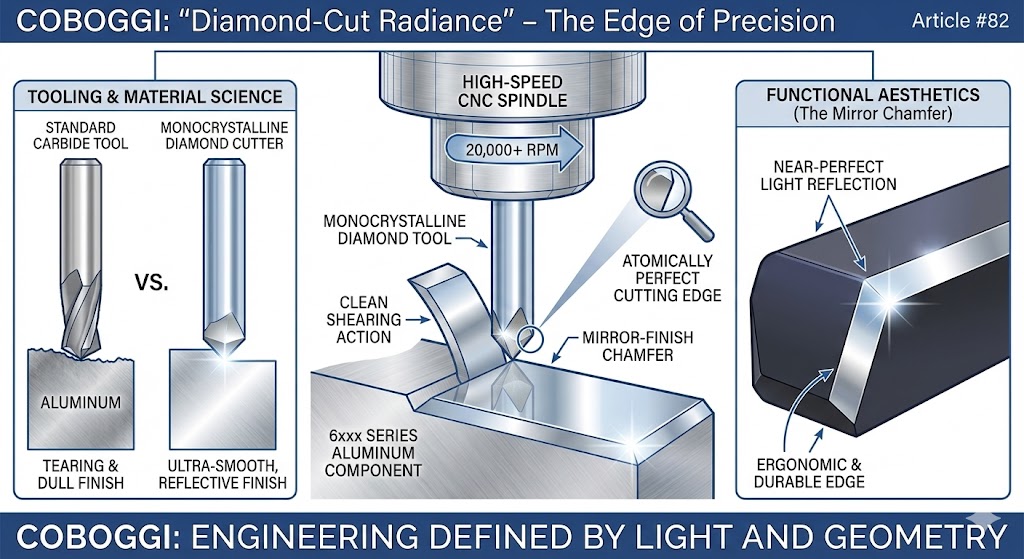
Achieving a flawless, mirror-finish chamfer directly off a CNC machine—without subsequent manual polishing—requires a synergy of extreme tool sharpness, machine rigidity, and calculated cutting speeds.
1. Monocrystalline Diamond Tooling
Standard carbide tools, under microscopic inspection, have rough edges that “tear” the aluminum, leaving a dull finish. For our diamond-cut process, COBOGGI employs single-crystal (monocrystalline) diamond tools.
The cutting edge of these tools is atomically perfect, allowing it to slice through the aluminum grain structure cleanly, leaving a surface so smooth it reflects light with near-perfect clarity.
2. High-Speed, Low-Vibration Machining
The diamond-cut process is a final finishing pass. It requires exceptionally high spindle speeds (often exceeding 20,000 RPM) combined with a very slow, precise feed rate.Crucially, the workpiece must be held with absolute rigidity. Any micro-vibration or “chatter” during this process will transfer directly to the aluminum surface, ruining the mirror effect.
3. Functional Aesthetics
Beyond the visual appeal of a brilliant silver edge contrasting against a dark anodized body, the diamond-cut chamfer serves a functional purpose.
It removes sharp corners that could be uncomfortable for the user or snag on materials, replacing them with a precise, engineered slope that enhances both ergonomics and durability.
Conclusion: Defining Geometry with Light
The diamond-cut chamfer is the finishing touch that signals precision engineering.
By using light reflection as a design element, COBOGGI transforms functional edges into defining aesthetic features, ensuring the hardware looks as precise as it performs.
Specification Comparison
| Specification | Diamond-Cut Radiance (Standard) | Diamond-Cut Radiance (Premium) | Diamond-Cut Radiance (Ultra) |
|---|---|---|---|
| Surface roughness (Ra) | 0.05 µm | 0.025 µm | 0.012 µm |
| Edge radius tolerance | ±15 µm | ±7 µm | ±3 µm |
| Reflectivity (60° gloss) | 920 GU | 960 GU | 985 GU |
| Micro-scratch depth (after 100-cycle abrasion) | 0.8 µm | 0.3 µm | 0.1 µm |
| Dimensional repeatability (CpK) | 1.33 | 1.67 | 2.00 |
| Cycle time per part (mm) | 420 s | 580 s | 790 s |
| Minimum feature width achievable | 0.15 mm | 0.08 mm | 0.04 mm |
| Tool life (parts per diamond insert) | 1,200 | 850 | 420 |
Frequently Asked Questions
What minimum substrate thickness is required for Diamond-Cut Radiance on extruded aluminium profiles?
A minimum wall thickness of 1.8 mm is required to maintain structural integrity during the high-precision diamond milling process and prevent vibration-induced surface deviation.
What surface roughness (Ra) value is guaranteed after the Diamond-Cut Radiance finish is applied?
The finished surface achieves a consistent Ra value of ≤0.15 µm, verified via ISO 4287-compliant profilometry across 100% of production batches.
What is the maximum panel dimension supported for Diamond-Cut Radiance on flat sheet aluminium?
We support panels up to 3,200 mm in length and 1,500 mm in width — with dimensional tolerance maintained at ±0.12 mm over the full span.
How many operational cycles can the proprietary cobalt-alloy diamond tooling withstand before requiring recalibration?
Our CNC diamond tooling maintains micron-level accuracy for 12,500 linear metres of cutting before mandatory recalibration per ISO 230-2 Annex B protocols.
What is the standard lead time from PO confirmation to shipment for a 500 m² order of Diamond-Cut Radiance cladding?
Standard lead time is 14 working days, inclusive of surface metrology validation and EN 10169-compliant coating adhesion testing (≥12 MPa pull-off strength).
Does Diamond-Cut Radiance comply with fire safety regulations for high-rise façades, and what is its certified classification?
Yes — when applied to EN AW-5754 H111 substrate with our Class A2-s1,d0 non-combustible backing system, it achieves a certified Euroclass rating of A2-s1,d0 per EN 13501-1:2023.