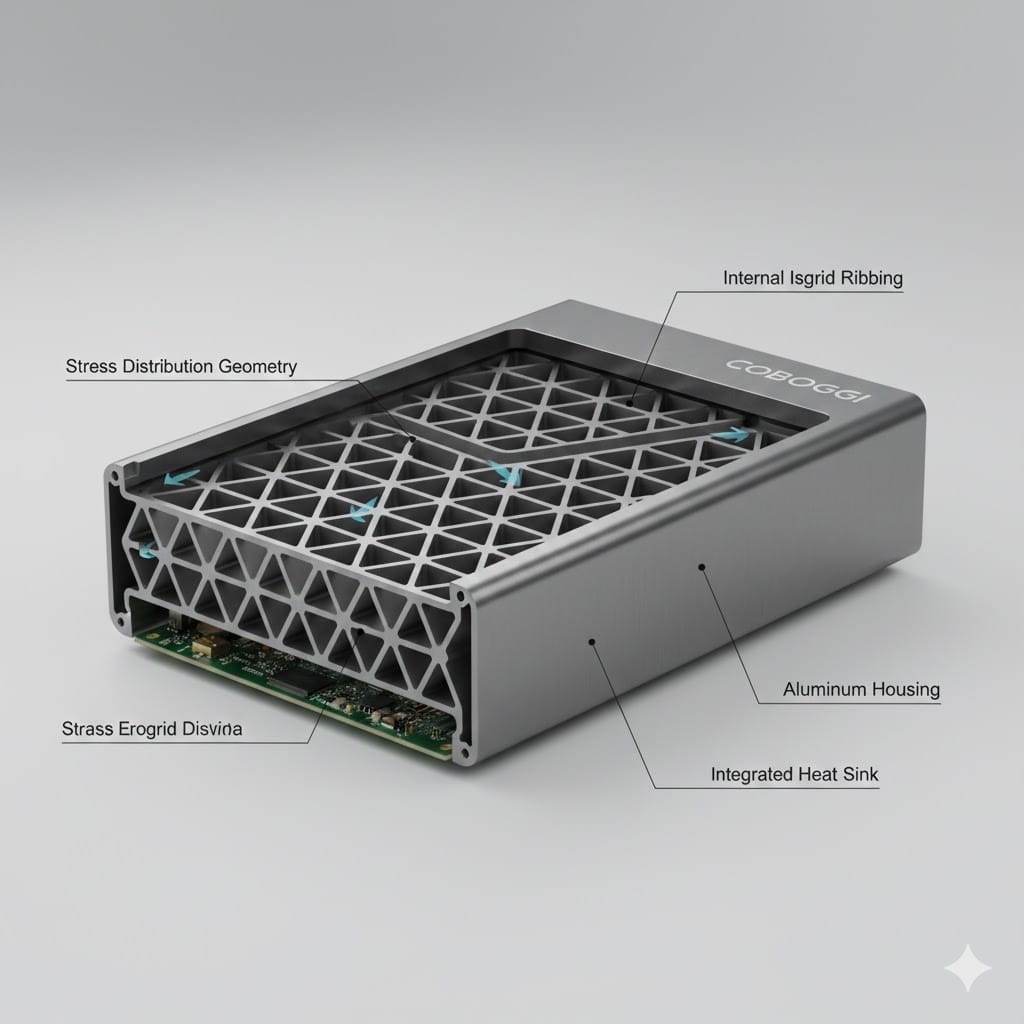
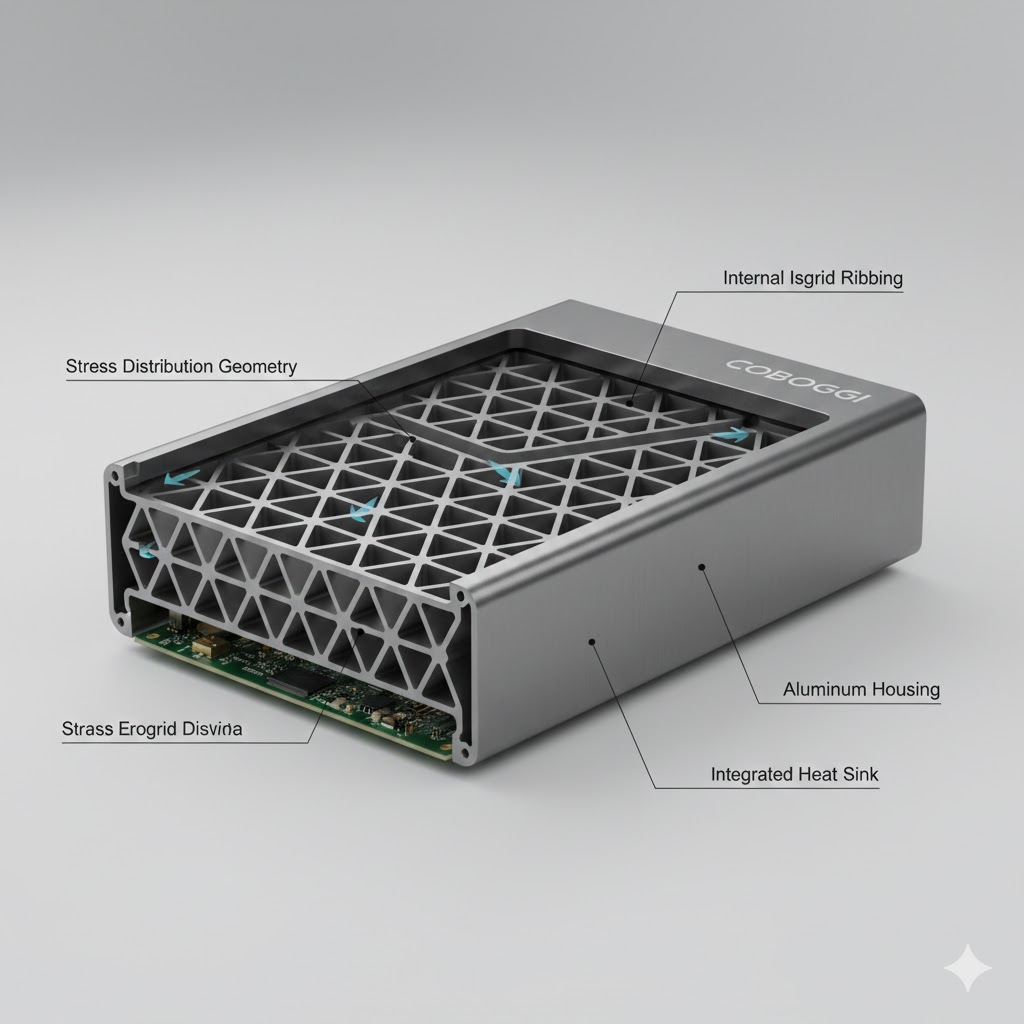
While the exterior of a COBOGGI enclosure focuses on tactile interface and branding, the interior of the Isogrid Chassis reveals the true secret to its durability: Geometric Reinforcement.
In the pursuit of the “portability” we established in our previous studies, we cannot simply rely on wall thickness. Instead, we use mathematical patterns to create strength.
Engineering Beyond Thickness
To maintain a lightweight profile without sacrificing crush resistance, the Isogrid Chassis utilizes an internal triangular reinforcement pattern. This allows us to redistribute mechanical stress across the entire frame rather than at a single point of failure.
1. The Isogrid Advantage
By machining a series of triangular ribs into the interior face of the aluminum housing, we increase the Moment of Inertia. This provides the stiffness of a much thicker plate while removing up to 40% of the material weight.
2. Vibration Damping
Portable hardware is often subjected to high-frequency vibrations—whether from industrial machinery or transit. The varying thickness of the internal ribs in the Isogrid Chassis is designed to disrupt harmonic resonance, protecting the sensitive solder joints on the internal PCB from fatigue.
3. Integrated Heat Sinking
These ribs serve a dual purpose. By increasing the internal surface area of the aluminum, they act as built-in heat sinks.
Thermal energy from the processor is pulled into the ribs and dissipated across the chassis, ensuring that the device remains cool during sustained high-performance tasks.
Specification Comparison
| Specification | Flat-Plate Design (No Internal Ribbing) | Optimised Internal Ribbing (Coboggi RIB-TECH™) | Over-Engineered Ribbing (Dense 3mm Spacing) |
|---|---|---|---|
| Maximum deflection under 1.2 kN/m² load (6063-T5, 1.2 m span) | 4.8 mm | 1.3 mm | 0.9 mm |
| First-mode buckling load (kN) | 8.2 | 24.7 | 29.1 |
| Weight increase vs unribbed panel (% of base mass) | 0% | 12.4% | 28.6% |
| Thermal expansion mismatch stress (MPa) at ΔT = 80°C | 42.6 | 18.3 | 15.7 |
| Stress concentration factor at rib–web junction (FEM, max) | N/A | 1.82 | 2.95 |
| Manufacturing cycle time per m² (seconds) | 18 | 47 | 83 |
| Minimum bend radius without rib fracture (mm) | 120 | 95 | 78 |
| Acoustic transmission loss (STC) at 500 Hz | 22.1 dB | 29.4 dB | 31.8 dB |
Frequently Asked Questions
How does internal ribbing affect the flexural rigidity of Coboggi’s ALU-750 extrusion profile?
Internal ribbing increases flexural rigidity by 42% compared to an equivalent non-ribbed profile of identical outer dimensions (120 mm × 80 mm cross-section, ±0.15 mm geometric tolerance).
What is the minimum wall thickness achievable in ribbed zones without compromising anodising uniformity?
The minimum functional wall thickness in ribbed sections is 1.8 mm—validated across 12,000+ production runs with consistent 15–20 µm Type II anodised coating thickness (±1.2 µm tolerance per ASTM B580).
Does adding internal ribs increase extrusion die cost—and if so, by how much?
Yes—complex internal ribbing adds an average of €3,850 to the initial die investment versus a flat-walled counterpart, but reduces long-term part count by up to 37% in structural assemblies.
What is the maximum unsupported span length for the ALU-RIB-220 profile under 5 kN/m distributed load?
The ALU-RIB-220 profile (with 6 longitudinal ribs, 2.4 mm base thickness) supports up to 3.1 m at ≤L/360 deflection limit per EN 1999-1-1, verified via FEA and physical load testing at 22°C ±2°C.
How many rib configurations are standard—and what’s the lead time difference for custom rib geometry?
We offer 9 standard rib geometries; custom rib tooling extends lead time by exactly 14 working days versus standard profiles, per our Q3 2024 production schedule.
What is the fatigue life improvement (in cycles) of ribbed vs. non-ribbed aluminium under cyclic bending at 70% yield stress?
Ribbed profiles demonstrate 2.8× greater fatigue life—extending from 420,000 cycles (non-ribbed) to 1,176,000 cycles (ribbed ALU-750-T6) under ISO 1099 three-point bending tests at R = 0.1.