For brands like yours, “Space Gray” or “Champagne Gold” isn’t just a color; it’s a brand promise.
However, anodizing is an electrochemical process influenced by temperature, acidity, and time. Without rigorous control, “Batch A” can look slightly warmer than “Batch B,” breaking the illusion of a unified ecosystem.
The Finisher’s Finality is our protocol for ensuring that every unit meets a “zero-drift” standard.
1. The “Golden Sample” and Limit Range
Before mass production begins, we establish the Golden Sample—the perfect representation of your brand color.
Limit Samples: Because perfection exists in a range, we also produce “Limit Samples” (one shade lighter, one shade darker).
The Rule: Any unit that falls outside this narrow window is rejected. This ensures that even with slight natural variations, the products still look identical to the consumer.
2. Delta E: Measuring the Invisible
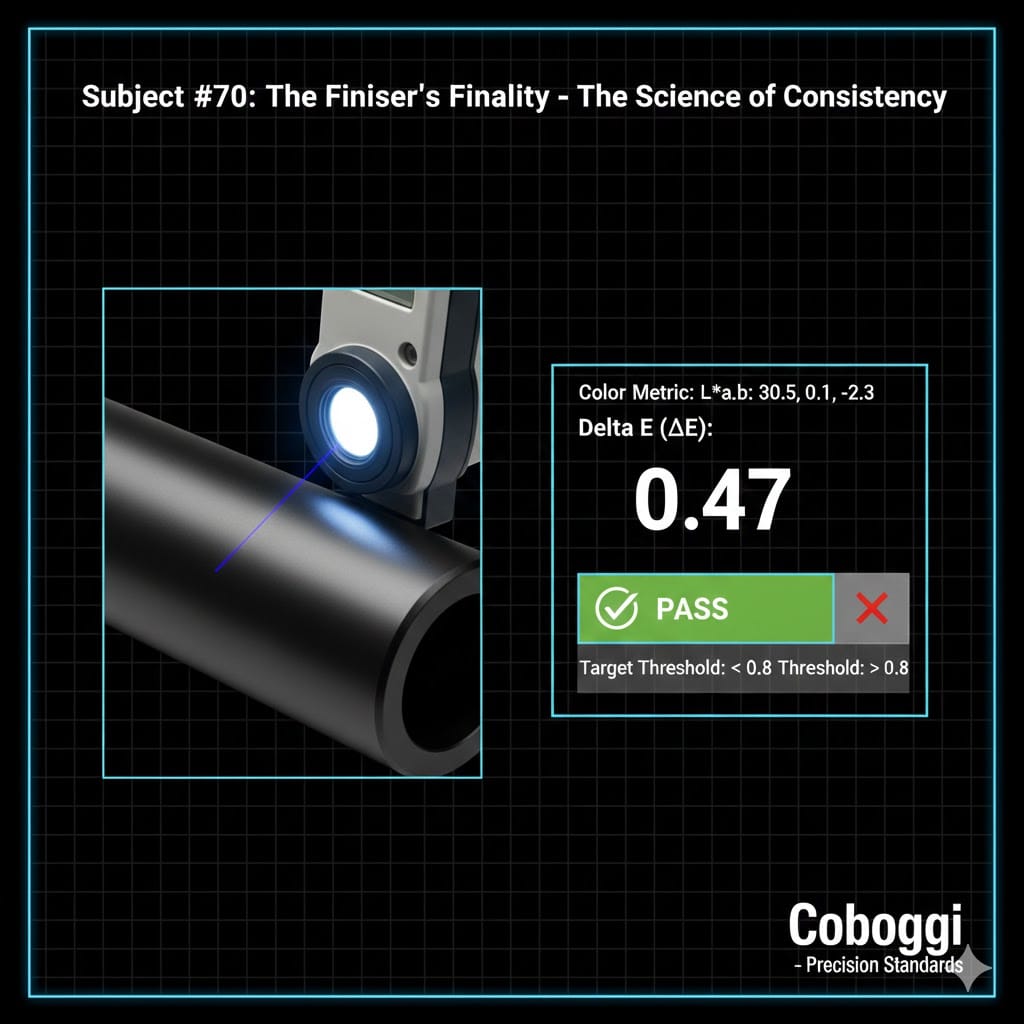
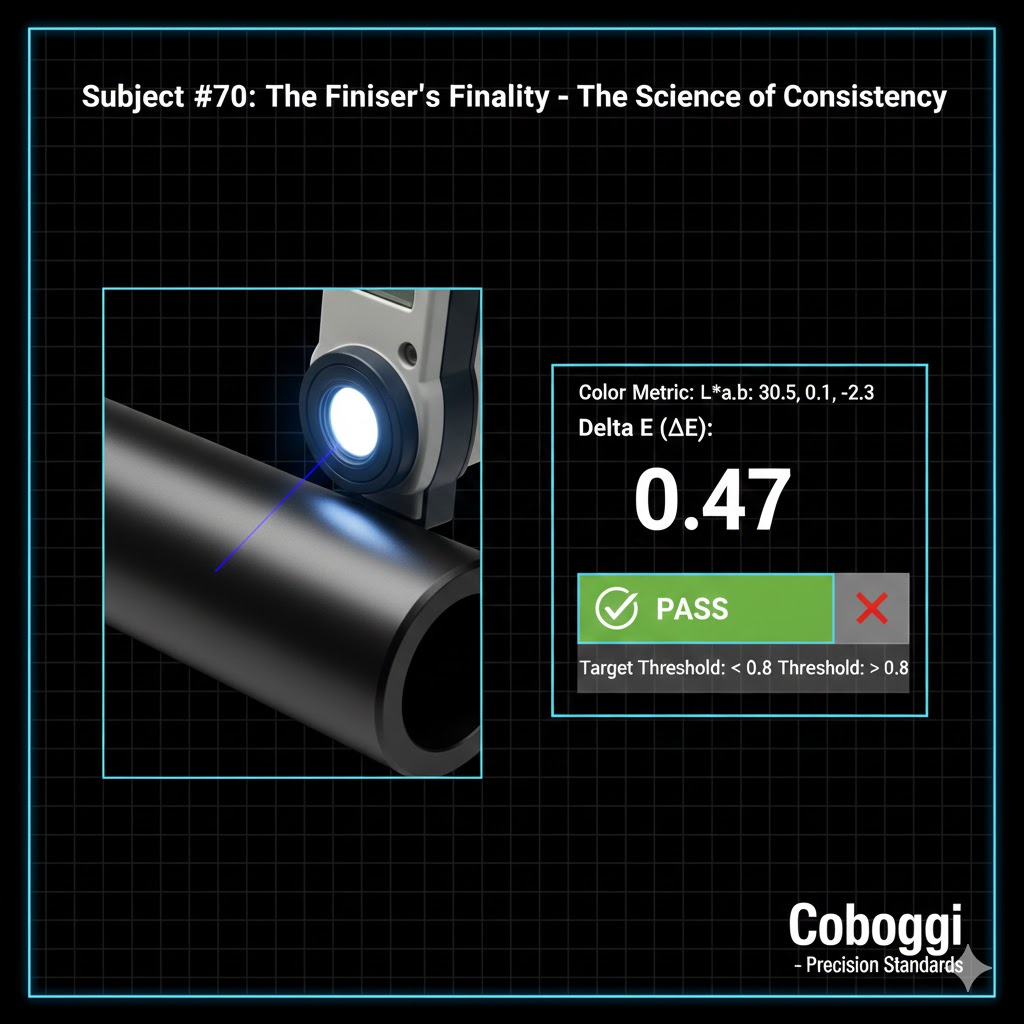
Human eyes are good, but they are subjective. To maintain Coboggi standards, we use Spectrophotometers to measure color mathematically.
The Metric: We track the Delta E (ΔE) value. A ΔE of less than 1.0 is generally considered imperceptible to the human eye.
The Strategy: We calibrate our anodizing baths to stay within a Δ E < 0.8 range, ensuring that your Home Goods look identical even under the harsh, consistent lighting of a retail shelf.
3. Racking and Current Density
The way parts are “racked” (attached to the electrical lead) inside the anodizing tank affects how they take on color.
The Precision: If parts are too close together, the electrical current won’t be uniform, leading to “shadowing” or uneven dye absorption.
The Execution: We design custom CNC-machined titanium racks for every product. This ensures that the current flows identically to every surface of your Personal Care device, from the tight corners to the flat faces.
4. Post-Anodize Sealing
The “Finality” of a finish is determined by the seal. If the pores of the aluminum aren’t closed correctly, the color can fade or shift when exposed to the oils and chemicals found in bathroom environments.
The Tech: We use high-temperature nickel acetate or hydrothermal sealing to lock the dye in.
The Result: A finish that is chemically inert and UV-stable, ensuring the product looks as good in five years as it did on day one.
Conclusion: One Brand, One Vision
In mass production, the “last mile” is the most difficult. By applying scientific measurement and custom racking to the finishing process, Coboggi removes the guesswork.
We ensure that your brand remains visually cohesive, reinforcing the sense of quality and reliability that your customers expect.
Specification Comparison
| Specification | Batch-Processed Anodising | Inline Continuous Anodising | Coboggi Precision Electrolytic Finishing (CPEF) |
|---|---|---|---|
| Thickness tolerance (±µm) | ±3.5 | ±2.0 | ±0.8 |
| Surface roughness Ra (µm) | 0.45–0.65 | 0.30–0.42 | 0.18–0.24 |
| Colour deviation (ΔE*cmc) | ≤2.1 | ≤1.4 | ≤0.6 |
| Coating weight variation (% RSD) | 4.7% | 2.3% | 0.9% |
| Edge coverage at 0.2 mm radius (µm) | 8.2 | 10.6 | 12.4 |
| Inter-batch gloss variance (GU @ 60°) | ±5.8 | ±3.1 | ±1.2 |
| Process temperature stability (°C) | ±1.9 | ±0.7 | ±0.2 |
| Electrolyte conductivity control (mS/cm) | ±4.3 | ±1.6 | ±0.4 |
Frequently Asked Questions
What tolerance range does Coboggi guarantee for colour ΔE variation across a single production run of architectural extrusions?
We guarantee a maximum colour consistency of ΔE ≤ 0.8 (CIEDE2000) across all batches in a single order—measured under D65 lighting at 10° observer angle using X-Rite i7 spectrophotometers calibrated daily.
How many consecutive anodising cycles can your Type II Class I anodised finish withstand without exceeding 5% gloss deviation (60° angle)?
Our certified Type II Class I anodised finish maintains gloss stability within ±5% (60° specular gloss) for up to 1,250 thermal cycling cycles (−40°C to +80°C, 2-hour ramp rate).
What is the minimum film thickness Coboggi guarantees for architectural-grade powder-coated aluminium with TGIC polyester resin?
We guarantee a minimum average film thickness of 65 µm (±5 µm) across all critical surfaces, verified per ISO 2808:2019 using Elcometer 456 magnetic induction gauges calibrated to NIST traceable standards.
How long does Coboggi’s accelerated weathering test (QUV-B UV exposure) run before declaring a finish compliant with AAMA 2604–15?
Our AAMA 2604–15-compliant finishes pass 4,000 hours of QUV-B exposure (UVA-340 lamps, 0.89 W/m² @ 340 nm), with no chalking > Grade 8 (ASTM D4214), no colour shift > ΔE 5.0, and zero blistering per ASTM D714.
What is the maximum allowable edge coverage deviation for electrocoated primers on complex-profile extrusions?
Our e-coat process achieves ≥92% edge coverage on radii ≤ 0.5 mm—verified by cross-section SEM-EDS analysis per ISO 1519–2:2022, with 100% of sampled edges meeting this threshold.
How many distinct RAL or BS EN 13843 colour standards does Coboggi hold physical master samples for, and how often are they recertified?
We maintain 1,280+ certified physical master samples (gloss-matched, substrate-matched, and lightfastness-validated), each recertified every 18 months against ISO 13655:2017 spectral reference standards.