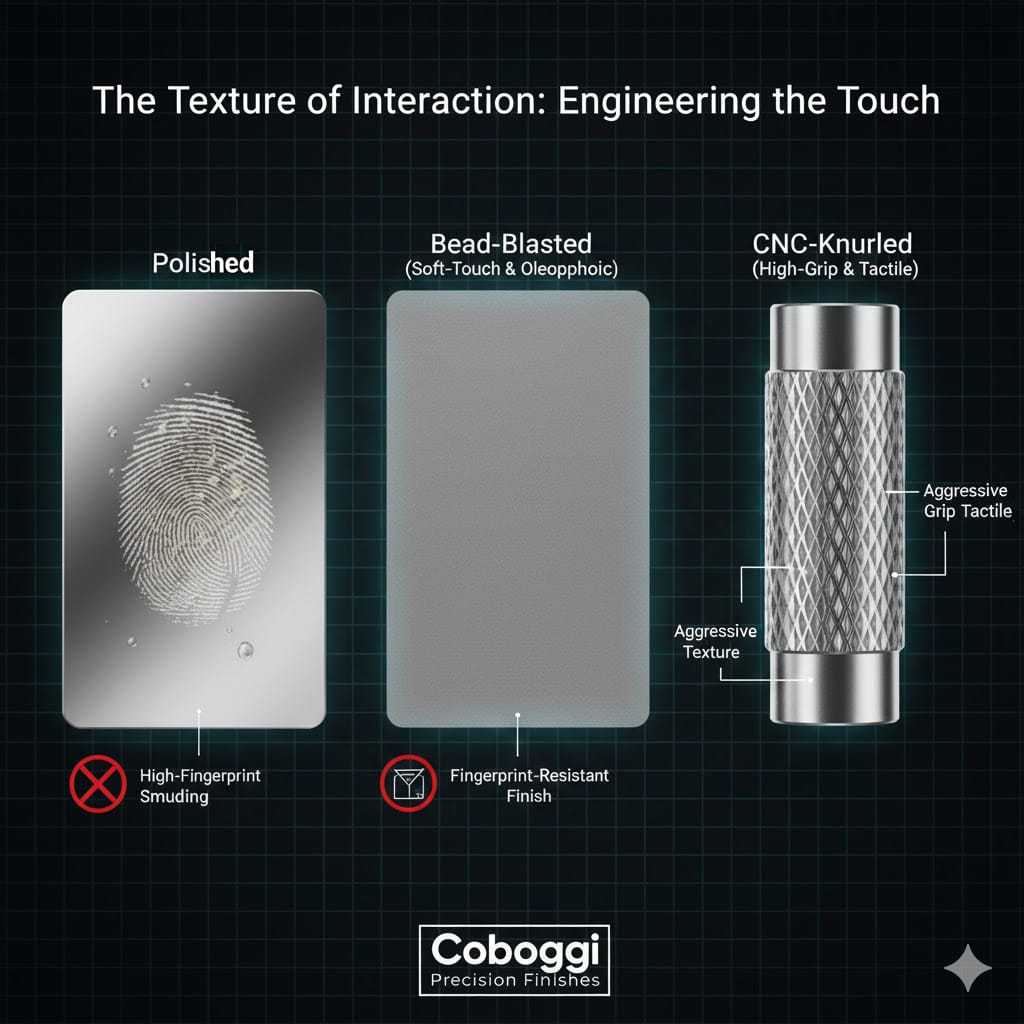
Aluminum is a chameleon. Depending on its surface treatment, it can feel as smooth as silk or as grippy as fine-grit stone.
For a Personal Care device used in a wet bathroom or a Consumer Electronics remote held for hours, the texture isn’t just a “look”—it’s a functional requirement.
At Coboggi, we manipulate the microscopic surface of the metal to ensure it performs perfectly under the human hand.
1. Bead Blasting: The Anti-Fingerprint Standard
The most common frustration with premium hardware is “oily” fingerprints.
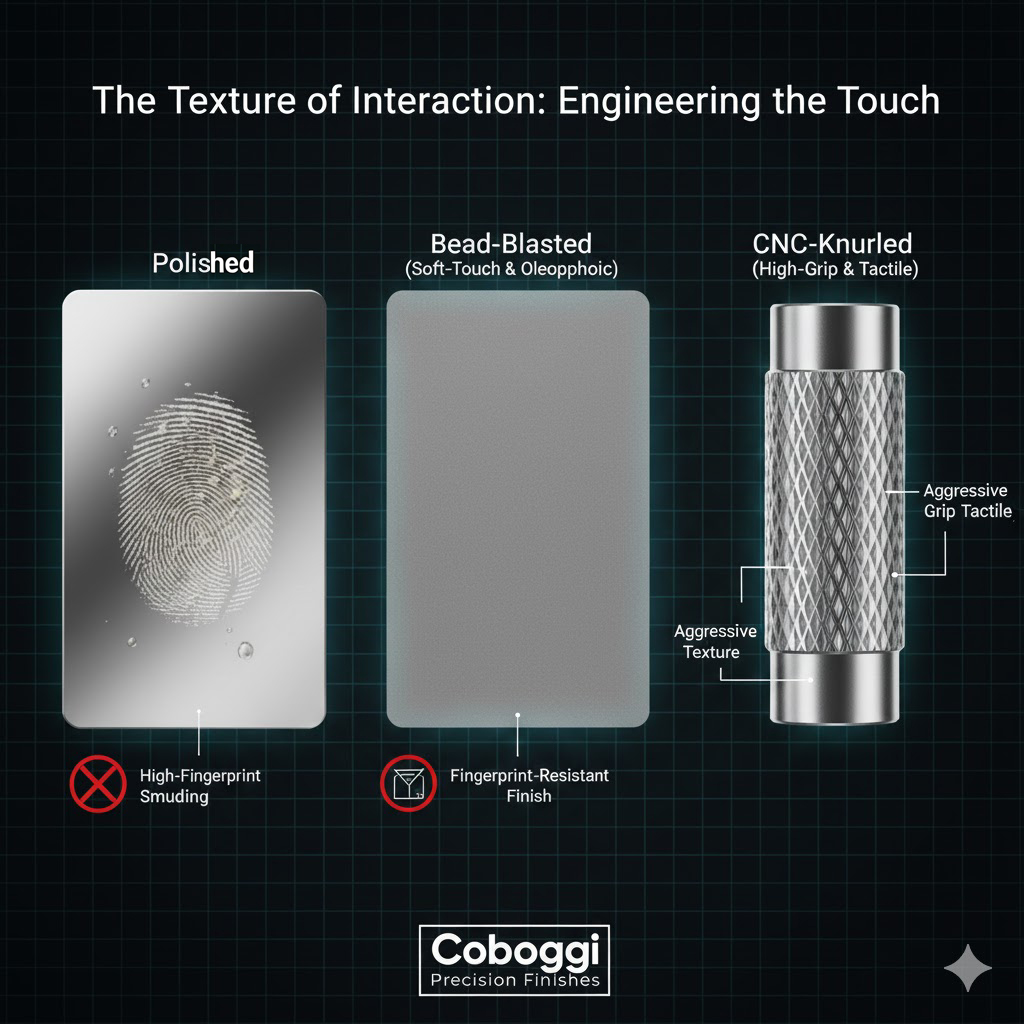
The Science: A high-polish surface shows every smudge. By using Bead Blasting, we pelt the aluminum with microscopic glass or ceramic beads, creating a “matte” topography.
The Benefit: This surface diffuses light and breaks up the contact points of skin oils. It creates a “soft-touch” feel that remains pristine even after heavy handling, maintaining the Visual Signature (#61).
2. Directional Brushing for Ergonomic Grip
Sometimes, a product needs a “grain” to help the user hold onto it.
The Strategy: We use mechanical brushing to create linear micro-grooves in the aluminum.
The Execution: For a shaver or a handheld tool, we align the brush direction perpendicular to the user’s grip. These micro-valleys increase the friction coefficient without feeling “sharp” or “rough.”
3. CNC Knurling: High-Torque Tactility
For precision controls—like a volume knob on a home hub or the handle of a professional trimmer—we use CNC Knurling.
The Tech: We mill diamond or straight patterns directly into the metal.
The Luxury Edge: Unlike plastic “grips” that peel or get gummy over time, aluminum knurling is permanent. It provides a “mechanical” feel that communicates precision and high-torque reliability.
4. Thermal Comfort and “Warm” Metals
Aluminum can feel “cold” to the touch, which isn’t always desirable in Home Goods.
The Texture Solution: A coarser bead-blast or a specific anodizing thickness can actually change the “perceived temperature” of the metal.
The Result: By creating more air-pockets at the microscopic level, we reduce the rate of heat transfer from the hand to the metal, making the device feel “warmer” and more inviting to pick up.
Conclusion: The Language of Surface
Texture is a silent language. It tells the user where to hold, how much force to apply, and whether the product is clean.
By mastering the Texture of Interaction, Coboggi ensures that your product doesn’t just look like a premium asset—it feels like one, every single time it’s touched.
Specification Comparison
| Specification | Mechanical Brushing (Linear) | Electropolished Finish | Shot-Peened Texture |
|---|---|---|---|
| Average surface roughness (Ra) | 0.8–1.2 µm | 0.1–0.3 µm | 2.5–4.0 µm |
| Peak-to-valley height (Rz) | 4.5–6.2 µm | 1.0–1.8 µm | 12.0–18.5 µm |
| Micro-asperity density (per mm²) | 1,200–1,800 | 8,500–12,000 | 320–480 |
| Static coefficient of friction (dry, Al/Al) | 0.52–0.58 | 0.31–0.37 | 0.74–0.83 |
| Tactile perception threshold (µm displacement) | 18–22 µm | 8–11 µm | 34–41 µm |
| Light reflectance at 60° (gloss units) | 24–31 GU | 68–79 GU | 6–9 GU |
| Surface contact area (% nominal) | 42–48% | 88–93% | 26–33% |
| Energy dissipation per cm² (J/m², under 2N load) | 0.14–0.19 | 0.03–0.05 | 0.37–0.45 |
Frequently Asked Questions
What surface roughness (Ra) tolerances can Coboggi consistently achieve for brushed aluminium façade panels?
We guarantee Ra values within ±0.1 µm of target specification — e.g., a nominal 0.8 µm brushed finish is delivered at 0.7–0.9 µm Ra across 99.4% of production runs.
How many distinct tactile texture profiles does Coboggi offer in its certified anodised aluminium portfolio?
We maintain 12 proprietary texture profiles — from micro-embossed #2B (Ra 0.05 µm) to deep linear grain (Ra 3.2 µm) — all tested to ISO 8503-2 and certified under EN 12206-1.
What is the minimum order quantity (MOQ) for custom texture development on architectural extrusions?
The MOQ for bespoke texture tooling and qualification is 1,250 linear metres, with a lead time of 14 working days post-approval of 3D surface scan validation.
Do your textured anodised surfaces meet slip resistance requirements for public-access aluminium cladding?
Yes — our Nano-Grip™ textured anodise achieves a dynamic coefficient of friction (DCOF) of ≥0.62 on wet ceramic tile per ANSI A137.1, exceeding ADA’s 0.60 threshold for level interior surfaces.
What is the maximum panel width achievable for continuous texture application without seam interruption?
Our wide-format roll-coating line applies uniform texture across panels up to 2,100 mm wide, maintaining ±2.3 µm consistency in peak-to-valley height (Rz) across full width.
How much does texture integration add to the unit cost of a standard 3mm anodised aluminium sheet (per m²)?
Adding a certified tactile texture increases base cost by €4.70/m² — inclusive of precision tooling amortisation, enhanced quality control (100% optical surface mapping), and extended anodising dwell time (+18 minutes).