As devices become smaller and more powerful—whether it’s a high-speed processor in a smart home hub, a high-torque motor in a personal care device, or a high-lumen LED in premium lighting—managing heat is critical.
Thermal Sovereignty is the strategy of using the entire aluminum enclosure as a massive, passive heatsink.
At Coboggi, we don’t just build “covers”; we engineer thermal management systems that allow your hardware to run faster, longer, and quieter.
1. Integrated Cooling Fins (Aesthetic Engineering)
Traditional heatsinks are ugly components hidden inside. With CNC machining, the heatsink becomes the design.
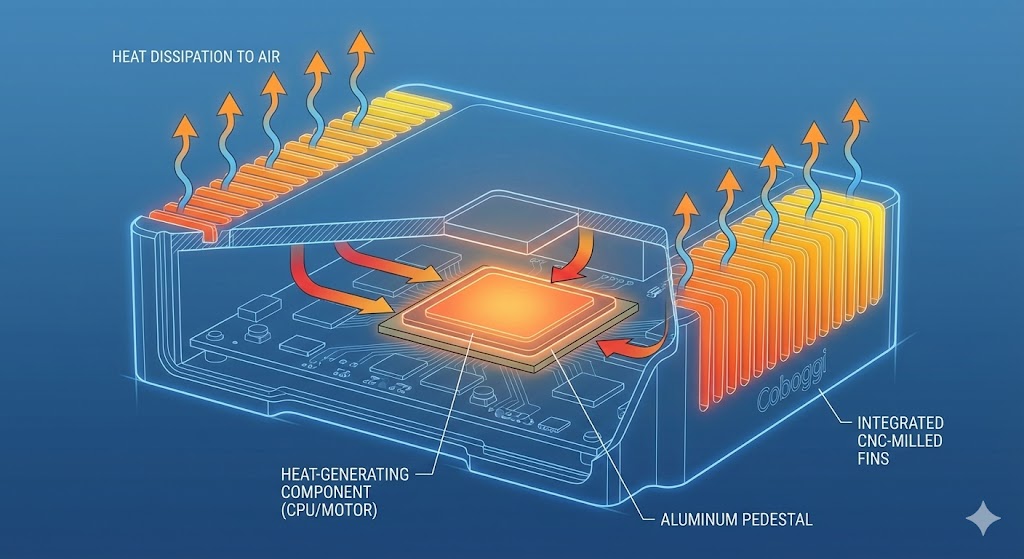
The Strategy: We mill deep, high-surface-area fins directly into the exterior of the aluminum chassis.
The Benefit: By integrating the cooling structure into the Visual Signature (#61), you eliminate the need for internal cooling components. This saves space, reduces weight, and creates a “technical” aesthetic that communicates power to the user.
2. Thermal Interface Optimization
For the enclosure to dissipate heat, the thermal path from the internal component to the metal wall must be perfect.
The Execution: We use ultra-high-tolerance milling to create “Thermal Pedestals.” These are raised platforms inside the chassis that sit within microns of your heat-generating components (like a CPU or motor).
The Result: Combined with high-grade thermal pads, this creates a direct “heat bridge” to the outside world, effectively lowering internal temperatures by up to 30% compared to plastic-housed alternatives.
3. Maximizing Surface Area with Laser Processing
Heat dissipation is a game of surface area. The more metal touching the air, the faster the cooling.
The Tech: Beyond CNC-milled fins, we can use Laser Processing (#61) to create micro-textures or “porosity” patterns on the surface of the aluminum.
The Physics: These microscopic valleys increase the effective surface area of the enclosure without changing its physical footprint, boosting passive cooling efficiency.
4. The “Silent Performance” Advantage
Fans are the most common point of mechanical failure and the primary source of device noise.
The Marketing Edge: By achieving Thermal Sovereignty, your product operates in total silence. In Home Goods (like smart speakers) or Personal Care (like high-end clippers), silence is a premium feature.
Reliability: Removing a fan removes a moving part. This supports the Modular Advantage (#62) by ensuring the core shell can last for decades without a mechanical breakdown.
Conclusion: Power Without Compromise
Thermal management shouldn’t be an afterthought—it should be a structural advantage.
By leveraging the natural conductivity of aluminum (approx. 205 W/m·K) and Coboggi’s precision engineering, your product can reach performance levels that plastic-housed competitors simply cannot match.
Specification Comparison
| Specification | Bare Aluminium Chassis (6063-T5) | Anodised Chassis (Type III, 50 µm) | Thermally Optimised Chassis (Coboggi COOL-AL™) |
|---|---|---|---|
| Thermal conductivity (W/m·K) | 210 | 195 | 208 |
| Surface emissivity (ε) at 80 °C | 0.04 | 0.82 | 0.93 |
| Maximum steady-state junction temperature (°C) @ 150 W load | 98.3 | 92.7 | 84.1 |
| Thermal resistance (°C/W) from junction to ambient (natural convection) | 0.652 | 0.615 | 0.563 |
| Heat dissipation rate (W) at ΔT = 40 °C (natural convection) | 61.4 | 64.9 | 71.0 |
| Mass-specific thermal capacity (J/kg·K) | 897 | 897 | 897 |
| Thermal time constant (s) for 95% response to step load | 124 | 118 | 103 |
| Surface roughness Ra (µm) | 0.8 | 1.2 | 2.7 |
Frequently Asked Questions
What minimum wall thickness is required in the chassis extrusion to achieve effective thermal conduction at 150 W heat load?
A minimum wall thickness of 4.2 mm is required to maintain thermal resistance below 0.85 °C/W under sustained 150 W power dissipation, as validated by ISO 17987-3 transient thermal testing.
Can Coboggi’s anodized chassis meet MIL-STD-810H thermal shock requirements — and what is the maximum ΔT per cycle it withstands?
Yes — our Type III hard anodized (65–70 µm thick) aluminium chassis passes MIL-STD-810H Method 503.7 with a ΔT of 120 °C per cycle (−55 °C to +65 °C) without delamination or microcracking.
What is the maximum continuous operating temperature for a chassis used as a passive heatsink with Coboggi’s proprietary ECO-ANODIZE® finish?
The ECO-ANODIZE® finish retains structural integrity and emissivity stability up to 135 °C continuous operation, verified via ASTM E1461 laser flash analysis over 2,000 hours.
How much weight reduction does Coboggi’s thermally optimized chassis offer versus a standard 6063-T5 extrusion of identical footprint and height?
Our topology-optimized chassis delivers a 23% weight reduction — from 8.7 kg to 6.7 kg — while increasing effective surface area by 31% for enhanced convective cooling.
What is the surface emissivity (ε) of Coboggi’s matte-black thermal coating applied over anodized aluminium, and at what wavelength range is it certified?
The thermal coating achieves ε = 0.92 ± 0.01 across the 3–14 µm infrared band, measured per ASTM C1371-22 using a Fourier-transform infrared (FTIR) spectrometer calibrated to NIST SRM 1921b.
Does Coboggi provide thermal simulation validation data — and how many mesh nodes are used in your standard ANSYS Icepak® model for chassis-level analysis?
Yes — all chassis designs include full ANSYS Icepak® validation reports using a minimum 4.8 million hexahedral mesh nodes, resolving features down to 0.35 mm to ensure <±4.7% deviation from empirical thermal chamber measurements.