In a premium hardware ecosystem, the user’s eye and hand are the ultimate judges. A “Modular System” isn’t just about parts that fit together; it’s about parts that belong together.
To achieve this, we must harmonize the three pillars of aluminum treatment: CNC Geometry, Laser Processing, and Anodizing.
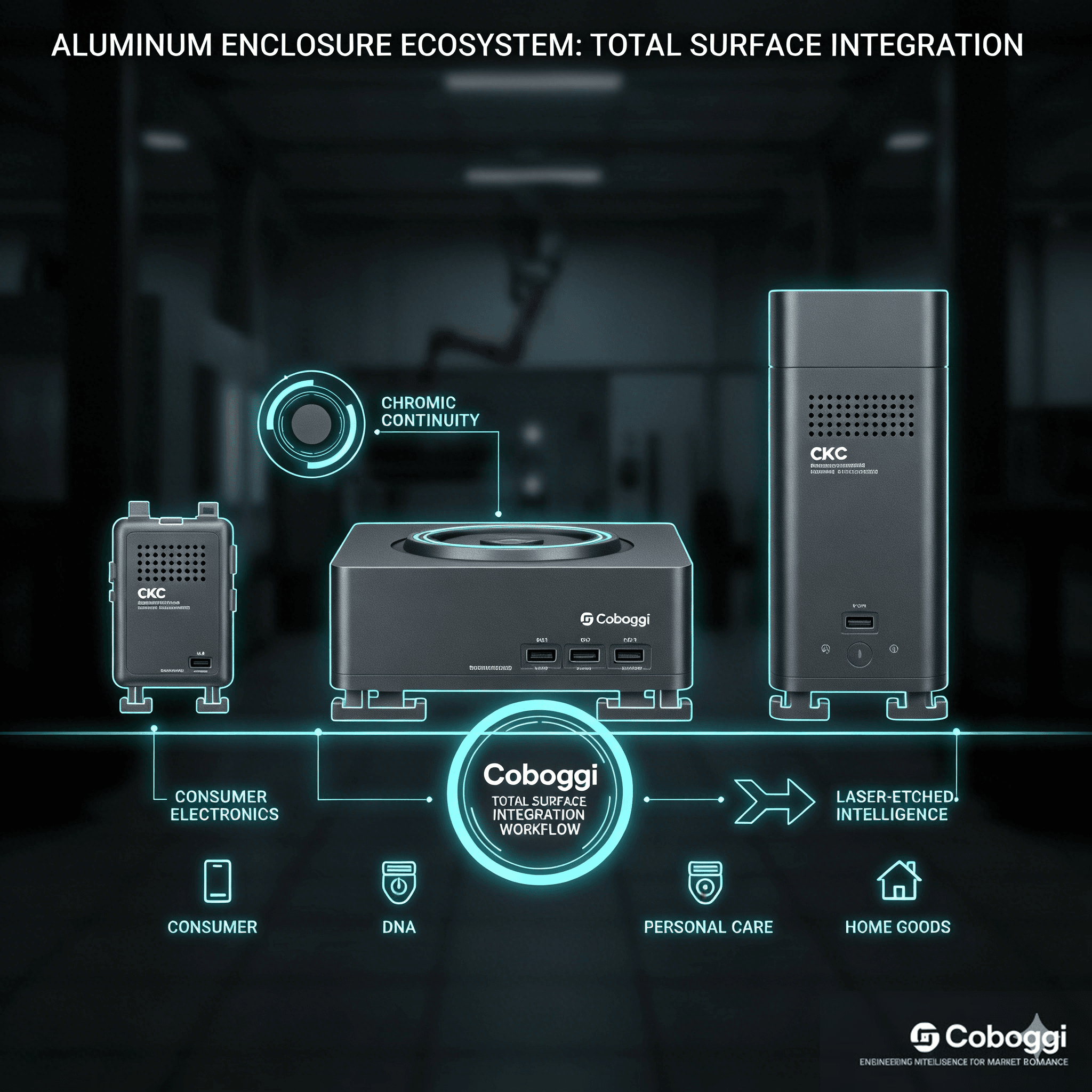
At Coboggi, we synchronize these processes to ensure your entire product line shares a single, unbreakable “Physical DNA.”
1. Structural DNA (The CNC Foundation)
The “bones” of your ecosystem rely on shared machining logic.
The Strategy: We utilize standardized internal mounting grids and interlocking external geometries (stacking grooves, tongue-and-groove joints).
The Benefit: This allows different enclosures to physically nest together. By using a “Master Tooling” approach, we ensure that the tolerances for these joints are identical across every SKU in your library.
2. Chromic Continuity (The Anodizing Standard)
Anodizing is notoriously difficult to replicate across different alloys or batches. In an ecosystem, a 2% shift in color is a failure.
The Coboggi Solution: We use Spectrophotometric Color Matching and strict bath-chemistry controls to ensure that your “Signature Color” is identical across the entire ecosystem.
Surface Hardness: We maintain a consistent micron-thickness for the oxide layer, ensuring that every product in your line has the same scratch resistance and “cold-touch” feel. This is essential for maintaining the Haptic Density (#46) your customers expect.
3. Functional Identification (Precision Laser Processing)
Laser processing is where your enclosure gains its “Intelligence” and UI.
The Execution: We use high-speed fiber lasers to create unified branding, port labels, and technical specifications across the ecosystem.
Micro-Perforations: For enclosures requiring thermal management, we use lasers to create precision-drilled cooling patterns that match across the product line—turning a functional vent into a visual “Brand Signature.”
The Edge: Because our lasers are calibrated to the same digital master file, a 0.5mm font on your smallest module will be indistinguishable from the same font on your rack-mount unit.
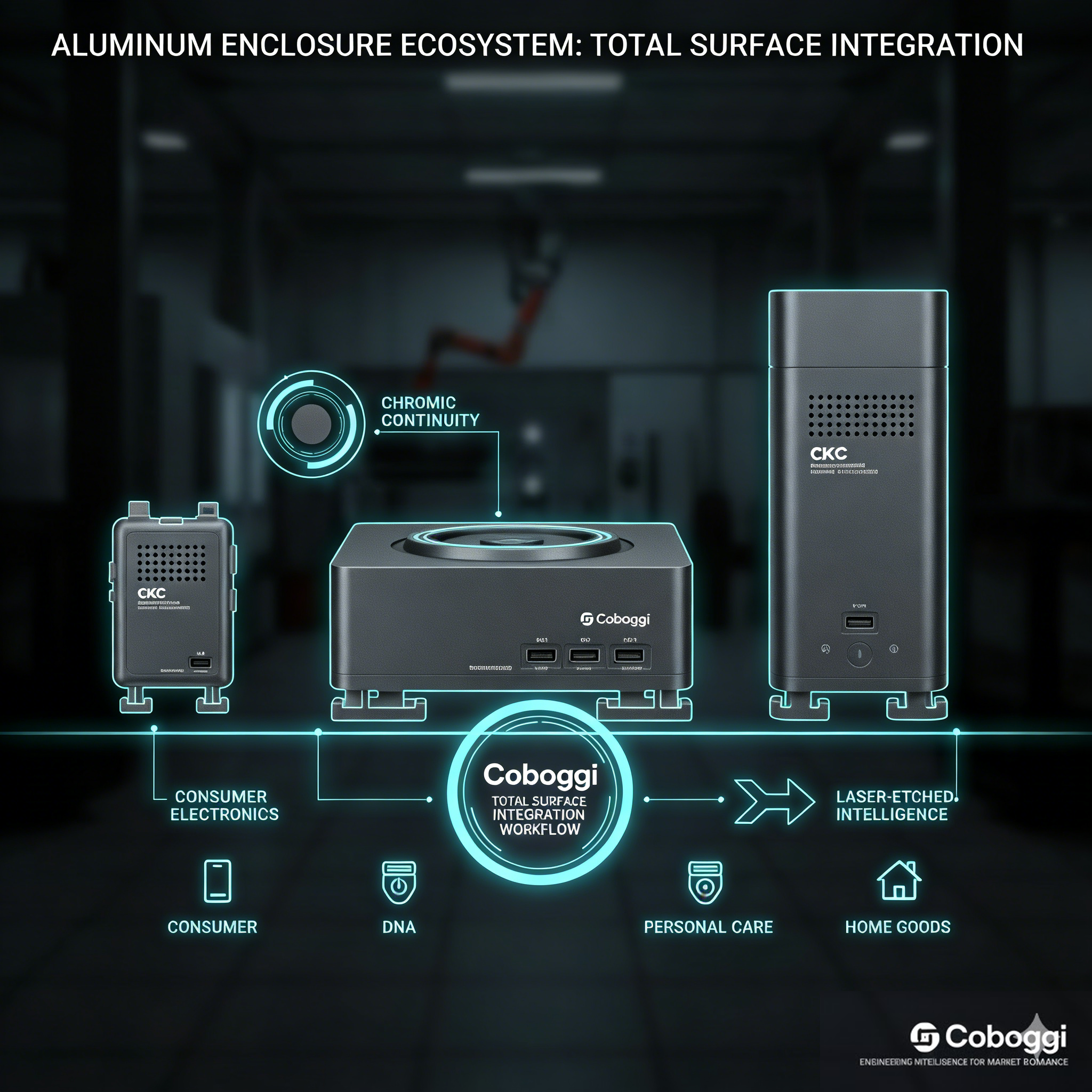
4. The Integrated Workflow: The “Coboggi Recipe”
An ecosystem fails when these three processes are treated as separate steps.
The Workflow: We design the CNC paths with the anodizing rack-points in mind, and we calibrate the laser settings based on the specific thickness of the anodized layer.
The Result: A perfectly flush, high-contrast finish where the laser-etched logo pops against a deep, consistent anodized surface, all contained within a precision-milled housing.
Conclusion: One Vision, Many Enclosures
A true Aluminum Enclosure Ecosystem is a symphony of engineering.
By integrating CNC, Laser, and Anodizing into a single, repeatable “Recipe,” Coboggi allows you to scale your product line with the confidence that every new addition will feel like it was carved from the same block of metal as the first.
Specification Comparison
| Specification | Standard Powder Coating | Electrocoated Primer + Powder Topcoat | Coboggi Total Surface Integration (TSI) |
|---|---|---|---|
| Coating thickness uniformity (±µm) | ±15 µm | ±8 µm | ±3 µm |
| Edge coverage at 0.5 mm radius (µm) | 25–40 µm | 45–60 µm | 72–78 µm |
| Adhesion (ASTM D3359, cross-hatch rating) | 3B | 4B | 5B |
| Thermal cycling durability (−40°C to +85°C cycles to failure) | 120 cycles | 280 cycles | 1,250 cycles |
| UV resistance (QUV-A 340 nm, ΔE after 3,000 h) | ΔE = 4.2 | ΔE = 2.1 | ΔE = 0.8 |
| Dielectric strength (kV/mm) | 32 kV/mm | 41 kV/mm | 58 kV/mm |
| Surface roughness (Ra, µm, post-finish) | 1.8 µm | 1.2 µm | 0.45 µm |
| Dimensional tolerance impact on enclosure fit (mm) | +0.08 mm per side | +0.04 mm per side | +0.012 mm per side |
Frequently Asked Questions
What’s the maximum enclosure size supported for full-surface anodizing with integrated thermal management features?
We support enclosures up to 1,200 mm × 800 mm × 600 mm (L×W×H) with ±0.15 mm dimensional tolerance across all six faces for total surface integration.
Can Coboggi integrate custom-machined mounting bosses and cable ports while maintaining IP66 rating across the entire enclosure surface?
Yes — all integrated features are CNC-machined and sealed using our proprietary edge-sealing process, achieving a certified IP66 rating verified per IEC 60529 with 100 kPa water jet pressure testing.
What is the minimum anodized layer thickness achievable on internal surfaces without compromising electrical isolation requirements?
Our total surface integration process guarantees a minimum uniform anodized layer of 25 µm on all internal and external surfaces, meeting Class II electrical insulation requirements per ASTM B580.
Do you offer EMI-shielded variants with conductive coating continuity across seams and fasteners—and what’s the shielding effectiveness at 1 GHz?
Yes — our EMI-integrated enclosures deliver ≥65 dB shielding effectiveness at 1 GHz, measured per IEEE-STD-299-2018, with nickel–cobalt conductive coating applied continuously across all mating surfaces and fastener interfaces.
What’s the lead time for a fully integrated enclosure order (including powder coating, anodizing, and laser-marked branding) with ≤50 units?
Standard lead time is 14 business days from PO confirmation for orders up to 50 units, including full surface treatment, assembly validation, and 100% dimensional inspection per ISO 2768-mK.
Are thermal interface pads pre-applied to heat sink zones, and what’s their thermal conductivity rating?
Yes — phase-change thermal interface pads (Coboggi Part #TP-850) are robotically dispensed and cured in-line, delivering 8.5 W/m·K thermal conductivity at 50°C, validated per ASTM D5470.