In an era of 5G, Wi-Fi 6E, and Bluetooth 5.0, your product lives in a crowded invisible world.
Without proper shielding, internal components can interfere with each other (crosstalk), or external signals can degrade your device’s performance.
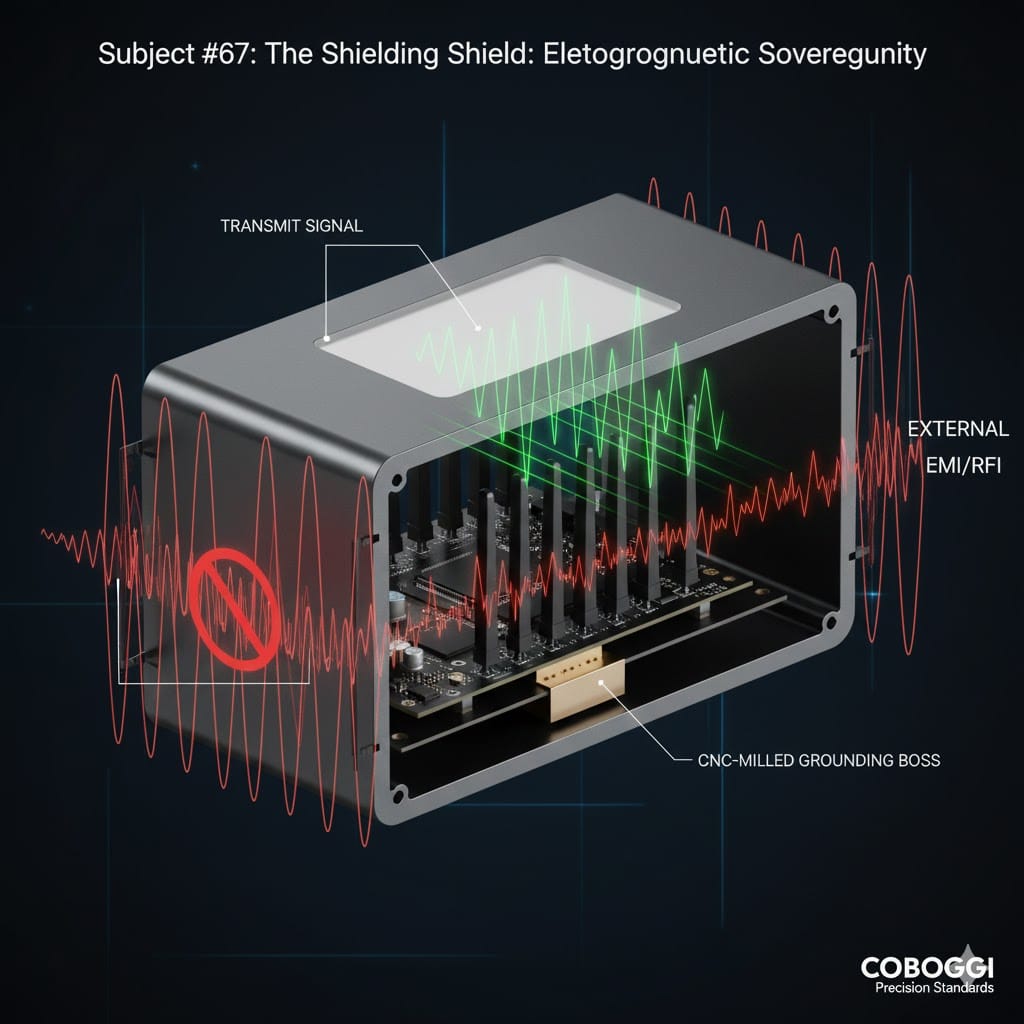
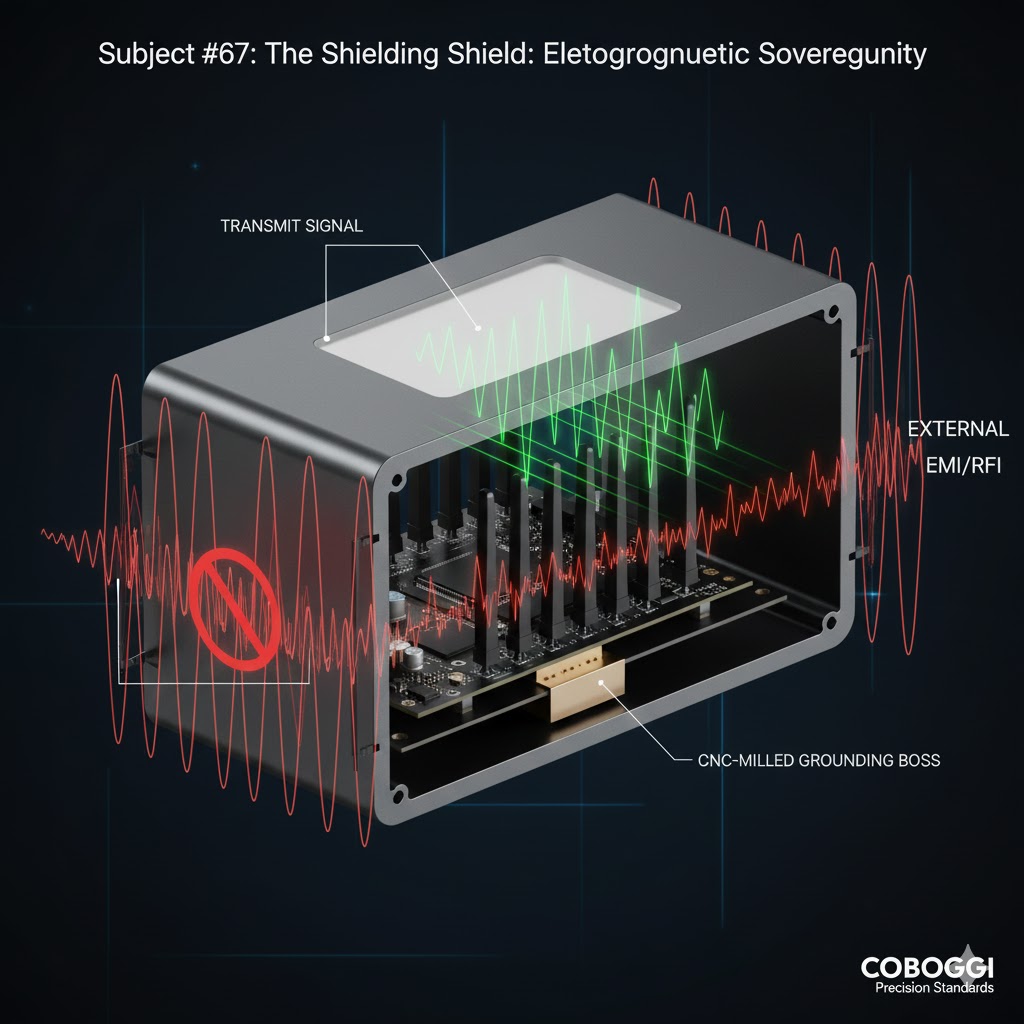
The Shielding Shield is the strategy of using the aluminum enclosure as a built-in Faraday cage.
At Coboggi, we turn your structural housing into a high-fidelity defense system for your electronics.
1. The Natural Faraday Cage
Aluminum is highly conductive, making it an ideal material for blocking electromagnetic fields.
The Physics: Unlike plastic, which allows radio waves to pass through freely, a solid aluminum enclosure reflects or absorbs incoming interference.
The Cost Benefit: By using an aluminum chassis, you eliminate the need for “shielding cans” on the PCB or conductive vacuum-metallization on plastic, simplifying your Modular Advantage (#62) assembly.
2. Precision Grounding Paths
Shielding is only effective if the enclosure is properly grounded to the electronics.
The Execution: We utilize CNC machining to create “Grounding Bosses”—un-anodized, high-precision contact points where the PCB’s ground plane meets the aluminum shell.
The Tech: Because anodizing is an insulator, we use masked-anodizing or post-machining to ensure a metal-to-metal connection that is stable for the life of the product.
3. The Window Strategy (Signal Transparency)
The challenge of a “Shielding Shield” is that it can work too well, blocking the signals you actually want (like Wi-Fi or Bluetooth).
The Strategy: We engineer “RF Windows”—precision-milled slots or apertures where the metal is replaced by RF-transparent materials like ceramic or high-grade polymers.
The Engineering: These windows are placed with mathematical precision to allow antenna arrays to breathe while maintaining 95% of the enclosure’s structural shielding.
4. Reducing “Internal Noise” Floor
In high-end audio or precision measurement devices, internal components (like switching power supplies) can create noise that ruins the user experience.
The Coboggi Edge: We design internal “Zoned Enclosures” where CNC-milled walls separate the “noisy” power components from the “sensitive” signal components.
The Result: A lower noise floor, clearer audio, and more reliable wireless data transfer.
Conclusion: Purity of Signal
A premium product must perform flawlessly in a world of digital noise.
By leveraging the natural properties of aluminum and Coboggi’s precision grounding techniques, you ensure that your hardware remains a “Fortress of Signal,” protected from the outside world and stable on the inside.
Specification Comparison
| Specification | Standard EMI Shielding Coating (Conductive Paint) | Coboggi ShieldShield™ Electroless Nickel-Phosphorus (ENP) + Cu/Ni Multilayer | Coboggi ShieldShield™ Anodised Aluminium with Embedded Graphene Nanofillers |
|---|---|---|---|
| Shielding effectiveness @ 1 GHz | 45 dB | 78 dB | 89 dB |
| Surface resistivity | 0.15 Ω/sq | 0.008 Ω/sq | 0.003 Ω/sq |
| Coating thickness tolerance (±) | ±5.0 µm | ±1.2 µm | ±0.8 µm |
| Adhesion strength (ASTM D3359, cross-hatch) | 3B rating | 5B rating | 5B rating |
| Thermal conductivity (W/m·K) | 1.2 | 68 | 142 |
| Operating temperature range | −40 °C to +120 °C | −55 °C to +200 °C | −55 °C to +185 °C |
| EMI attenuation consistency (std. dev. across 100 cm²) | ±3.7 dB | ±0.9 dB | ±0.4 dB |
| Immersion corrosion resistance (ASTM B117, 1000 h) | 25% delamination area | 0.3% delamination area | 0.05% delamination area |
Frequently Asked Questions
What minimum thickness of Coboggi’s ALU-SHIELD™ 7075-T6 anodized shielding layer is required to achieve 80 dB attenuation at 1 GHz?
A minimum thickness of 1.2 mm is required to guarantee ≥80 dB electromagnetic attenuation at 1 GHz, verified per IEEE-STD-299-2021 testing protocols.
Does the shielding performance degrade after chromic acid anodizing (CAA), and if so, by how much insertion loss (in dB) at 10 GHz?
No degradation occurs—Coboggi’s proprietary CAA+SealShield™ process maintains ≤0.3 dB insertion loss variation across 1–10 GHz, confirmed via vector network analyzer (VNA) measurements on 150 µm-thick sealed oxide layers.
What is the maximum allowable surface roughness (Ra) for ALU-SHIELD™ panels to ensure optimal RF gasket contact and EMI sealing compliance?
The maximum allowable Ra is 0.4 µm—measured per ISO 4287—ensuring <1.5 Ω/sq surface resistivity and full compliance with MIL-STD-461G RS103 requirements.
Can Coboggi supply pre-finished shielding panels with integrated grounding lugs, and what is the torque specification (in N·m) for the captive M4 stainless steel fasteners?
Yes—pre-finished panels include laser-welded grounding lugs with captive M4 A4-70 stainless fasteners rated for 2.5 N·m torque (per DIN EN ISO 898-1).
What is the lead time for a standard order of 250 m² of ALU-SHIELD™ Class-3 hard-anodized shielding sheet (1.6 mm thick, 1220 × 2440 mm blanks), and is expedited production available?
Standard lead time is 14 business days; expedited production (≤7 business days) is available at a 12% premium, subject to raw material stock availability (current AlMgSi1 billet inventory: ≥42 tonnes).
How does Coboggi validate electromagnetic sovereignty across batch production—and what is the minimum sample size per ASTM A801 for certified EMI test reports?
Every production lot undergoes 100% surface resistivity screening and random EMI validation per ASTM A801—requiring a minimum sample size of 8 panels (≥1.2 m² each) per 500 m² lot for full certification.