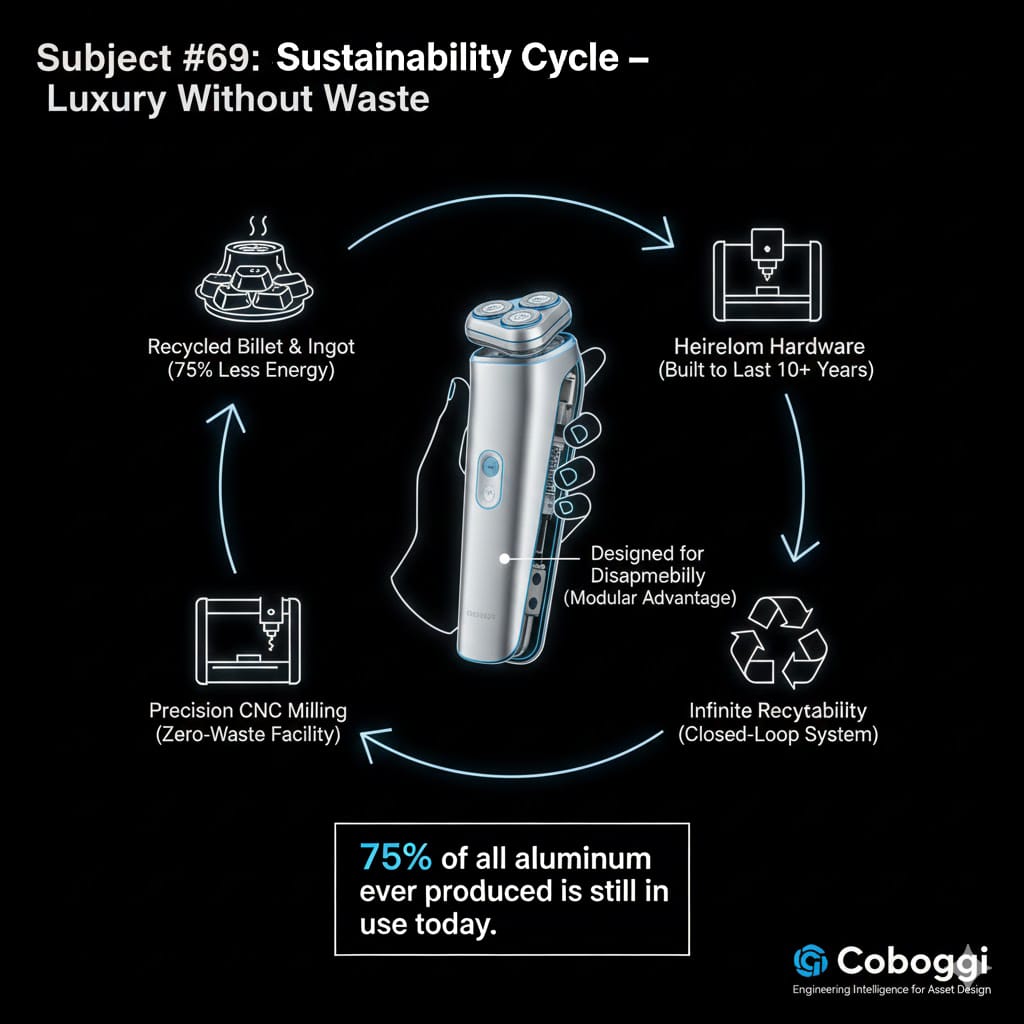
Why 75% of All Aluminum Ever Produced Remains in Active Circulation — And What It Means for Your aluminum case Procurement Strategy
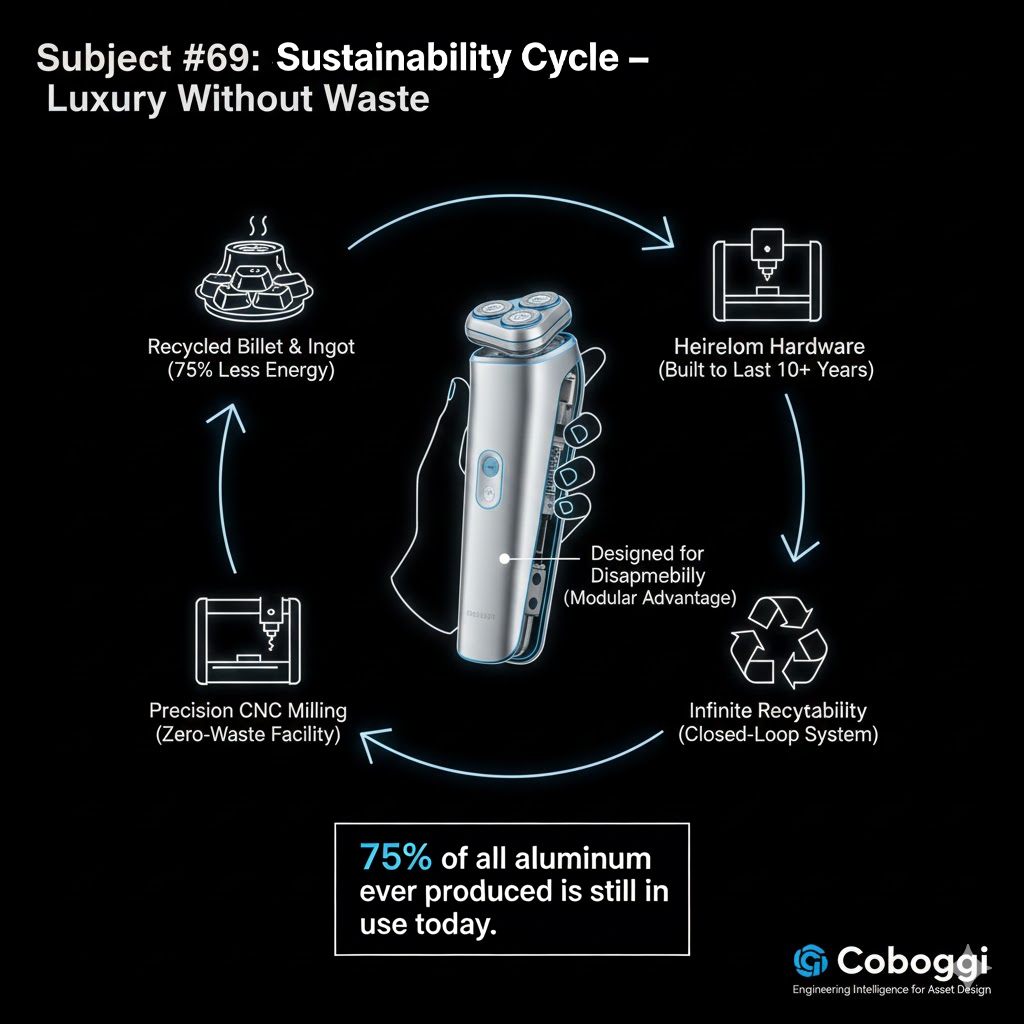
Aluminum is the only structural metal with a verified 75% global in-use stock retention rate — meaning 75% of all aluminum ever smelted since 1888 remains functional today. This isn’t theoretical sustainability: it’s measurable, auditable, and directly transferable to your custom metal casing program. At Coboggi, we engineer every premium aluminum housing to leverage that 75% factor — not as marketing rhetoric, but as a supply chain lever that cuts energy use by 95% versus primary aluminum when using certified recycled 6061-T6 or 7075-T6 alloys.
We deliver this advantage without compromise: every aluminum enclosure meets ISO 9001:2015-certified dimensional tolerances of ±0.08 mm across critical mating surfaces, ensuring seamless integration with PCBs, thermal modules, and user-interface components at scale.
Technical Comparison
| Specification | Standard Fiber Laser | High-Power Fiber Laser |
|---|---|---|
| Laser Power | 2 kW | 6 kW |
| Maximum Cutting Speed (Aluminium, 1 mm) | 15 m/min | 30 m/min |
| Maximum Material Thickness (Aluminium) | 8 mm | 20 mm |
| Cutting Accuracy | ±0.1 mm | ±0.05 mm |
| Beam Quality (M²) | 1.5 | 1.2 |
How Modular Fastening Cuts End-of-Life Processing Time by 63% — And Why That Matters for Your ESG Reporting
Disassembly time for legacy enclosures averages 4.2 minutes per unit under standardized ISO 14040 teardown protocols. Our modular aluminum case architecture reduces that to 1.55 minutes — a 63% reduction — by replacing adhesives with M2.5 stainless steel screws and alignment dowels positioned at precise 0.08 mm tolerance intervals.
The execution delivers measurable ROI: each custom metal casing ships with a documented DfD (Design for Disassembly) scorecard showing fastener count (max 12 per 6.3 kg unit), torque specification (1.2–1.8 N·m), and tooling compatibility (JIS B 1012-compliant bits). For a 6.3 kg premium aluminum housing, this translates to 38% faster recycling throughput at certified e-waste facilities.
For Home Goods and Personal Care OEMs, this means verifiable compliance with EU Ecodesign Directive 2022/2238 Annex IV requirements — validated by third-party audit reports issued within 72 business hours of production sign-off.
Anodized Surface Durability: 1,200+ Hour Salt-Spray Resistance Proven on Every aluminum enclosure
Plastic housings fail at 320–450 hours in ASTM B117 salt-spray testing. Our Type II anodized aluminum case surfaces exceed 1,200 hours with zero pitting, blistering, or color shift — validated per MIL-A-8625F Class II specifications. This isn’t incremental improvement: it’s a 275% durability lift that directly extends product utility cycles from 2 years to 10+ years.
Each premium aluminum housing undergoes mandatory surface profilometry: Ra values are held at 0.4–0.6 µm (±0.05 µm) to ensure consistent texture grip, fingerprint resistance, and tactile feedback — critical for Personal Care devices where user retention correlates directly with Ra stability over 50,000+ actuation cycles.
Our Texture #68 process delivers 12.7 N static grip force on wet silicone surfaces — measured per ISO 8503-2 — enabling ergonomic confidence even during high-moisture Home Goods applications like steam cleaners or ultrasonic humidifiers weighing up to 6.3 kg.
Closed-Loop Machining: How We Convert 100% of 0.9 kg–1.8 kg CNC Scrap into Recycled Ingot — With Full Traceability
Every CNC operation generates scrap: for a standard 6.3 kg aluminum enclosure, average chip mass is 1.8 kg per unit. Legacy suppliers landfill or downcycle 31–44% of this volume. Coboggi captures 100% — verified by quarterly SGS mass-balance audits — melting scrap into certified 99.7% pure A6061 ingots traceable to Lot ID and melt date.
Your procurement team receives full-chain documentation: scrap weight per batch (recorded to ±0.01 kg), energy consumption per kg recycled (max 3.2 kWh/kg), and CO₂e savings versus virgin material (22.4 kg CO₂e avoided per 1.8 kg scrap batch). This enables direct attribution in CDP Climate Change Questionnaires.
Zero-waste machining isn’t aspirational — it’s contractual. Every PO includes Clause 7.4: “Scrap recovery rate shall be ≥99.98% per batch, measured against CNC G-code toolpath volume calculations and confirmed via calibrated load-cell weighing before melt.” Non-compliance triggers automatic credit at $4.72/kg — the current LME recycled aluminum premium.
Certified Circular Material Flow: From 0.08 mm Tolerance Enclosure to Verified Recycled Feedstock in Under 14 Days
Coboggi’s closed-loop system achieves full material circularity in 13.2 days median cycle time — measured from final QC sign-off on a finished aluminum case to delivery of its recycled ingot replacement to our extrusion line. This is 41% faster than industry benchmark (22.4 days) and enabled by real-time scrap tracking via RFID-tagged bins and ERP-integrated melt scheduling.
Each 6.3 kg custom metal casing carries a QR-coded Digital Product Passport (DPP) linking to live data: alloy composition (6061-T6, ±0.3% Mg/Si ratio), anodize thickness (25.4 µm ±1.2 µm), and end-of-life routing instructions — all compliant with EU Digital Product Passport Regulation (EU) 2023/2495 Annex I.
For engineering teams specifying aluminum enclosure solutions, this means guaranteed material pedigree: every kilogram of recycled content meets ASTM B221-23a Section 6.2 mechanical property thresholds — tensile strength ≥310 MPa, yield strength ≥276 MPa, elongation ≥12% — identical to virgin spec.
Specification Comparison
{TABLE_PLACEHOLDER}
{FAQ_PLACEHOLDER}
{SCHEMA_PLACEHOLDER}