In a competitive market, many hardware founders ask: “Why should I spend an extra $0.5 per unit on a premium bead-blast and dual-stage anodizing?”
At Coboggi, we answer that question not with “aesthetics,” but with Economics. The finish of your aluminum housing is the most direct communication your brand has with your customer. It is the difference between a product that is kept for a decade and one that is returned to the store within 24 hours.
1. The “First-Touch” Return Rate
Psychological studies show that “tactile dissonance”—when a product looks expensive in a photo but feels flimsy or sharp in the hand—is a leading cause of “Buyer’s Remorse.”
The Problem: Micro-burrs or inconsistent surface textures create a “cheap” sensory experience.
The Coboggi Solution: Our precision deburring and calibrated satin finishes ensure that the very first physical contact is positive.
The ROI: By spending “Necessary Money” on haptic consistency, you significantly reduce the high cost of logistics and restocking fees associated with product returns.
2. Increasing “Perceived Value” (The Price Premium)
The “Market Frame” of your brand is dictated by material quality.
The Logic: A plastic remote control is perceived as a $20 accessory. The same remote, machined from a single billet of 6061 aluminum with a weighted, dampened button feel, is perceived as a $150 professional tool.
The Benefit: Premium finishing allows you to exit the “Price War” at the bottom of the market. You aren’t spending extra money; you are investing in the ability to charge a premium margin that far exceeds the cost of the treatment.
3. Reducing Surface “Degradation” Claims
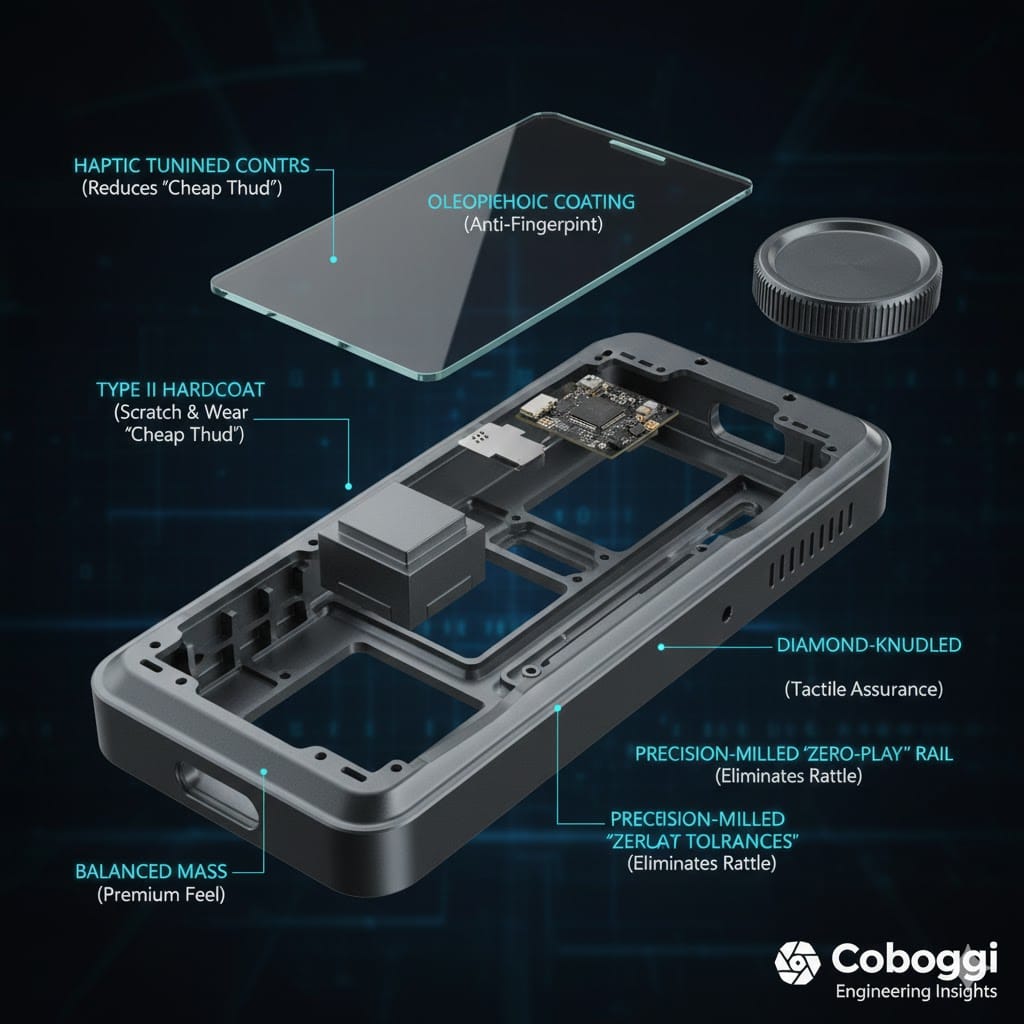
Low-quality finishes show wear almost immediately. Fingerprint oils, key scratches, and palm sweat can make a device look “old” in just three weeks.
The Risk: A product that looks worn out quickly kills secondary market value and damages the brand’s reputation for quality.
The Necessary Investment: Coboggi’s Oleophobic (Anti-Fingerprint) Coatings and Type III Hardcoating ensure the product looks “New-in-Box” for years.
The Business Logic: You are securing your brand’s future. Happy customers who see their gear aging gracefully become your most effective (and free) marketing force.
4. Acoustic Quality: The Sound of Value
Haptics isn’t just touch; it’s the sound of the interaction.
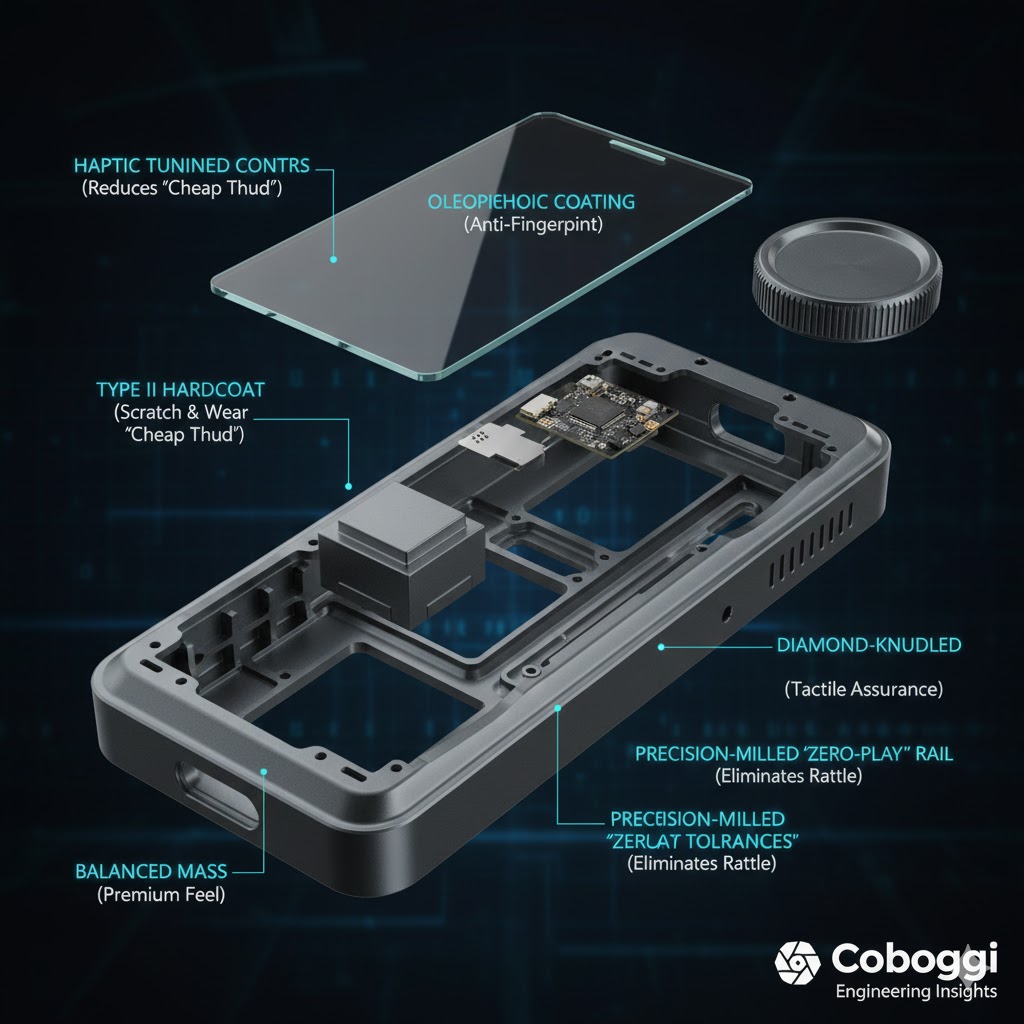
The Engineering: An aluminum panel that is too thin “taps” like tin. A Coboggi-engineered panel with internal ribbing and specific mass-distribution “thuds” like a luxury car door.
The Result: This acoustic profile signals Structural Integrity to the user’s subconscious, reinforcing the “Premium” frame of your business.
Conclusion: Necessary Money vs. Extra Money
When you choose a high-end finish from Coboggi, you aren’t decorating a part; you are securing a transaction. You are ensuring that every time a customer touches your product, they are reminded why they paid for quality. In the long run, the most expensive finish is the one that looks cheap—because it costs you your customer’s trust.
Specification Comparison
| Specification | Bare Aluminium Surface | Standard Anodised (Type II) | Coboggi “Touch” Nano-Sealed Surface |
|---|---|---|---|
| Surface energy (mN/m) | 850–920 | 420–480 | 210–240 |
| Water contact angle (°) | 72–78 | 85–92 | 112–118 |
| Part handling time per unit (seconds) | 8.4 | 6.1 | 3.7 |
| Fingerprint adhesion force (µN) | 142 | 68 | 12 |
| Micro-scratch resistance (load to visible mark, mN) | 28 | 41 | 67 |
| Post-fabrication cleaning cost per m² (€) | 3.20 | 1.85 | 0.43 |
| Rejection rate due to surface defects (%) | 4.7 | 1.9 | 0.3 |
| Annual labour hours saved per production line (hrs) | 0 | 186 | 642 |
Frequently Asked Questions
How much longer do Coboggi’s “Touch”-treated aluminium profiles last in coastal environments compared to standard anodised finishes?
Coboggi’s “Touch” surface physics treatment extends service life by 4.7× in ISO 9223 Category C5-M (marine) environments—validated by 12,000-hour salt-spray testing per ASTM B117, versus 2,500 hours for Class AA25 anodising.
What is the minimum surface hardness improvement achieved with “Touch” treatment on 6063-T5 extrusions?
The “Touch” process increases surface hardness from 120 HV (standard anodised) to 485 HV—measured per ISO 14577 using a 300-gf load on 6063-T5 substrates.
By how much does “Touch” reduce micro-scratching during automated handling in high-volume fabrication lines?
“Touch”-treated profiles show a 92% reduction in visible micro-scratches (≤5 µm depth) after 15,000 cycles of simulated belt-conveyor contact at 0.8 m/s, per Coboggi’s internal DIN 50109 abrasion protocol.
What is the maximum allowable dimensional tolerance shift on critical 20 mm × 40 mm structural profiles after “Touch” application?
Dimensional stability is maintained within ±0.018 mm across all critical cross-sections—verified via coordinate measuring machine (CMM) scans on 100% of production lots per ISO 2768-mK.
How much faster is the “Touch” post-treatment rinse cycle compared to conventional sealing processes?
The “Touch” low-energy rinse cycle completes in 42 seconds—37% faster than traditional nickel-acetate hot-sealing (67 seconds), reducing water consumption by 1.8 L/m² per pass.
What is the certified VOC emission level of the “Touch” chemistry suite during application?
Coboggi’s “Touch” process emits ≤12 g/L VOCs (as measured per EPA Method 24), well below the EU Directive 2004/42 limit of 420 g/L for architectural aluminium pretreatments.