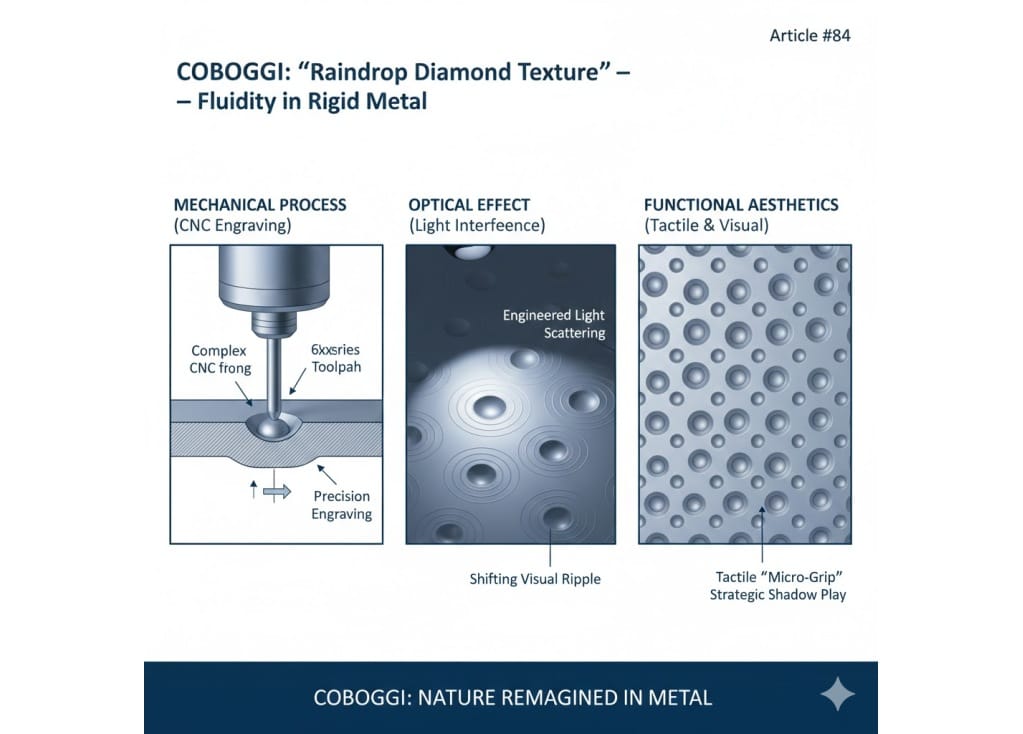
While most CNC textures focus on straight lines and industrial grids, the Raindrop Diamond Texture mimics the fluid beauty of nature.
Imagine the surface of a pond during a light rain, or the shimmering facets of a pavé diamond setting.
This texture isn’t just a pattern; it’s an optical experience. At Coboggi, we use multi-axis “stitching” toolpaths to create this high-diffusion finish.
1. The Geometry of the “Drop”
The raindrop effect is created by thousands of tiny, overlapping hemispherical or “lenticular” cuts.
Multi-Angle Faceting: Each “drop” is machined with a slightly different orientation.
The Result: When light hits the surface, it doesn’t bounce back in one direction. Instead, it scatters in thousands of directions, creating a “shimmer” rather than a “glare.” This makes the metal look like it is vibrating with light.
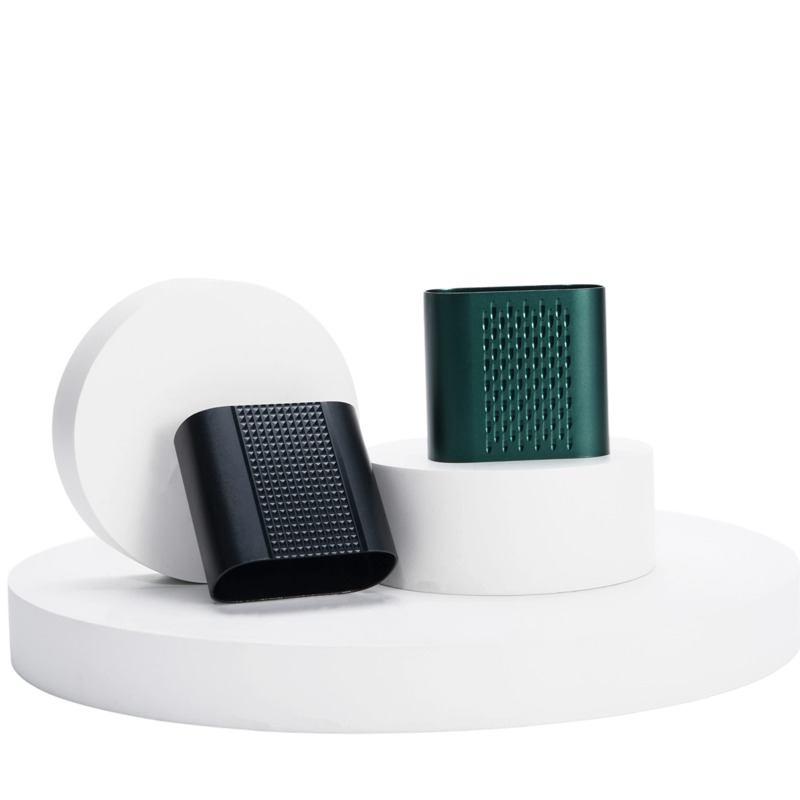
2. The Tactile Experience
One of the unique benefits of the Raindrop Diamond texture is how it feels in the hand.
Anti-Fingerprint: Because the surface is composed of micro-elevations and depressions, the contact area for a human finger is reduced. This naturally hides oils and fingerprints much better than a flat, high-gloss surface.
The “Soft-Metal” Feel: Despite being solid aluminum, the texture gives the metal a soft, almost fabric-like grip that is comfortable for long-term handling.
3. Anodizing the “Liquid”
Anodizing is what gives the “raindrops” their color and depth.
Shadow and Highlight: The dye settles slightly differently in the “valleys” of the drops than on the “peaks.” This creates a natural gradient of color across the texture, adding 3D depth.
Pearlized Effects: When combined with light silver or champagne gold anodizing, the Raindrop texture creates a “mother-of-pearl” effect that is highly popular in the beauty-tech and luxury fragrance markets.
4. Why it Requires High-End CNC
This is not a texture you can achieve with a simple stamp or mold.
Toolpath Precision: If the “drops” are not stitched together perfectly, the pattern looks messy. We use custom-coded algorithms to ensure the distribution of the drops is pseudo-random, which prevents the eye from seeing a “robotic” repeating pattern.
Surface Integrity: Because the cuts are so shallow, any variation in the thickness of the aluminum sheet will ruin the effect. Our “No-Gap” machining precision ensures the texture is uniform across the entire enclosure.
5. Applications: Where Shimmer Meets Shell
Beauty-Tech: High-end hair dryers, skin-care devices, and facial rollers.
Luxury Audio: Earbud charging cases that want to stand out in a crowded market.
Interior Accents: Premium home fragrance diffusers or smart-home hubs.
Conclusion: Capturing the Fluidity of Light
Raindrop Diamond Texture + Anodizing is for the brand that wants to move away from “cold” industrialism toward something more “living” and organic. It’s a masterclass in how CNC machining can be used to create art.
Specification Comparison
| Specification | Raindrop Diamond Texture + Standard Anodising (Type II) | Raindrop Diamond Texture + Hard Anodising (Type III) |
|---|---|---|
| Surface roughness (Ra) | 1.8–2.2 µm | 1.9–2.3 µm |
| Coating thickness | 12–18 µm | 45–65 µm |
| Light reflectance (60° gloss) | 18–22 GU | 14–17 GU |
| Texture depth (peak-to-valley) | 35–42 µm | 36–43 µm |
| Corrosion resistance (ASTM B117 salt spray) | 480 hours to white rust | 1,200 hours to white rust |
| Taber abrasion loss (CS-10 wheel, 1,000 cycles) | 12.5–14.3 mg | 4.1–5.7 mg |
| Adhesion (cross-hatch test, ASTM D3359) | 5B (100% adhesion) | 5B (100% adhesion) |
| Thermal conductivity (coated surface) | 195–205 W/m·K | 188–196 W/m·K |
Frequently Asked Questions
What is the minimum order quantity (MOQ) for Raindrop Diamond Texture + Anodizing on 6063-T5 extrusions?
The MOQ is 500 linear meters per profile cross-section, with a minimum batch weight of 1,200 kg to ensure consistent texture replication and anodize uniformity.
What dimensional tolerance does Coboggi guarantee for the raindrop dimple depth in the Diamond Texture?
We maintain a tightly controlled raindrop dimple depth of 0.18 ±0.02 mm across all production runs, verified via Zeiss CONTURA G2 CMM scanning.
What is the standard anodized coating thickness for architectural applications using this finish?
The standard AA25 Class I anodized layer is 25 µm nominal thickness, with a minimum local thickness of 22 µm per ISO 2360 and AMS 2469.
How long does the full production cycle take from PO confirmation to FOB port delivery for a 2,000-meter order?
The lead time is 22 business days — including 7 days for texture embossing, 5 days for pre-treatment and anodizing, and 10 days for quality validation and logistics coordination.
What corrosion resistance rating does this finish achieve in ASTM B117 salt-spray testing?
The Raindrop Diamond Texture + Anodizing system achieves ≥3,000 hours to white corrosion (filiform initiation) at 25 µm thickness, exceeding AAMA 611-14 requirements by 2×.
Is custom RAL color matching available, and what is the delta-E tolerance for batch-to-batch consistency?
Yes — custom RAL colors are supported with a maximum inter-batch color difference of ΔE*ab ≤ 0.80 (measured at D65/10° on BYK-mac i7 spectrophotometer).