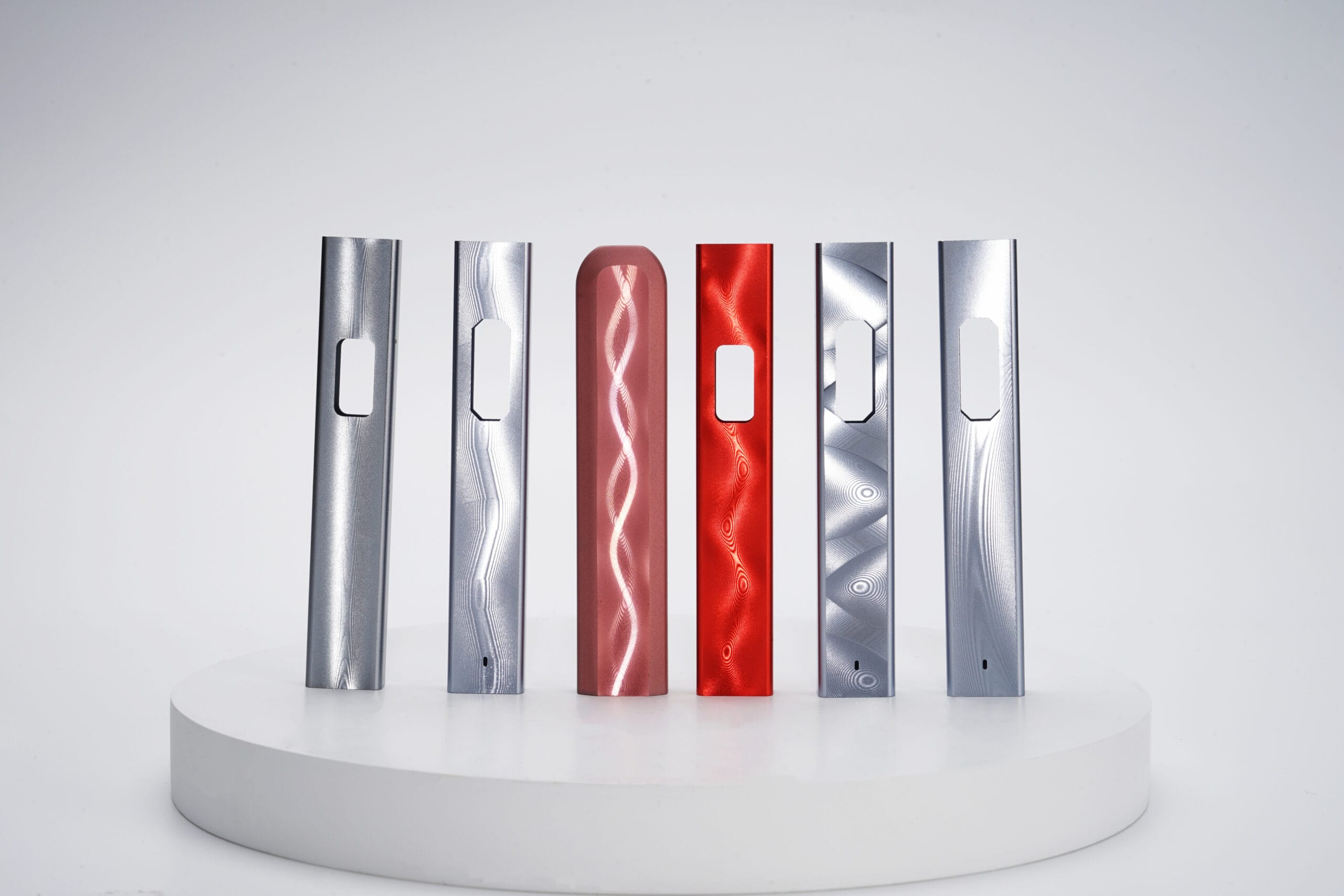
In traditional manufacturing, “toolmarks” (the lines left by a cutting bit) are considered defects to be sanded away.
But in the world of Industrial Chic design, these marks are the main event. By precisely controlling the movement of the CNC spindle, we can create rhythmic, light-catching patterns that tell a story of precision.
At Coboggi, we turn “milling” into “art.”
1. Designing the Toolpath
We don’t just “cut” the metal; we “draw” on it with the CNC bit. We use specialized CAM (Computer-Aided Manufacturing) software to create intentional patterns:
Concentric Circles (The “Vinyl” Look): Perfect for volume knobs or camera lens rings, creating a “rainbow” refraction similar to a vinyl record.
Linear Micro-Grooves: Parallel lines that give a product a “brushed” look but with much more depth and regularity than manual brushing.
Cross-Hatch Textures: Intersecting paths that create a tactile, diamond-like grid.
2. The “3D Anodizing” Effect
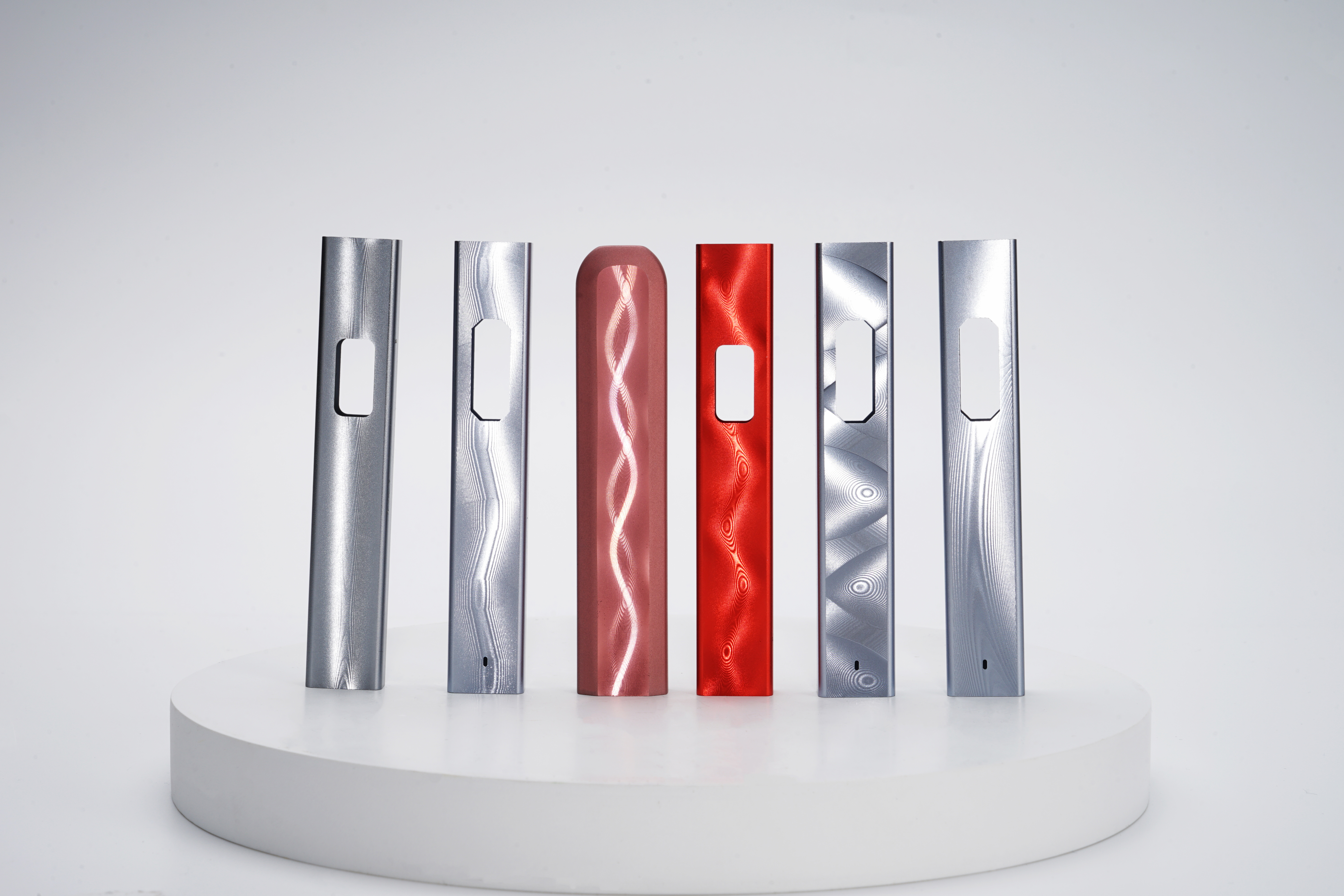
When you anodize a machined texture, something magical happens. The dye settles into the microscopic grooves left by the tool.
High-Contrast Shading: The “valleys” of the toolmark hold more color, while the “peaks” reflect more light. This creates a natural gradient that makes the texture look much deeper than it actually is.
Metallic Lustre: Because the tool “burnishes” the metal as it cuts, the aluminum underneath the anodized layer remains incredibly bright, giving the color a metallic “glow.”
[Image showing a macro view of concentric CNC toolmarks on a volume knob, colored with deep emerald green anodizing]
3. Why This Beats Traditional Brushing
Standard “Brushed Aluminum” is done with a belt or a wheel. It’s often irregular and “fuzzy.”
Digital Consistency: With CNC texturing, every line is exactly 0.02mm apart. It is mathematically perfect.
Pattern Versatility: We can change the texture direction mid-part—for example, a circular texture on the top of a button and a vertical texture on the sides—creating a complex interplay of light.
4. Durability & Fingerprint Resistance
A major advantage of CNC Machined Textures is their practicality:
Masking Scratches: Because the surface already has a rhythmic pattern, “micro-scratches” from daily use become invisible.
Haptic Feedback: The ridges provide a high-quality “mechanical” feel, giving the user better grip and a sense of the material’s strength.
5. Applications: Where the Machine Shines
Mechanical Keyboards: Using aggressive toolpaths on the “weight” or the casing for a premium, heavy-duty look.
Hi-Fi Audio Equipment: Faceplates that want to showcase the “billet aluminum” origin.
Professional Camera Gear: Dials and rings that require a precise, tactile “click” feel.
Conclusion: The Soul of the Machine
CNC Machined Texture + Anodizing is for the designer who loves the “Honesty of Materials.” It doesn’t pretend to be plastic or carbon fiber; it proudly announces that it was carved from a solid block of aluminum. At Coboggi, we provide the precision to make those toolmarks look like a masterpiece.
Specification Comparison
| Specification | CNC Machined Texture Only | CNC Machined Texture + Standard Anodising (Type II) | CNC Machined Texture + Hard Anodising (Type III) |
|---|---|---|---|
| Surface roughness (Ra) | 0.4–3.2 µm (machined as-is) | 0.8–3.6 µm (post-anodise seal) | 1.2–4.0 µm (post-anodise seal) |
| Coating thickness added | 0 µm | 15–20 µm | 50–75 µm |
| Dimensional change per surface | 0 µm | +7.5–10 µm | +25–37.5 µm |
| Microhardness of finished surface | 60–90 HV (base Al alloy) | 200–350 HV | 450–650 HV |
| Wear resistance (Taber abrasion, mg loss/1000 cycles) | 85–120 mg | 25–45 mg | 8–15 mg |
| Corrosion resistance (ASTM B117 salt spray, hours to white rust) | 24–72 hours | 336–500 hours | 1000–2000 hours |
| Electrical resistivity (surface, Ω/sq) | 0.03–0.05 Ω/sq | 10⁶–10⁸ Ω/sq | 10⁹–10¹⁰ Ω/sq |
| UV stability (ΔE after 1000 hrs QUV) | N/A (non-coloured) | ≤1.2 (dyed black) | ≤0.8 (natural or black) |
Frequently Asked Questions
What’s the minimum feature size achievable with your CNC-machined textures before anodizing?
We achieve crisp, repeatable texture features down to 0.15 mm in width and 0.08 mm depth—verified via Zeiss Contura G2 RDS CMM with ±0.005 mm probing accuracy.
What anodizing thickness do you guarantee for architectural-grade Type II anodized parts with CNC textures?
We guarantee a nominal anodized coating thickness of 15–25 µm (per ASTM B580), with a minimum local thickness of 12 µm across all textured surfaces—even in recessed grooves ≥0.2 mm wide.
Can textured CNC parts pass salt spray testing to ISO 9227 for exterior façade applications?
Yes—our standard hard-anodized (Type III) textured panels achieve ≥1,000 hours neutral salt spray (NSS) resistance without red rust, verified per ISO 9227:2022 test reports.
What is the typical lead time from PO to shipment for a batch of 250 textured + anodized aluminium panels (up to 1,200 × 600 mm each)?
Our standard lead time is 14 working days—including CNC texturing, alkaline etch pre-treatment, Type II anodizing, and quality sign-off—assuming approved GD&T drawings and material stock on hand.
What surface roughness (Ra) range do you maintain on machined textures prior to anodizing?
We hold Ra between 0.4 µm and 1.6 µm across all texture zones, measured using a Mitutoyo SJ-410 profilometer with 5 µm cutoff length and 3x traverse averaging.
Do you offer colour-matched anodized finishes for custom textures—and what’s the Delta E tolerance vs. master sample?
Yes—we match to Pantone Metallics or customer-supplied anodized standards within ΔE ≤ 1.2 (CIEDE2000, D65 illuminant, 10° observer), measured using Konica Minolta CM-3700A spectrophotometer.