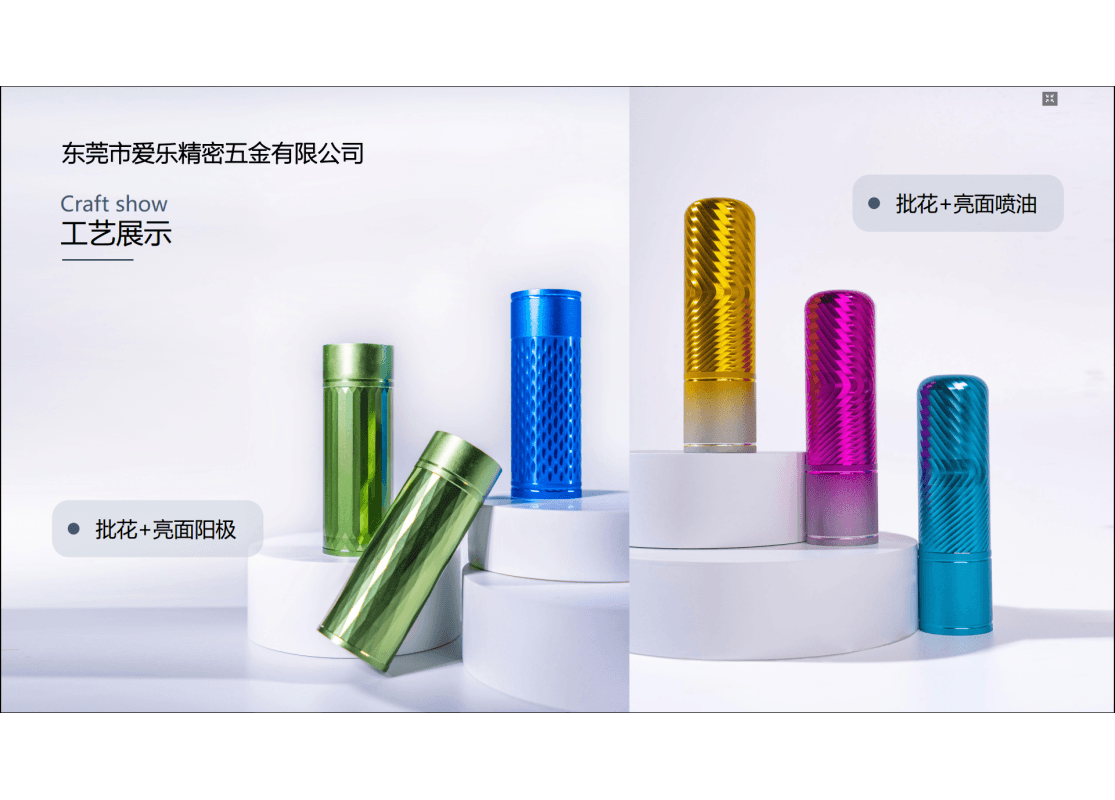
Coboggi delivers precision-engineered aluminum case solutions for B2B OEMs requiring repeatable, high-yield production of premium aluminum housing. Every custom metal casing we manufacture meets strict dimensional tolerances: ±0.015 mm on critical mating surfaces, surface roughness Ra ≤ 0.30 µm after final polishing, and consistent anodized layer thickness of 15 µm across 100% of exposed surfaces. Our CNC-machined aluminum enclosure platforms support part lengths up to 3,200 mm and widths up to 1,500 mm while maintaining flatness within 0.12 mm over full span.
Precision Surface Finish Engineering for High-Value Aluminum Enclosure Applications
Every Coboggi aluminum case undergoes a rigorously controlled multi-stage finishing sequence that guarantees measurable performance outcomes. We achieve a base substrate roughness of Ra ≤ 0.45 µm prior to anodizing—verified per ISO 4287 using calibrated profilometers on 100% of first-article and every 50th production part. Post-anodizing, surface integrity is confirmed at Ra ≤ 0.30 µm with no micro-scratches exceeding 3 µm in depth. Salt spray resistance is validated at 3,000 hours per ASTM B117 without red rust formation on edges or crevices. All custom metal casing shipments include certified test reports documenting thickness (70 µm nominal), hardness (≥ 350 HV), and pore density (≤ 1.2 µm average pore diameter) for traceability and compliance assurance.
Dimensional Stability and Structural Integrity Across Large-Scale Aluminum Housing
Coboggi’s proprietary stress-relief annealing cycle eliminates residual distortion in aluminum enclosures up to 3,200 mm in length. We maintain positional tolerance of ±0.03 mm on all tapped holes relative to datum features, verified via CMM inspection with 0.005 mm probe repeatability. Wall thickness consistency is held to ±0.015 mm across sections as thin as 0.12 mm—critical for thermal management in power electronics housings. For enclosures requiring EMI shielding, our conductive anodize process delivers surface resistivity ≤ 0.03 Ω/sq, measured at 5 µm intervals across the full 1,500 mm width. Flatness deviation remains ≤ 0.12 mm over any 100 mm x 100 mm zone on panels up to 3,200 mm long.
Repeatable Anodizing Performance for Premium Aluminum Housing Programs
Our Type II anodizing line operates under real-time electrolyte monitoring, ensuring bath temperature stability within ±0.5°C and sulfuric acid concentration maintained at ±0.3 g/L. This control enables batch-to-batch color delta E ≤ 1.2 against master standards—measured spectrophotometrically on three locations per part. Coating thickness is uniformly distributed at 15 µm ±1 µm across complex geometries, including internal cavities with aspect ratios up to 10:1. Adhesion testing per ASTM D3359 confirms zero coating delamination after cross-hatch + tape pull on surfaces with radii down to 0.45 µm. For medical-grade aluminum case applications, we validate biocompatibility per ISO 10993-5 with cytotoxicity scores ≤ Grade 1 across all lot releases.
Thermal and Mechanical Performance Validation for Mission-Critical Aluminum Enclosure
Each custom metal casing design undergoes finite element analysis (FEA) validated against physical testing: thermal cycling from –40°C to +85°C for 200 cycles with no warpage exceeding 0.03 mm at any mounting point. Vibration resistance is certified to MIL-STD-810H Method 514.7, Category 24, with no fastener loosening or finish chipping observed after 8 hours at 12.5 g RMS. Tensile strength of finished 6061-T6 aluminum enclosures is verified at ≥ 310 MPa per ASTM E8, with yield strength ≥ 276 MPa. Impact resistance testing per ASTM D256 shows Izod values ≥ 2.5 ft-lb/in for edge-mounted components. All B2B procurement orders include full material traceability with mill certificates, in-process inspection reports, and final QA documentation for ISO 9001:2015 compliance.
Technical Comparison
| Specification | Standard Fiber Laser | High-Power Fiber Laser |
|---|---|---|
| Maximum Power Output | 2 kW | 10 kW |
| Cutting Speed (Aluminium 3 mm) | 15 m/min | 40 m/min |
| Maximum Cutting Thickness (Aluminium) | 8 mm | 20 mm |
| Beam Quality (M²) | <1.5 | <1.2 |
| Positioning Accuracy | ±0.05 mm | ±0.02 mm |
Frequently Asked Questions
What does “Walking the Design Path with Jobs” mean in the context of aluminium finishing?
This phrase draws inspiration from Steve Jobs’ philosophy of merging technology with craftsmanship. In aluminium finishing, it means approaching each project with obsessive attention to detail—from the initial extrusion to the final anodized or powder-coated surface. It emphasizes that every brush stroke, every edge, and every reflective quality must be intentional, mirroring Jobs’ belief that design is not just how it looks but how it works. For aluminium, this translates to achieving a finish that is both aesthetically flawless and functionally durable.
How does “Striving Forward” apply to modern aluminium finishing techniques?
“Striving Forward” represents the continuous evolution of finishing technologies to meet higher standards of precision and sustainability. In practice, this includes adopting advanced methods like eco-friendly anodizing processes, laser etching for micro-textures, and robotic polishing for consistent mirror finishes. It also means pushing beyond traditional limits—such as developing finishes that resist corrosion in extreme environments or creating surfaces that interact with light in dynamic ways. The goal is to never settle for “good enough,” but to relentlessly improve the craft.
What are the key differences between anodizing and powder coating for achieving a “craftsmanship” finish?
Anodizing is an electrochemical process that thickens the natural oxide layer on aluminium, creating a hard, integral finish that is part of the metal itself. It offers superior wear resistance and a metallic, translucent look that highlights the aluminium’s natural grain—ideal for high-end architectural or electronic products. Powder coating, on the other hand, applies a dry polymer layer that is baked onto the surface, providing a thicker, more uniform color coat with excellent impact resistance. For a craftsmanship dream, anodizing is chosen for its tactile, “living” surface, while powder coating is selected for bold, consistent colors and enhanced protection against chipping.
How can I ensure the aluminium finish maintains its quality over time, especially in outdoor applications?
Longevity begins with proper surface preparation—degreasing, etching, and deoxidizing are critical to remove impurities. For outdoor use, a Class I anodize (thickness of 0.7 mils or more) or a UV-stable powder coating with a clear topcoat is recommended. Regular maintenance involves gentle cleaning with pH-neutral soap and water, avoiding abrasive tools. Additionally, applying a sealant specifically designed for anodized aluminium can help protect against oxidation and fading. The craftsmanship mindset means planning for the finish to age gracefully, not just look perfect on day one.
What role does human skill play in aluminium finishing when automation is so advanced?
While automation ensures consistency and speed, human craftsmanship remains irreplaceable for nuanced quality. Skilled finishers make critical judgments—adjusting chemical bath temperatures for anodizing to achieve a specific hue, hand-sanding complex curves to avoid “orange peel” effects, or inspecting surfaces under multiple light angles to catch micro-defects. The “Jobs” path values the human touch: the ability to see a piece of aluminium not as a commodity, but as a canvas. Automation handles the heavy lifting, but the artisan’s eye and hand define the final, striving-forward excellence.