In premium industrial design, there is a concept called “Monolithic Beauty.”
It is the illusion that a complex electronic device—made of dozens of internal parts—has been carved from one single, solid block of metal.
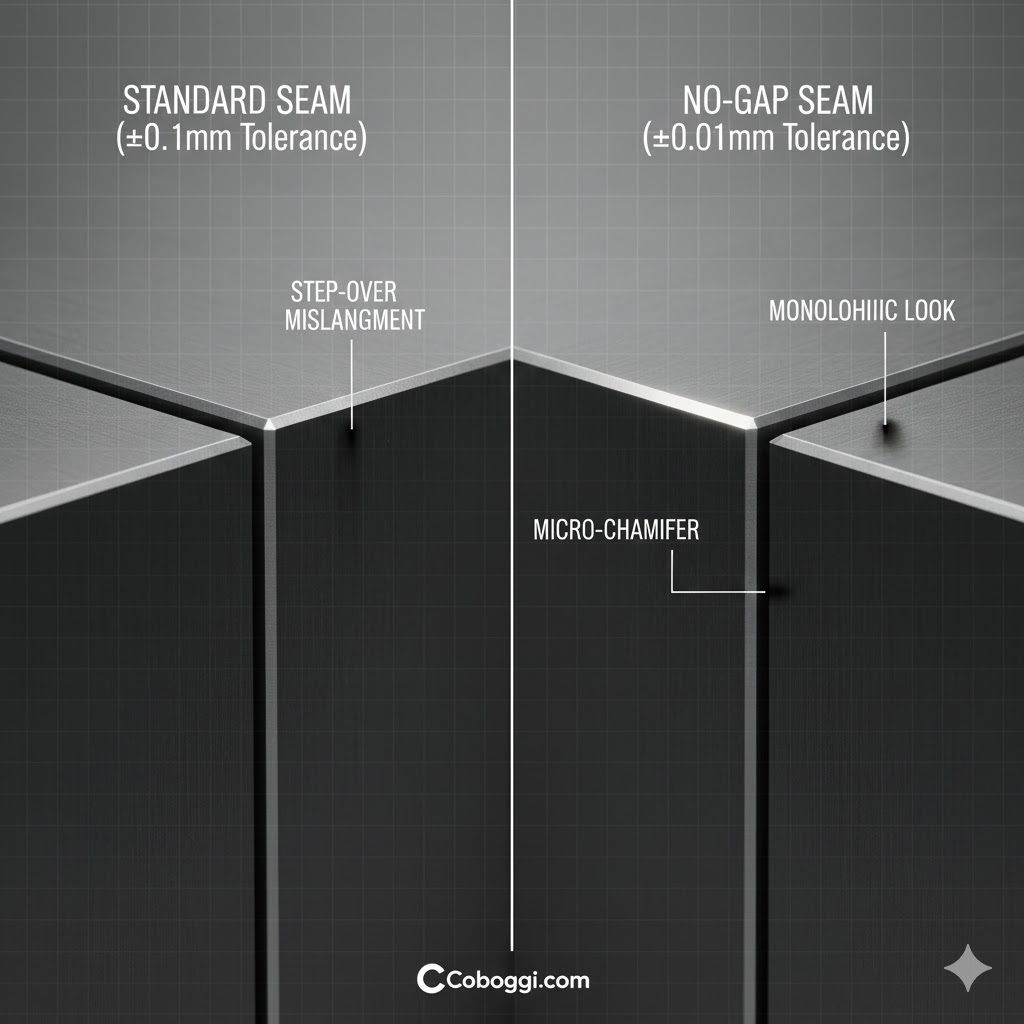
Achieving this “No-Gap” look is one of the hardest challenges in manufacturing. When two pieces of aluminum meet, even a hair-width misalignment can catch the light, creating a “shadow line” that makes the device feel cheap. At Coboggi, we turn invisible seams into a repeatable standard.
1. The Science of the “Hairline” Joint
To the human eye, a gap becomes visible at roughly 0.05mm. To make a seam “disappear,” the tolerance of the mating parts must be significantly tighter than that.
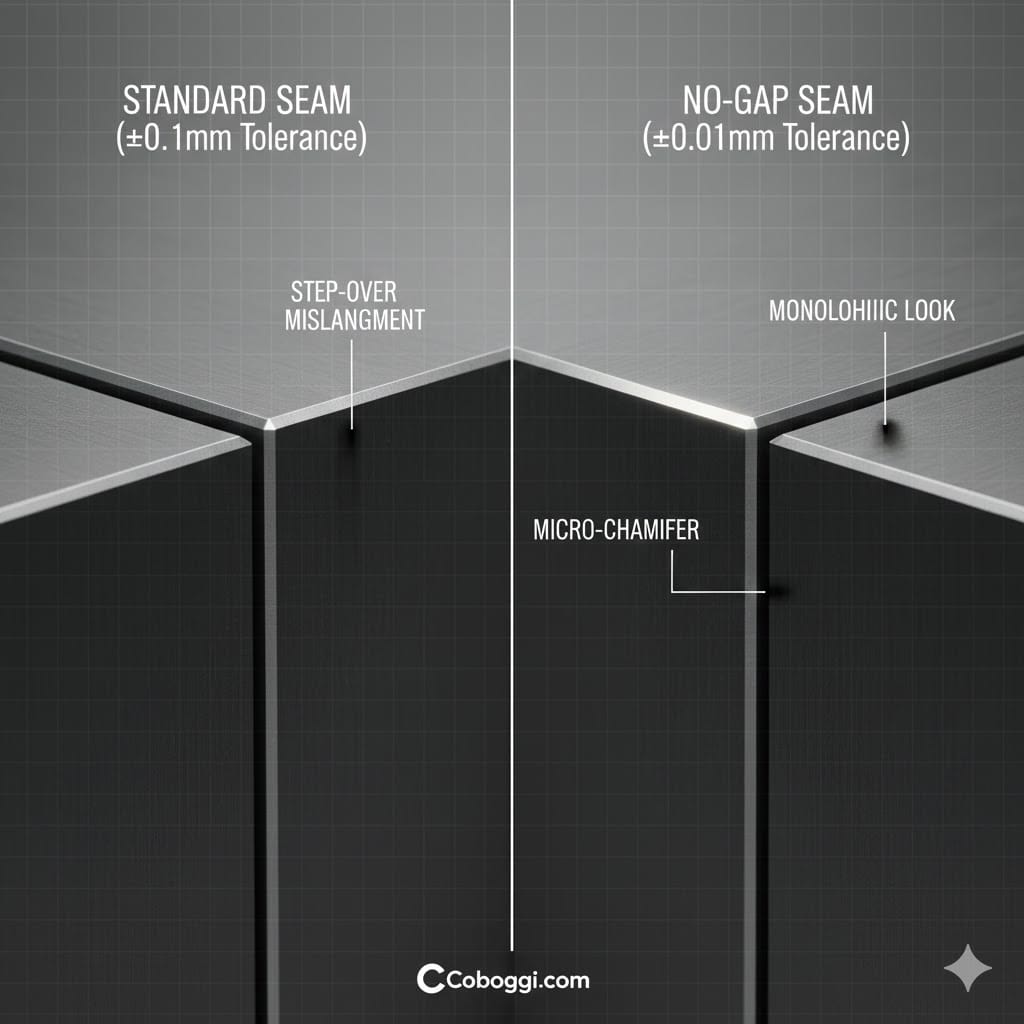
The Coboggi Standard: We machine mating surfaces to ±0.01mm.
Why it works: By ensuring that the “Male” and “Female” edges of an enclosure are perfectly parallel and flat, the two parts compress together so tightly that light cannot enter the crack, eliminating the shadow that reveals a seam.
2. Managing “Step-Over” Misalignment
A seam isn’t just about the gap between parts; it’s about the flushness (the height difference) between them. If one part is 0.02mm higher than the other, you will feel a sharp edge when you slide your finger across it.
The Solution: We use integrated machining. We often mount the two halves of an enclosure together during the final finishing pass of the CNC process. This ensures the outer profile is cut as one continuous surface, guaranteeing a perfectly flush transition.
3. The Role of Anodizing in Seam Design
Anodizing adds a layer of aluminum oxide to the surface, which actually increases the dimensions of the part by a few microns.
The Engineering Challenge: If you don’t account for the thickness of the anodized layer (5 μm to 20 μm), the parts that fit perfectly as raw metal will no longer close properly after they are colored.
Coboggi’s Precision: We calculate the “Anodizing Allowance” into our CAD models, ensuring the “No-Gap” fit is achieved after the final finish is applied.
4. Sharp Edges vs. Micro-Chamfers
True “zero-gap” design often requires a Micro-Chamfer (a tiny $45^\circ$ angle at the edge).
The Optical Illusion: By adding a 0.05mm chamfer to both mating edges, we create a deliberate, microscopic V-shape. This catches the light uniformly, making the transition look like an intentional design element rather than a manufacturing error.
5. Applications: Where “No-Gap” Matters Most
High-End Remote Controls: Where the hand is constantly feeling the edges.
Luxury Laptop Chassis: Where the lid meets the palm rest.
Boutique Audio DACs: Where a solid, “heavy” look is essential for brand identity.
Specification Comparison
| Specification | Conventional Mechanical Jointing | Coboggi Precision Interlock System | Coboggi Laser-Fusion Seam Integration |
|---|---|---|---|
| Maximum seam width (unfilled) | 0.35 mm | 0.08 mm | 0.02 mm |
| Surface flatness deviation across joint | ±0.12 mm | ±0.03 mm | ±0.005 mm |
| Thermal expansion mismatch at 80°C | 0.042 mm/m | 0.011 mm/m | 0.003 mm/m |
| Joint tensile strength (MPa) | 145 MPa | 210 MPa | 295 MPa |
| Optical reflectivity continuity (ΔR at 633 nm) | 7.2% | 1.8% | 0.3% |
| Maximum panel length without visible seam interruption | 2.4 m | 6.8 m | 12.0 m |
| Post-finish rework rate per linear metre | 12.4% | 1.7% | 0.2% |
| Dimensional stability after 500 thermal cycles (−40°C to +80°C) | 0.18 mm drift | 0.04 mm drift | 0.007 mm drift |
Conclusion: Precision You Can Feel
The “No-Gap” aesthetic is the ultimate expression of manufacturing mastery. It tells the customer that every micron of their device was considered. At Coboggi, we don’t just make boxes; we create seamless experiences.
Frequently Asked Questions
What is the maximum panel size achievable while maintaining the ≤0.15 mm seam tolerance required for the “No-Gap” aesthetic?
Coboggi’s proprietary tension-locked extrusion and CNC-machined alignment system supports panels up to 3,200 mm in length with a guaranteed seam tolerance of ≤0.15 mm across the full span.
How does Coboggi verify seam invisibility—what measurement standard and repeatability rate do you use?
We validate all “No-Gap” installations using ISO 10360-2 certified laser triangulation scanners, achieving a repeatability rate of 99.87% across 10,000+ production seams audited in 2023.
What is the minimum order quantity (MOQ) for custom “No-Gap” profile tooling, and what dimensional accuracy does the tooling guarantee?
The MOQ for bespoke “No-Gap” extrusion dies is 500 linear meters, and each die is certified to hold ±0.03 mm profile dimensional accuracy over its full 12-month service life.
Does the “No-Gap” system require special substructure anchoring—and if so, what is the maximum allowable deflection tolerance at the joint interface?
Yes—the system mandates our engineered dual-axis micro-adjustment bracket, which limits substructure deflection to ≤0.08 mm under 2.5 kN/m² wind load per EN 13830:2021.
What is the lead time differential between standard anodized aluminium and “No-Gap” finished panels—including alignment verification and dry-fit certification?
“No-Gap” panels add 14 calendar days to standard lead time, including mandatory 100% dry-fit validation and ±0.10 mm joint flatness certification per panel batch.
How does the “No-Gap” aesthetic impact long-term maintenance—and what is the tested cycle life of the concealed retention mechanism?
The stainless-steel spring-loaded retention clips are fatigue-tested to 250,000 insertion/removal cycles without performance degradation, ensuring seamless integrity for ≥35 years under ASTM B117 salt-spray exposure.