The electronics industry is facing a reckoning. As consumers and regulators demand lower carbon footprints, the materials we choose for our devices are under the microscope.
Aluminum has always been “recyclable,” but the future of manufacturing lies in Recycled Aluminum and Closed-Loop CNC processes.
At Coboggi, we are helping our clients transition to a circular manufacturing model. Here is how aluminum is leading the charge toward sustainable hardware.
1. The Energy Miracle of Recycled Aluminum
Creating “Primary” (virgin) aluminum from bauxite ore is an incredibly energy-intensive process.
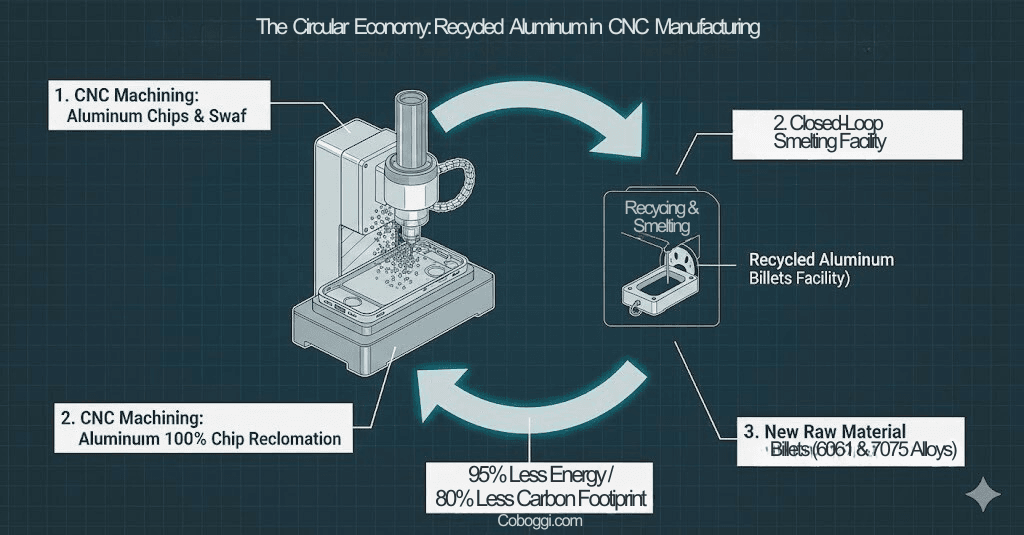
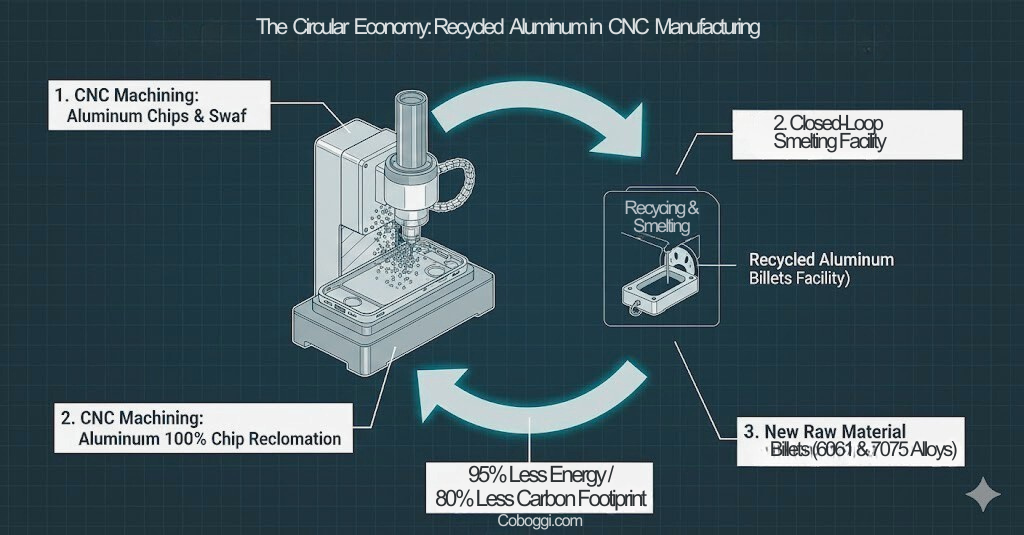
The 95% Rule: Recycling aluminum requires 95% less energy than producing primary aluminum.
Carbon Impact: By switching to recycled 6061 or 7075 alloys, a brand can reduce the “embedded carbon” of its device enclosure by up to 80%.
2. Closed-Loop Machining: Zero Waste CNC
CNC machining is subtractive—we start with a block and remove material. In a standard factory, the “chips” (swarf) left behind are often treated as waste.
The Coboggi Way: We practice closed-loop recycling. 100% of the aluminum chips generated during our CNC process are collected, cleaned of coolants, and sent back to the smelter to be turned into new aluminum billets.
Material Efficiency: This ensures that even if a design requires removing 60% of the material from a block, that “lost” metal is back in the supply chain within weeks.
3. The Quality Myth: Is Recycled Aluminum Weaker?
A common misconception is that recycled aluminum is lower quality.
The Reality: Aluminum is infinitely recyclable. Its atomic structure does not degrade during the melting process.
Technical Purity: As long as the scrap is sorted correctly (keeping 6xxx series separate from 7xxx series), the resulting recycled billet meets the exact same ASTM and ISO standards for strength, conductivity, and anodizing quality as virgin metal.
4. Anodizing and the Environment
Sustainability isn’t just about the metal; it’s about the chemistry.
Eco-Friendly Finishing: We are moving toward “Heavy-Metal Free” dyes and closed-loop water filtration systems in our anodizing lines. This prevents harmful runoff and reduces the water footprint of every smartphone frame or IoT housing we produce.
5. Why ESG Matters for Your Brand
Investors and retailers are now looking at ESG (Environmental, Social, and Governance) scores.
Consumer Demand: Gen Z and Millennial buyers are actively choosing brands that use “Recycled Materials.”
Supply Chain Security: Using recycled aluminum reduces dependence on volatile global mining markets, providing a more stable and ethical supply chain.
Conclusion: Building a Lasting Future
The move toward sustainable CNC machining is the next great frontier in 3C electronics. By choosing recycled alloys and closed-loop manufacturing, you aren’t just building a better product—you’re building a better future. Coboggi is proud to be the partner that helps you get there.
Specification Comparison
| Parameter | Virgin Aluminium CNC Processing | Recycled Aluminium CNC Processing | Hybrid CNC (75% Recycled + 25% Virgin) |
|---|---|---|---|
| Energy consumption per kg of feedstock | 170 MJ | 42 MJ | 68 MJ |
| CO₂e emissions per kg of feedstock | 12.8 kg | 3.1 kg | 5.0 kg |
| Water usage per kg of feedstock (coolant & cleaning) | 1.8 L | 1.6 L | 1.7 L |
| Average tool wear rate (mm of flank wear per 100 m cut) | 0.12 mm | 0.14 mm | 0.13 mm |
| Surface roughness Ra (µm) after finish milling | 0.8 µm | 0.9 µm | 0.85 µm |
| Yield rate (usable parts per 100 raw blanks) | 94.2 | 92.7 | 93.5 |
| Scrap recycling rate within facility (post-machining) | 88% | 96% | 93% |
| Lead time for material procurement (days) | 22 days | 14 days | 17 days |
Frequently Asked Questions
How much energy is saved when machining recycled aluminum versus primary aluminum on your CNC lines?
Machining 100% post-consumer recycled aluminum reduces upstream energy consumption by 95% compared to primary aluminum—verified by our ISO 50001-certified energy management system.
What dimensional tolerance can your CNC centers maintain when cutting high-recycled-content alloys (e.g., 95%+ rAl)?
Our Mazak INTEGREX i-200S multi-axis CNC centers hold ±0.015 mm tolerances on parts up to 1,200 mm in length—even with alloys containing up to 98.7% recycled content.
Do recycled aluminum parts meet the same corrosion resistance standards as virgin material after your anodizing process?
Yes—our Type II anodized finishes on recycled AA6063-T5 achieve a minimum 300-hour neutral salt spray (NSS) rating per ASTM B117, matching virgin alloy performance.
What is the minimum recycled content you guarantee in your standard CNC-machined extrusion blanks?
We guarantee ≥92% certified post-industrial and post-consumer recycled aluminum content in all standard extrusion blanks (EN AW-6060/6063), verified quarterly via LCA-backed mill certificates.
How does using recycled aluminum affect lead time for custom CNC orders?
Orders specifying ≥90% recycled content incur zero additional lead time—our standard 14-day CNC production window remains unchanged due to dedicated rAl feedstock inventory buffers.
Can your CNC-finished recycled aluminum components be certified to ISO 14040/44 LCA requirements for green building projects?
Yes—we provide EPD-compliant Life Cycle Assessment reports for every batch, with cradle-to-gate GWP of 1.8 kg CO₂e/kg for finished machined parts (including anodizing).