In the world of high-end electronics and luxury hardware, the most beautiful finish is worthless if it is obscured by oils and smudges within minutes of use.
Specification Comparison
| Specification | Standard AF Nano-Coating (Sol-Gel) | Advanced AF Nano-Coating (Hybrid SiO₂-TiO₂) | Fluoropolymer-Based AF Coating |
|---|---|---|---|
| Coating thickness | 15–30 nm | 25–45 nm | 40–70 nm |
| Water contact angle | 102° ± 3° | 118° ± 2° | 125° ± 2° |
| Oil contact angle | 68° ± 4° | 82° ± 3° | 94° ± 3° |
| Taber abrasion loss (mg/1000 cycles) | 8.2 mg | 4.7 mg | 3.1 mg |
| Adhesion (cross-cut test, ISO 2409) | Class 4 (≤15% flaking) | Class 2 (≤5% flaking) | Class 1 (0% flaking) |
| VOC content (g/L) | 120 g/L | 85 g/L | 45 g/L |
| UV resistance (ΔE after 1000 h QUV) | 2.8 | 1.4 | 0.9 |
| Application temperature range | 15–35 °C | 10–40 °C | 5–45 °C |
COBOGGI solves the “tactile paradox”—the desire to touch a premium surface without ruining its appearance—through Anti-Fingerprint (AF) Nano-Coatings.
These ultra-thin, vacuum-deposited layers ensure that the pristine look of the aluminum remains intact, regardless of handling.
The Chemistry of Repulsion
AF coatings are not just “waxes”; they are engineered molecular chains, typically fluoropolymers, that are chemically bonded to the anodic oxide layer of the aluminum.
1. Hydrophobic and Oleophobic Properties
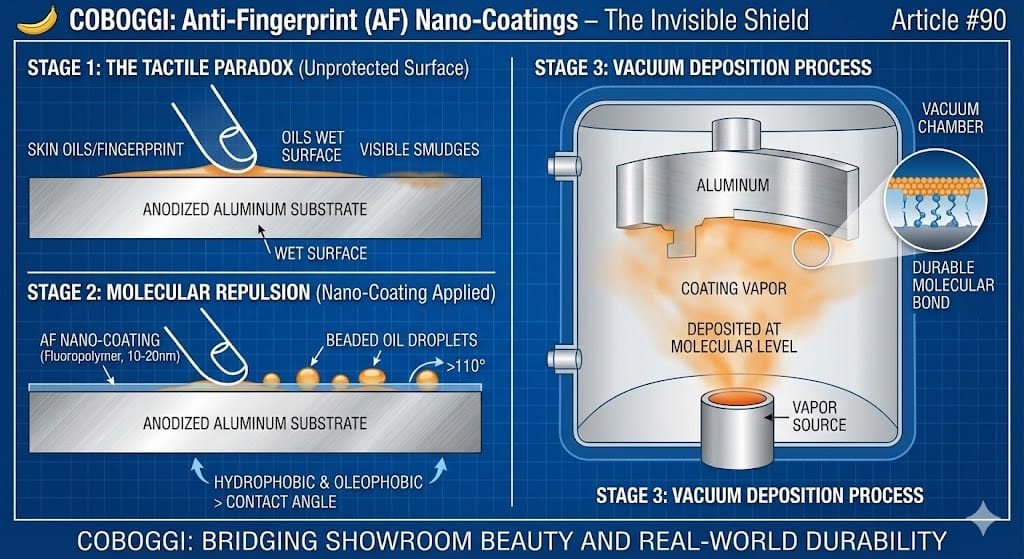
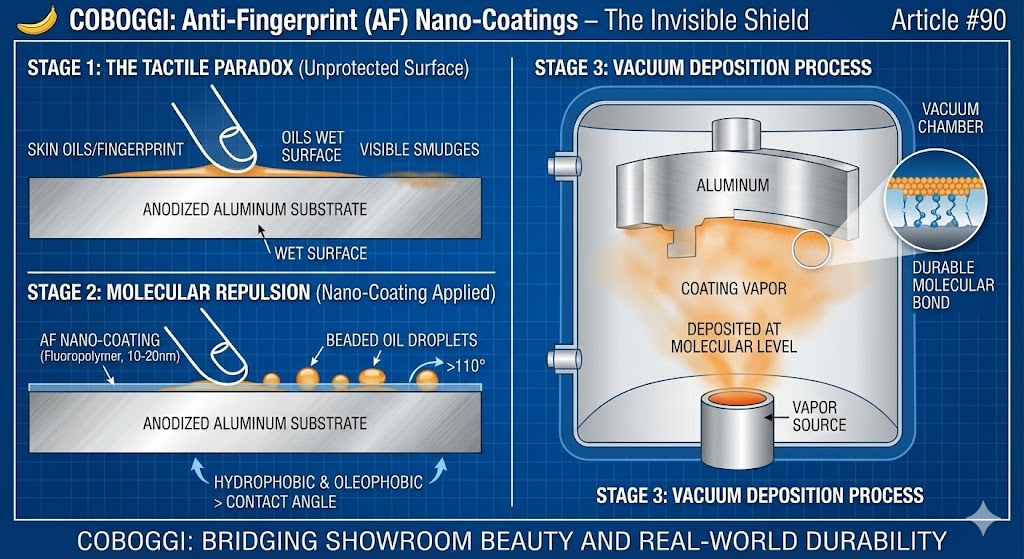
The primary function of an AF coating is to lower the surface energy of the hardware. By creating a surface that is both hydrophobic (water-repelling) and oleophobic (oil-repelling), skin oils from fingertips cannot “wet” the surface. Instead of spreading out and becoming visible, the oils bead up or fail to adhere, making them nearly invisible and incredibly easy to wipe away.
2. The Contact Angle Benchmark
We measure the effectiveness of our AF coatings by the water contact angle. A standard anodized surface might have a contact angle of 60–70°, causing liquids to spread.
A COBOGGI AF-treated surface maintains a contact angle exceeding 110°. This steep angle ensures that contaminants have minimal surface contact, preserving the “bright matte” or “high-gloss” luster underneath.
3. Vacuum Deposition (AF Spray vs. Evaporation)
While many competitors use cheap spray-on coatings, COBOGGI utilizes Vacuum Evaporation Deposition.
The coating material is vaporized in a vacuum chamber and deposited onto the aluminum at a molecular level.
This results in a layer that is only 10–20 nanometers thick—thin enough to be completely invisible to the eye and undetectable to the touch, yet durable enough to withstand thousands of “abrasion cycles” during daily use.
Conclusion: Permanent Pristine Aesthetics
Anti-fingerprint nano-coatings are the final, essential step in COBOGGI’s CMF workflow.
They represent the bridge between “showroom beauty” and “real-world durability,” ensuring that the engineering excellence of the aluminum is always the star of the show, not the fingerprints of the user.
Frequently Asked Questions
What is the typical coating thickness of Coboggi’s AF Nano-Coating on aluminium substrates?
The standard dry-film thickness is 8–12 nanometers, verified via ellipsometry with ±0.5 nm measurement tolerance.
How does the AF coating perform in salt spray corrosion testing per ASTM B117?
Coboggi’s AF Nano-Coating achieves ≥1,000 hours to white rust on AA6063-T5 anodized aluminium, exceeding ISO 9227 Class C5-I requirements.
What is the minimum order quantity (MOQ) for custom-formulated AF coatings for architectural extrusion lines?
The MOQ is 200 liters per batch for OEM-tailored formulations, with viscosity controlled to 18 ± 1.2 cP at 25°C.
Does the coating comply with EU REACH Annex XVII restrictions on nickel release?
Yes — nickel content is <0.001 wt%, certified to EN 1811:2023 with a detection limit of 0.0005 wt%.
What is the shelf life of unopened AF Nano-Coating under recommended storage conditions?
18 months when stored at 5–25°C in sealed HDPE containers, with viscosity drift limited to ≤3% over that period.
How many square meters can one liter of ready-to-use AF coating cover on mill-finished aluminium at target thickness?
One liter covers 120–140 m² at the optimal 10 nm dry-film thickness, measured using ISO 2808 drawdown bars with 15 µm wet-film applicators.