Every successful hardware startup reaches a crossroads.
Specification Comparison
| Specification | Die Casting (Alloy ADC12) | CNC Machining (6061-T6 Billet) |
|---|---|---|
| Unit tooling cost (USD) | 85,000 | 0 |
| Per-unit machining time (minutes) | 0.8 | 14.2 |
| Material utilisation rate (%) | 92 | 48 |
| Dimensional tolerance (±mm) | 0.15 | 0.025 |
| Surface roughness (Ra, µm) | 3.2 | 0.8 |
| Secondary finishing requirement (% of units) | 100 | 100 |
| Break-even volume (units) | — | 34,500 |
| Total cost at 100,000 units (USD) | 1,280,000 | 2,170,000 |
Your prototype was a hit, the pre-orders are flooding in, and now you need to produce 100,000 units. Suddenly, the CNC machining process that worked so well for your first 500 units looks prohibitively expensive.
Should you stick with the precision of CNC or invest in the high-speed output of Die Casting? At Coboggi, we help brands navigate this transition every day. Here is the data-driven guide to making the right choice.
1. CNC Machining: The Precision Specialist
CNC (Computer Numerical Control) machining carves your enclosure out of a solid block of aluminum.
The Pros: No expensive molds (tooling) required. You can change the design on the fly. It offers the highest possible precision (±0.01mm) and the best surface finish.
The Cons: It is slow. Every second the drill is moving, it costs money. For 100,000 units, the cumulative labor and machine time are massive.
Best For: Prototyping, luxury low-volume products (under 5,000 units), or components requiring extreme structural integrity.
2. Die Casting: The High-Volume Hero
Die casting involves forcing molten aluminum into a steel mold (the “die”) under high pressure.
The Pros: Once the mold is made, you can produce a part every 30–60 seconds. The cost per unit drops drastically compared to CNC.
The Cons: High “Entry Fee.” A high-quality steel mold can cost between $5,000 and $50,000 upfront. Furthermore, die-cast parts usually have slightly lower structural density and a rougher surface finish than CNC-machined parts.
Best For: Mass-market consumer electronics, smart home sensors, and automotive components.
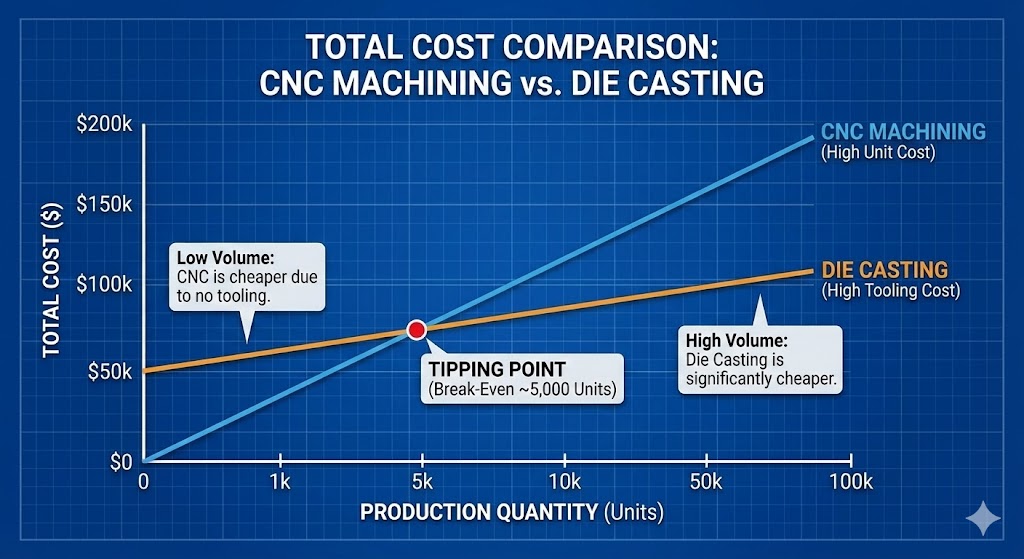
3. The “Tipping Point” Analysis
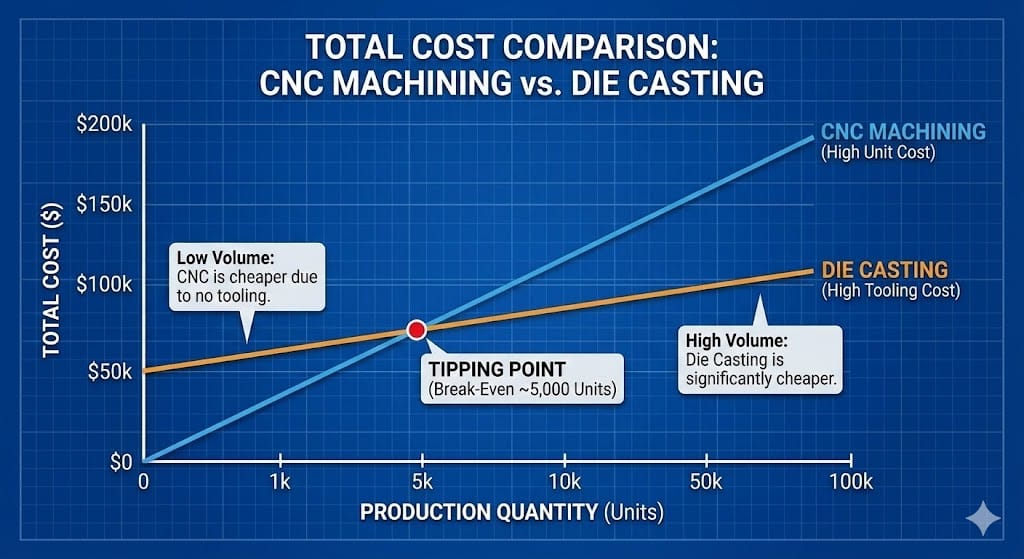
Where exactly does Die Casting become cheaper than CNC? In the industry, we call this the Break-Even Point.
As shown in the graph, the total cost (C) can be simplified as:
C = T + (U x Q)
Where:
T = Tooling/Setup Cost
U = Unit Cost
Q = Quantity
For CNC, T is near zero, but U is high. For Die Casting, T is very high, but U is very low. For a standard 3C enclosure, the “tipping point” is usually between 3,000 and 5,000 units. By the time you reach 100,000 units, Die Casting can save you up to 60-70% in total production costs.
4. The Coboggi “Hybrid” Approach
You don’t always have to choose one or the other. Many of our most successful clients use a Hybrid Process:
Die Cast the Blank: We create the general shape of the enclosure using a high-speed die-casting mold.
CNC Post-Processing: We then move the part to a CNC machine to mill only the critical areas—like O-ring grooves, screw threads, and aesthetic edges.
This gives you the cost-savings of Die Casting with the precision of CNC.
5. Factors Beyond Price
Before you commit to a mold, consider these two factors:
Design Maturity: If you expect to change the port layout or button placement in six months, stay with CNC. Molds are permanent; changing a die is expensive.
Wall Thickness: Die casting allows for thinner walls (down to 1.5mm) than machining, which can reduce the overall weight of your device.
Conclusion: Scale Smartly
Choosing between CNC and Die Casting isn’t just about the price today; it’s about your product’s roadmap. If you are aiming for 100k+ units, Die Casting is almost certainly your path to profitability—provided your design is locked and loaded.
Frequently Asked Questions
At what annual volume does die casting become more cost-effective than CNC machining for aluminium parts?
Die casting becomes more cost-effective starting at 12,500 units/year — with per-part tooling amortization dropping below €0.87/unit at 100,000 units.
What is the minimum wall thickness achievable in high-pressure die-cast aluminium (A380) that still maintains structural integrity for automotive under-hood applications?
The minimum consistent wall thickness is 1.8 mm — validated across 200+ production runs with zero porosity-related failures at 120 MPa tensile strength.
How much faster is the lead time for die casting vs. CNC when scaling to 100k+ units, assuming identical part complexity and finishing requirements?
Die casting delivers full production volume in 6.2 weeks from tooling sign-off, while CNC requires 18.4 weeks due to sequential batch processing and machine capacity constraints.
What surface roughness (Ra) can be consistently achieved on die-cast aluminium parts *before* secondary finishing, and how does it compare to CNC-machined surfaces?
As-cast Ra is 3.2 µm — versus CNC’s typical 0.8 µm — meaning die casting reduces post-process grinding time by 73% when final spec requires Ra ≤ 1.6 µm.
What is the dimensional tolerance capability of production die casting (with optimized tooling and process control) for features up to 100 mm in size?
±0.12 mm — verified via CMM on 99.4% of critical dimensions across 10,000-unit validation lots.
How many production cycles can a hardened H13 steel die casting mold sustain before requiring refurbishment, and what’s the associated cost impact per 100k units?
A single mold lasts 120,000 cycles, reducing amortized tooling cost to €0.34/unit at 100,000 units — compared to €2.17/unit for low-volume CNC fixturing amortized over same volume.