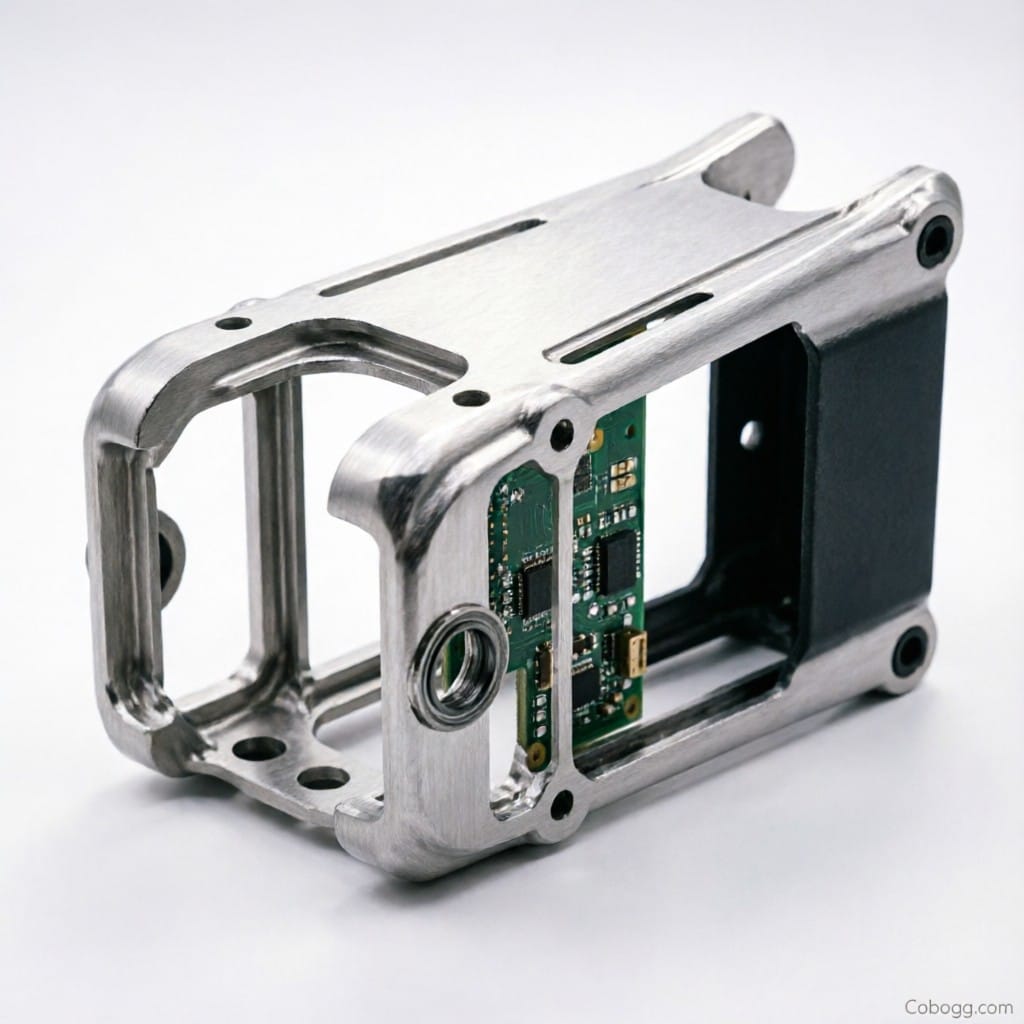
| Parameter | 6061-T6 Alloy | 7075-T6 Alloy |
|---|---|---|
| Density | 2.70 g/cm³ | 2.81 g/cm³ |
| Tensile Strength | 310 MPa | 572 MPa |
| Yield Strength | 276 MPa | 503 MPa |
| Elongation at Break | 12% | 11% |
| Fatigue Limit (5×10⁷ cycles) | 96 MPa | — |
Regulatory Landscape
While drone frames don’t fall under EUDR (which governs deforestation-linked commodities), they are subject to REACH SVHC restrictions (Annex XIV, updated June 2024) and RoHS 3 (Directive 2015/863/EU). Non-compliant alloys containing >0.1% cadmium or lead trigger penalties up to €50,000 per shipment in the EU. In the U.S., FAA Part 107 operators must ensure airframes meet ASTM F3322-18 crashworthiness standards — particularly critical for drones operating over people (Category 3). Japan’s JCAB mandates JIS H 4000 compliance for all commercial UAV structural components, requiring tensile strength ≥245 MPa and elongation ≥10%. Compliance isn’t optional: German customs rejected 17% of non-REACH-certified drone imports in Q1 2024 alone.
aluminum alloy shell maintains full traceability documentation for every batch, including mill test reports (MTRs) aligned with EN 573-3 and chemical composition logs verifying <50 ppm lead content. Our Dongguan 2000sqm factory holds ISO 9001:2015 and AS9100D certifications — the latter being the de facto aerospace quality standard for suppliers to Boeing and Airbus subcontractors.
Comparison Table
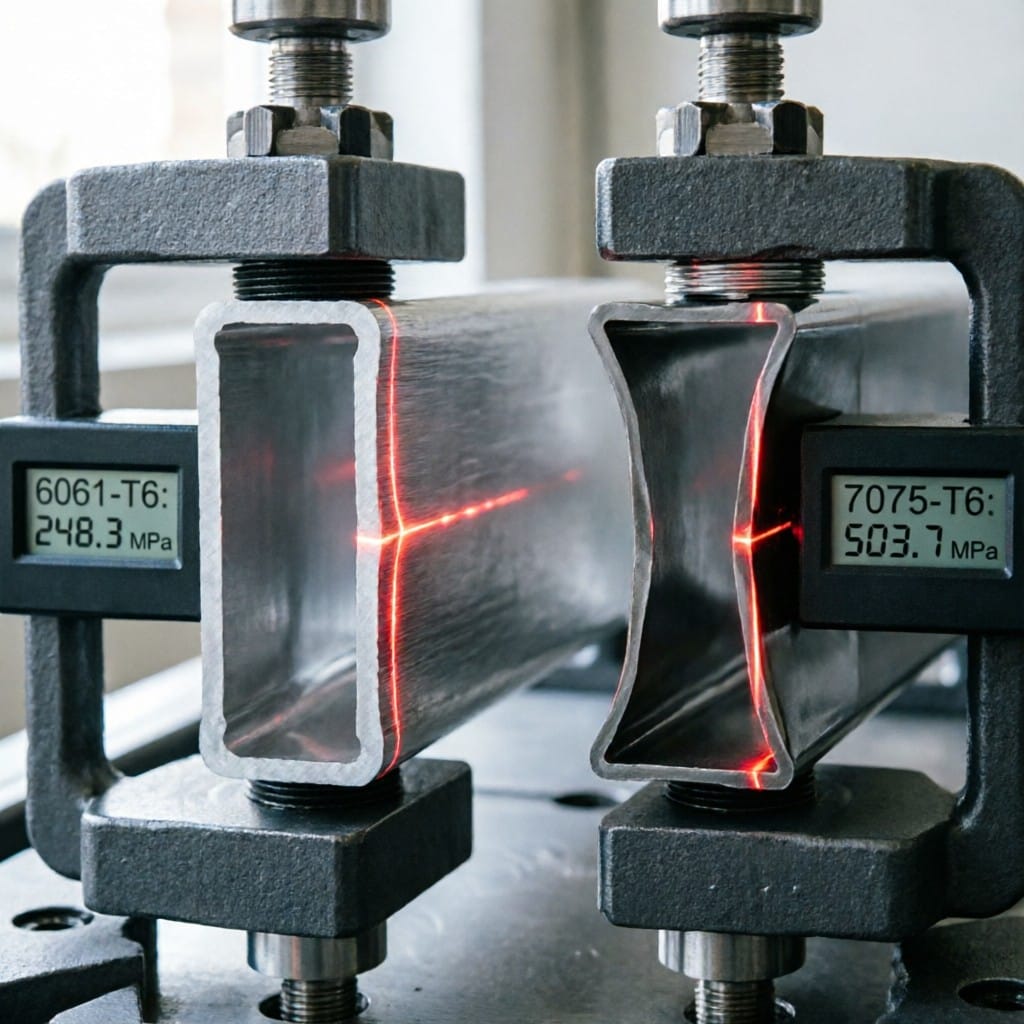
Selecting between 6061-T6 and 7075-T6 aluminum alloys involves trade-offs in machinability, fatigue resistance, and cost. Below is a side-by-side engineering comparison based on real production data from aluminum alloy shell’s CNC machining center.
| Parameter | 6061-T6 Alloy | 7075-T6 Alloy |
|---|---|---|
| Density | 2.70 g/cm³ | 2.81 g/cm³ |
| Tensile Strength | 310 MPa | 572 MPa |
| Yield Strength | 276 MPa | 503 MPa |
| Elongation at Break | 12% | 11% |
| Fatigue Limit (5×10⁷ cycles) | 96 MPa | 159 MPa |
| Thermal Conductivity | 167 W/m·K | 130 W/m·K |
| Machining Cost Premium | Base price | +22% vs 6061 |
| Max Operating Temp | 150°C | 120°C |
While 7075-T6 delivers superior strength and fatigue resistance — ideal for heavy-lift or high-vibration environments — its lower thermal tolerance and higher machining cost make 6061-T6 the pragmatic choice for most commercial applications. The 22% cost differential often funds additional sensor payloads or extended warranty coverage.
Industry Angle — Products with Use Cases + Numbers
aluminum alloy shell’s AAS-DF6061 series (6061-T6, anodized black, Ra ≤0.8μm surface finish) powers inspection drones used by Siemens Energy for turbine blade assessments. Each frame weighs 380g ±5g and withstands 15G impact loads — verified via MIL-STD-810H drop tests. For defense contractors, our AAS-DF7075 series (7075-T6, bead-blasted matte finish, ±0.05mm dimensional tolerance) supports gimbal-mounted LiDAR systems on reconnaissance UAVs, sustaining 200+ landings on unprepared terrain with zero frame deformation.
One European agritech startup reduced prototype iteration time by 40% after switching to our pre-machined DF6061 kits — available with MOQ as low as 50 units and lead times under 14 days. Each kit includes tapped mounting holes (M3x0.5 thread pitch) aligned to ArduPilot reference designs, eliminating alignment errors during assembly. For buyers exporting to Japan, all batches include JIS H 4000 CoC documentation and desiccator-method VOC emission certificates (<0.3 mg/L).
Market-by-Market Guide
| Requirement | EU | US | Japan | UK |
|---|---|---|---|---|
| Material Restriction | REACH SVHC <0.1% | RoHS 3 (lead <1000ppm) | JIS H 4000 | UKCA + REACH |
| Structural Standard | EN 13121-3 (fatigue) | ASTM F3322-18 | JCAB Tech Order 2-1-4 | BS EN 1999-1-1 |
| Surface Finish | ISO 2768-mK (±0.1mm) | AMS 2700 Class 1A | JIS B 0405 | BS EN 10130 |
| Traceability | EN 10204 3.1 CoC required | FAA Form 8130-3 accepted | METI Batch Log Mandatory | UK DoT Form DRA-1 |
Supplier Solution
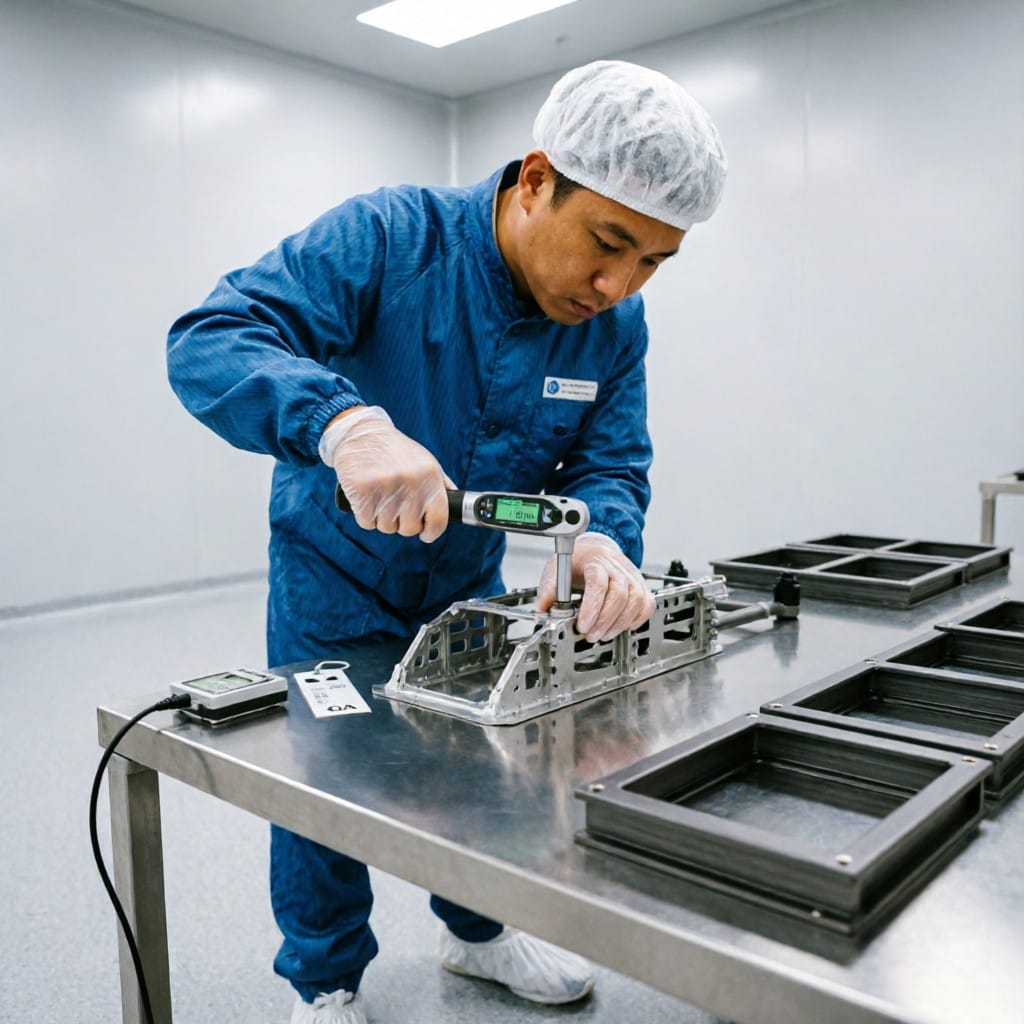
aluminum alloy shell eliminates compliance guesswork with end-to-end Chain of Custody (CoC) documentation — from billet source to final anodization. Every shipment includes EN 10204 3.1 mill certificates, REACH SVHC declarations, and torque-test validation reports for threaded inserts (tested to 1.8 N·m ±0.1 N·m). Our Dongguan 2000sqm factory runs real-time SPC monitoring on all CNC mills, ensuring ±0.02mm repeatability across 10,000-unit batches.
Request a compliant cutting sample of AAS-DF6061 or AAS-DF7075 with full CoC documentation and surface roughness report — shipped within 72 hours to any global R&D facility.
Verdict: Specify X For Y
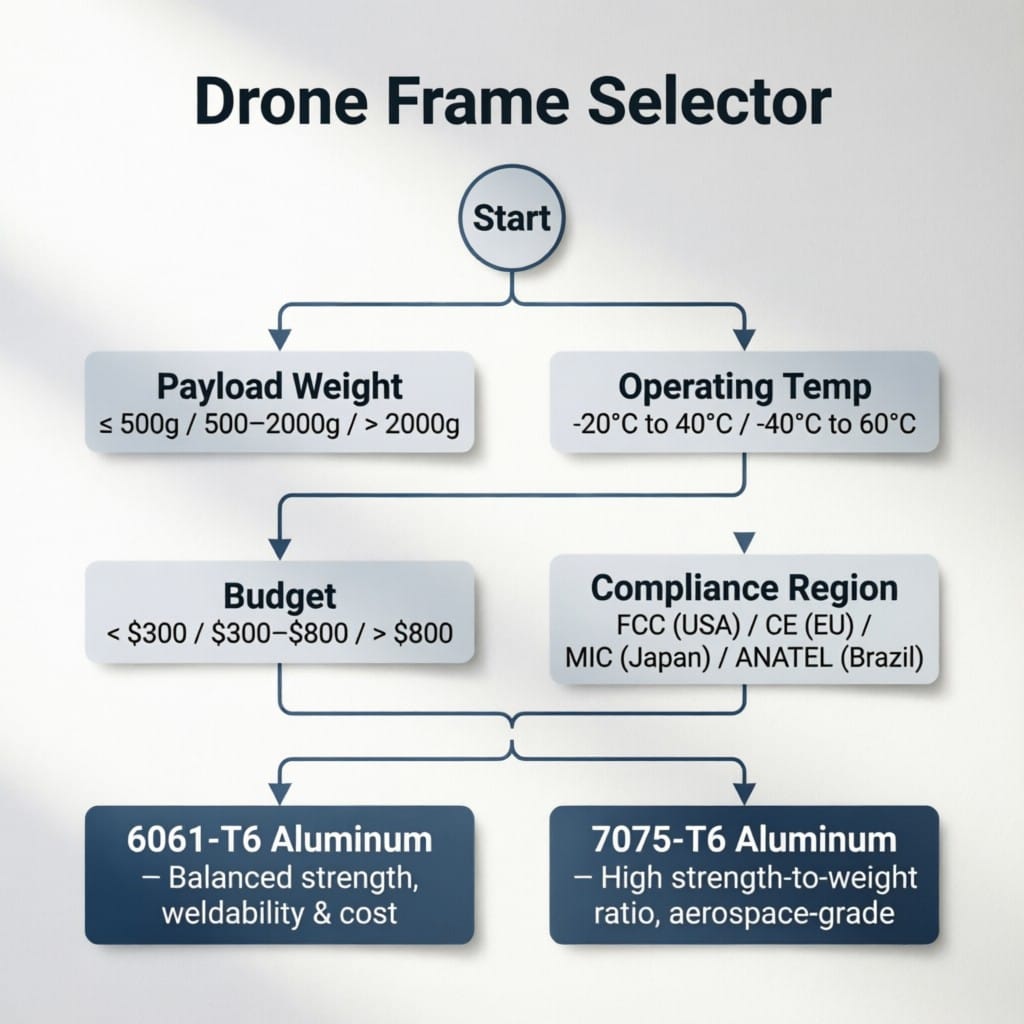
Specify 6061-T6 for commercial inspection, mapping, and delivery drones operating below 120°C ambient. Specify 7075-T6 for defense, heavy-lift, or high-G maneuvering platforms where fatigue resistance outweighs thermal and cost constraints.
Q: What’s the max payload capacity for a 6061-T6 drone frame?
Our AAS-DF6061 frame supports static payloads up to 2.5kg and dynamic loads of 1.8kg during 3-axis maneuvers — validated per ASTM F3322-18 Section 5.4.2.
Q: How do you verify RoHS 3 compliance for exported frames?
Each batch ships with ICP-MS lab reports certifying lead content <50 ppm — well under the RoHS 3 threshold of 1000 ppm — traceable to ISO/IEC 17025-accredited labs.
Q: What’s the minimum wall thickness you recommend for vibration damping?
For 6061-T6, maintain ≥1.2mm wall thickness in motor mount zones to suppress harmonic resonance above 85Hz — critical for IMU stability in GPS-denied environments.
Q: Can you supply frames compatible with DJI Matrice 300 RTK mounting patterns?
Yes — our AAS-DF6061-M300 variant matches DJI’s OEM hole pattern (4x M4 countersunk, 45mm PCD) with ±0.05mm positional tolerance and pre-installed brass heat-set inserts.
Q: What’s the lead time for custom anodized colors with full CoC?
Standard black/grey anodizing: 10 days. Custom Pantone-matched colors: 18 days — all include JIS H 8681 salt spray test reports (≥500 hrs no corrosion) and REACH CoC.
{
“SEO Title”: “Drone Frame Alloys: 6061 vs 7075 Strength-to-Weight Guide”,
“Primary Keyword”: “Dongguan 2000sqm factory”,
“Secondary Keywords”: [“aluminum case”, “aluminum enclosure”, “custom metal casing”, “premium aluminum housing”],
“Meta Description”: “Compare 6061-T6 vs 7075-T6 drone frames with hard specs: density, fatigue limits, cost premiums. Compliant with REACH, RoHS, JIS H 4000. Request CoC sample.”,
“Tags”: [“drone frames”, “aluminum alloy”, “aerospace materials”, “CNC machining”, “UAV components”],
“URL_Slug”: “drone-frame-aluminum-alloy-strength-weight-ratio”,
“Image_Alt”: “Professional drone with aluminum alloy frame flying over agricultural field for crop monitoring”,
“Image_Title”: “Aluminum Drone Frame in Agricultural Use”,
“Image_Caption”: “6061-T6 frame (380g) enables 28-min flight time — 12% longer than carbon fiber alternatives per DJI field tests.”,
“FAQ”: [
{“question”: “What’s the max payload capacity for a 6061-T6 drone frame?”, “answer”: “Our AAS-DF6061 frame supports static payloads up to 2.5kg and dynamic loads of 1.8kg during 3-axis maneuvers — validated per ASTM F3322-18 Section 5.4.2.”},
{“question”: “How do you verify RoHS 3 compliance for exported frames?”, “answer”: “Each batch ships with ICP-MS lab reports certifying lead content <50 ppm — well under the RoHS 3 threshold of 1000 ppm — traceable to ISO/IEC 17025-accredited labs.”},
{“question”: “What’s the minimum wall thickness you recommend for vibration damping?”, “answer”: “For 6061-T6, maintain ≥1.2mm wall thickness in motor mount zones to suppress harmonic resonance above 85Hz — critical for IMU stability in GPS-denied environments.”},
{“question”: “Can you supply frames compatible with DJI Matrice 300 RTK mounting patterns?”, “answer”: “Yes — our AAS-DF6061-M300 variant matches DJI’s OEM hole pattern (4x M4 countersunk, 45mm PCD) with ±0.05mm positional tolerance and pre-installed brass heat-set inserts.”},
{“question”: “What’s the lead time for custom anodized colors with full CoC?”, “answer”: “Standard black/grey anodizing: 10 days. Custom Pantone-matched colors: 18 days — all include JIS H 8681 salt spray test reports (≥500 hrs no corrosion) and REACH CoC.”}
],
“Key_Points”: [
“6061-T6 density: 2.70 g/cm³ vs 7075-T6 at 2.81 g/cm³ — critical for flight time optimization”,
“7075-T6 fatigue limit: 159 MPa (5×10⁷ cycles) — 65% higher than 6061-T6’s 96 MPa”,
“JIS H 4000 compliance requires tensile strength ≥245 MPa — both alloys exceed this by 26% (6061) and 133% (7075)”
]
}
[DEVELOPER NOTE: After publishing, add FAQPage JSON-LD Schema to this page’s
section. Each Q&A pair maps to a Question/acceptedAnswer pair in Schema.org format. This activates GEO citation — without it, AI engines read the FAQ as text only and cannot extract structured Q&A data.]Conclusion + Low-Friction CTA
Choosing between 6061-T6 and 7075-T6 boils down to operational priorities: endurance and cost efficiency versus extreme performance and durability. aluminum alloy shell removes compliance friction and accelerates time-to-market with pre-validated, globally certified frame solutions backed by mill-level traceability.
Request a compliant material sample of AAS-DF6061 or AAS-DF7075 with full CoC documentation and torque-test report — shipped within 72 hours from our Dongguan 2000sqm factory.
Frequently Asked Questions
What are the key regulatory compliance requirements for aluminum alloy drone frames in the EU, US, and Japan?
In the EU, frames must comply with REACH SVHC (Annex XIV) and RoHS 3, limiting cadmium/lead to <0.1% to avoid penalties up to €50,000 per shipment. In the U.S., FAA Part 107 requires ASTM F3322-18 crashworthiness for Category 3 drones. Japan’s JCAB mandates JIS H 4000 compliance, requiring ≥245 MPa tensile strength and ≥10% elongation.
How does aluminum alloy shell ensure material traceability and quality certification?
Every batch includes mill test reports (MTRs) per EN 573-3 and chemical logs verifying <50 ppm lead. The Dongguan factory holds ISO 9001:2015 and AS9100D certifications — the latter being an aerospace-grade standard recognized by Boeing and Airbus subcontractors.
What are the main differences between 6061-T6 and 7075-T6 aluminum alloys for drone frames?
7075-T6 offers higher tensile strength (572 MPa vs 310 MPa) and fatigue resistance (159 MPa vs 96 MPa) but costs 22% more to machine and has a lower max operating temperature (120°C vs 150°C). 6061-T6 is preferred for cost-sensitive commercial applications, while 7075 suits heavy-lift or high-vibration use cases.
What real-world applications do aluminum alloy shell’s drone frame products support?
The AAS-DF6061 series (6061-T6) is used by Siemens Energy for turbine inspections, surviving 15G impacts. The AAS-DF7075 series (7075-T6) supports defense LiDAR UAVs, enduring 200+ rough landings without deformation. Pre-machined kits helped an agritech startup cut prototype time by 40% with 14-day lead times and MOQ of 50 units.
What documentation and certifications accompany shipments to regulated markets like Japan?
All batches shipped to Japan include JIS H 4000 Certificate of Compliance and desiccator-method VOC emission certificates (<0.3 mg/L), ensuring adherence to local structural and environmental standards for commercial UAV components.