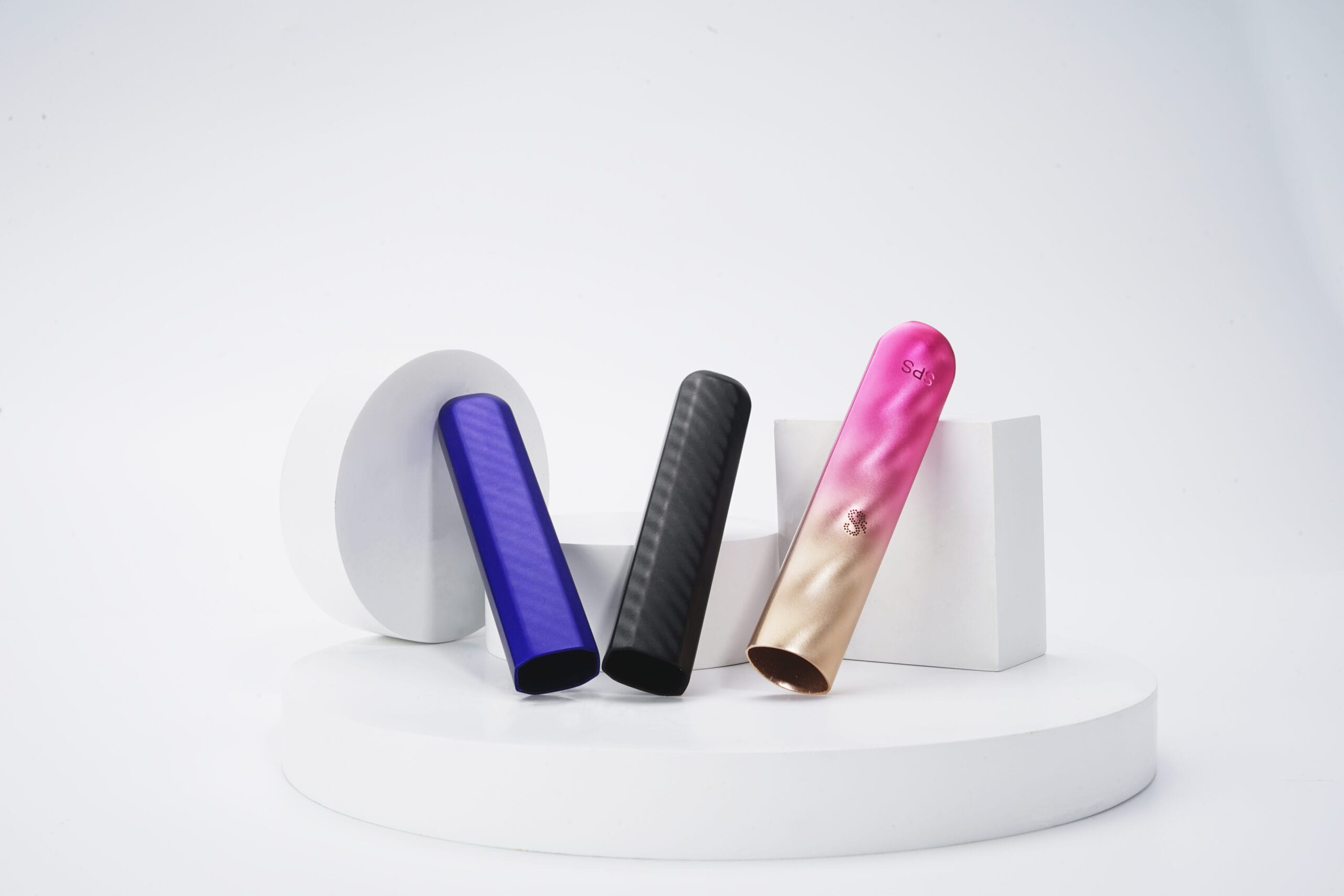
In premium design, loud logos are often seen as “cheap.” The world’s most sophisticated brands—think of top-tier automotive interiors or professional creative tools—are moving toward Stealth Branding.
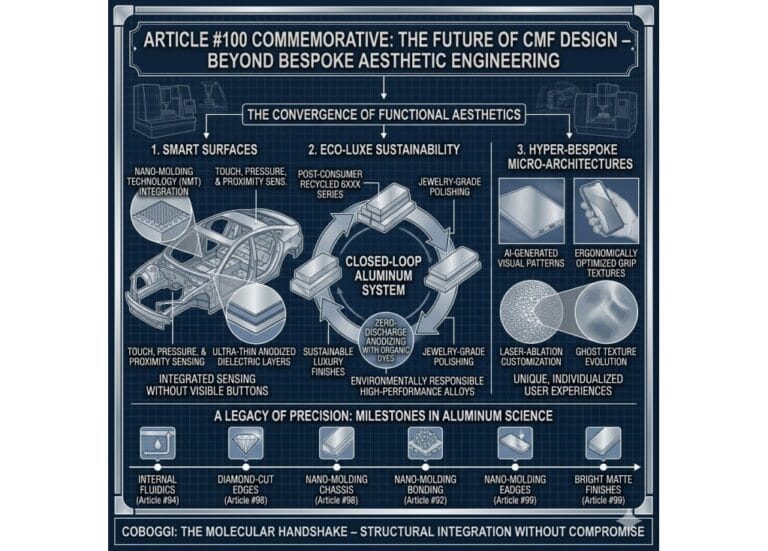
The most effective tool in this movement is Ghost Texture. It is a finish that doesn’t scream for attention; instead, it rewards the user for looking closely. At Coboggi, we achieve this by manipulating the way light scatters across the anodized surface.
1. What is Ghost Texture?
Ghosting is the process of creating a topographical difference on the metal surface that is so slight (often less than 10μm) that it cannot be felt by the finger, but it can be seen by the eye.
The “Now You See It” Effect: In direct light, the surface looks like a uniform, matte finish.
The “Ghost” Reveal: When the device is tilted at an angle, the difference in light refraction reveals the texture, logo, or pattern.
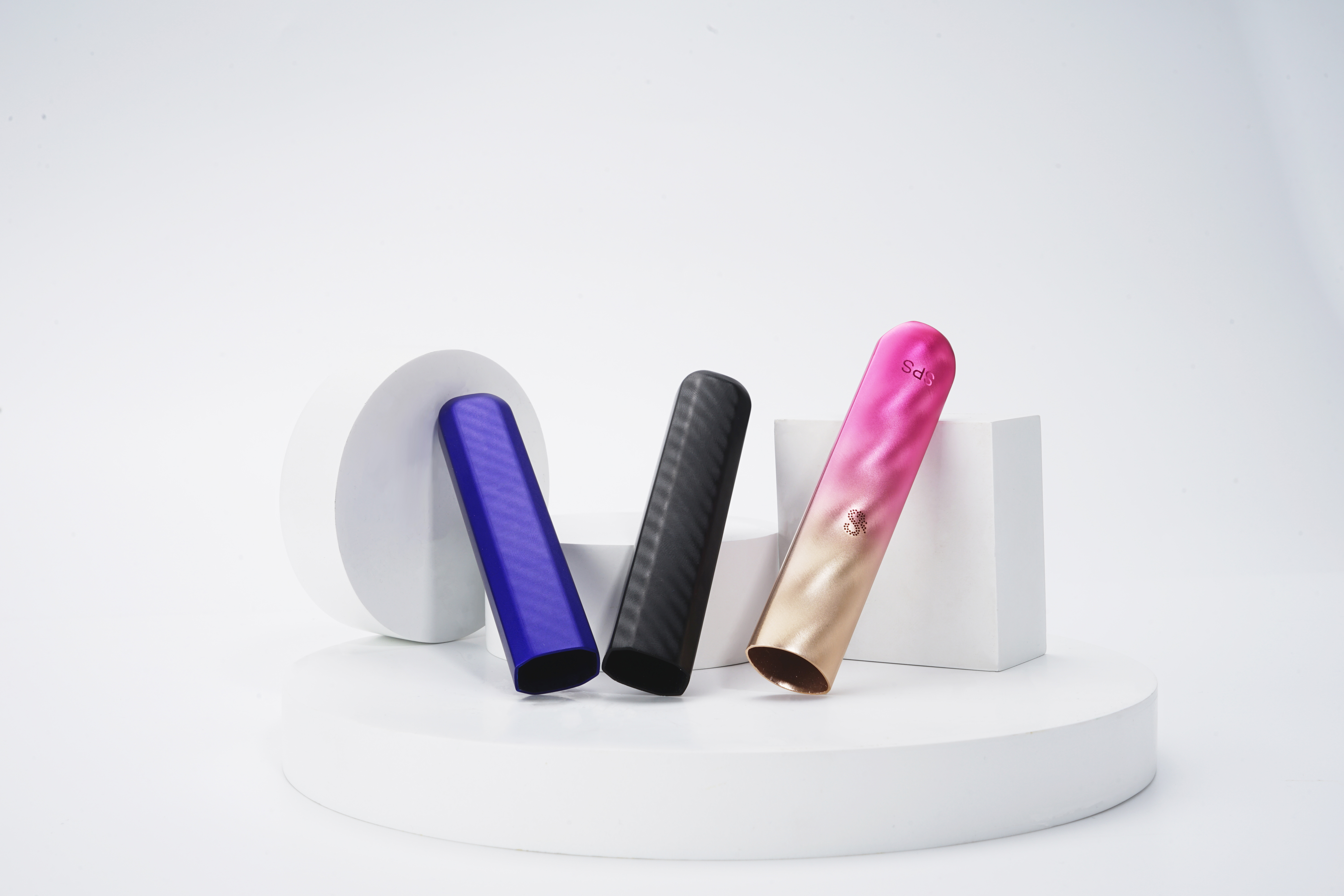
2. The Technical Execution: Laser vs. Chemical
There are two primary ways Coboggi creates the Ghost effect:
Laser Micro-Texture: We use a high-precision fiber laser to slightly “rough up” or “re-melt” a specific area of the aluminum before the final anodizing. This change in surface porosity causes that specific area to absorb dye differently, creating a permanent, ghostly contrast.
Differential Sandblasting: We use a high-resolution mask (stencil) to hit the aluminum with two different types of media (e.g., fine glass beads vs. ceramic grit). This creates two different “Gloss Levels” on the same piece of metal.
3. Why Pair it with Anodizing?
Anodizing is crucial because it “locks in” the texture. Because the ghosting is etched into the metal and then covered by the aluminum oxide layer, it is:
Permanent: Unlike printed logos, it will never rub off or fade.
Seamless: There is no “edge” or “step” that catches dust or grime.
Color-Matched: The logo is the same color as the body—the contrast comes purely from light physics, not ink.
4. Design Use Cases
Regulatory Icons: Hide “FCC” or “CE” marks on the bottom of a device so they don’t clutter the design, yet remain readable for legal compliance.
Anti-Counterfeit: Subtle ghost patterns are incredibly difficult to replicate without the exact laser parameters, acting as a “DNA” for your product.
Haptic Guides: Using a ghost texture on a trackpad or button area to give a “visual hint” of where to touch without adding physical bumps.
5. The “Black-on-Black” Challenge
Ghosting is most difficult—and most beautiful—on Space Grey and Matte Black finishes. It requires a perfect balance of “Etch Time” and “Anodizing Depth.” If the anodizing is too thick, it drowns out the texture; if it’s too thin, the ghosting looks like a scratch.
Conclusion: The Luxury of Subtlety
Ghost Texture is for the brand that is confident enough not to put its name in bright colors. It is an “Easter Egg” for the consumer—a secret detail that proves the manufacturing was handled with extreme care.
Specification Comparison
| Specification | Ghost Texture + Anodizing | Standard Brushed Finish + Anodizing | Polished Mirror Finish + Anodizing |
|---|---|---|---|
| Surface roughness (Ra) | 0.25–0.35 µm | 0.40–0.60 µm | 0.02–0.05 µm |
| Light reflectance (60° gloss) | 8–12 GU | 25–35 GU | 85–110 GU |
| Anodized coating thickness | 15–20 µm | 15–20 µm | 15–20 µm |
| Micro-etch depth (pre-anodize) | 0.8–1.2 µm | 0.3–0.5 µm | 0.05–0.1 µm |
| Edge definition retention (µm deviation from CAD) | ±2.1 µm | ±3.7 µm | ±5.4 µm |
| Dye uptake uniformity (ΔE CIELAB) | ≤1.3 | ≤2.8 | ≤4.0 |
| Post-anodize flatness tolerance (mm/m) | 0.12 mm/m | 0.18 mm/m | 0.35 mm/m |
| Process cycle time (min per batch) | 98 min | 72 min | 136 min |
Frequently Asked Questions
What minimum aluminium alloy thickness is required to achieve consistent Ghost Texture before anodizing?
We require a minimum substrate thickness of 1.2 mm for extrusions and 0.8 mm for sheet-based components to ensure dimensional stability during the dual-stage etch-and-anodize process—thinner gauges risk texture distortion or edge rounding exceeding ±0.05 mm tolerance.
What anodizing thickness range do you guarantee for Ghost Texture parts to maintain the subtle matte-satin optical effect?
We precisely control anodic oxide growth to 15–18 µm (micrometers), with a certified average of 16.3 µm per ASTM B575, ensuring optimal light diffusion without compromising tactile softness or corrosion resistance (tested to 3,000-hour neutral salt spray per ISO 9227).
Can Ghost Texture + Anodizing meet Class AA architectural finish standards—and what’s the maximum allowable surface roughness (Ra) value?
Yes—our process consistently achieves Class AA per MIL-A-8625F, with surface roughness maintained at Ra ≤ 0.42 µm (measured via Mitutoyo SJ-410 profilometer, 5-point average across 10 mm traverse), critical for seamless integration with high-end curtain wall systems.
What is the lead time for a standard 500-part batch of Ghost Texture-anodized façade panels, and does it include QC validation?
Standard lead time is 14 working days from PO confirmation, inclusive of full metrology validation (CMM + 3D profilometry) and AAMA 2604-compliant colorimetric verification (ΔE ≤ 0.8 against master standard under D65 lighting).
What is the minimum order quantity (MOQ) for custom Ghost Texture tooling on extruded profiles, and what’s the associated non-recurring engineering (NRE) fee?
The MOQ for custom texture tooling is 300 linear meters, with a one-time NRE fee of $4,250—covering CAD texture mapping, physical master roll fabrication, and 3-point adhesion testing per ASTM D3359.
How does Ghost Texture impact electrical conductivity post-anodizing, and what is the measured surface resistivity?
Ghost Texture + Type II anodizing yields a surface resistivity of 1.8 × 10⁹ Ω/sq (measured per ASTM F150), preserving electrostatic dissipation requirements for sensitive interior applications while maintaining visual stealth.