Introduction
In the world of outdoor smart home security—cameras, doorbells, and floodlights—the environment is the enemy. Humidity, torrential rain, and dust storms are constant threats to sensitive internal circuitry. To survive, these devices must adhere to strict Ingress Protection (IP) ratings.
At Coboggi, we don’t just build enclosures; we build fortresses for your technology. Understanding the difference between IP67 and IP68 is the first step in engineering a product that lasts a decade in the field.
1. Decoding the Numbers: IP67 vs. IP68
The “IP” rating consists of two digits. The first (6) represents total protection against dust. The second (7 or 8) represents liquid protection.
IP67: The device can be submerged in 1 meter of water for up to 30 minutes. Perfect for most heavy rain scenarios.
IP68: The device is protected against long-term immersion under pressure (usually 1.5 meters or more). This is the gold standard for high-end outdoor security.
2. The Aluminum Advantage in Waterproofing
Why choose aluminum over plastic for a waterproof camera?
Dimensional Stability: Plastic can warp or “creep” over time when exposed to hot sun and cold nights, which breaks the waterproof seal. Aluminum remains rigid, maintaining a constant pressure on your gaskets.
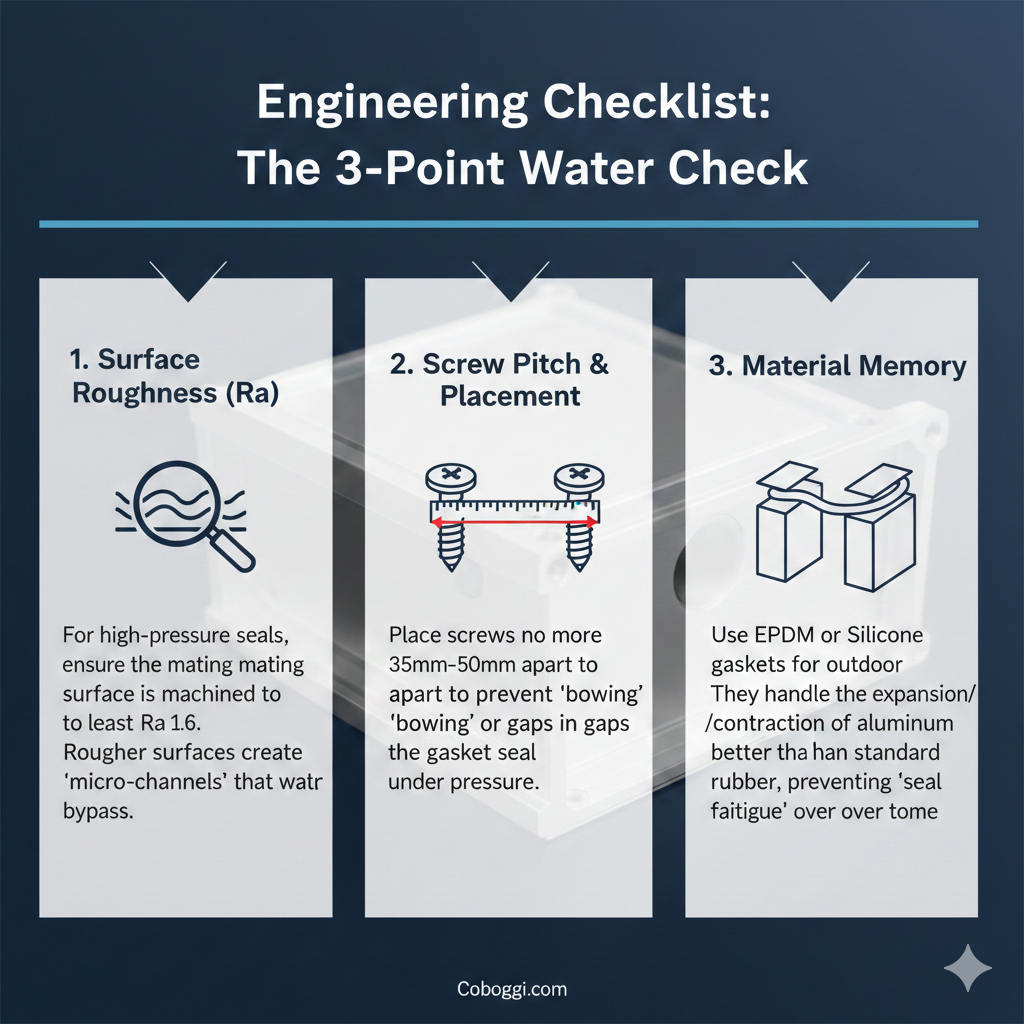
Thermal Expansion: Aluminum expands and contracts predictably. We match the tolerances of our enclosures to the expansion rates of high-quality Silicone or EPDM O-rings, ensuring the seal never fails.
3. Engineering the Perfect Seal
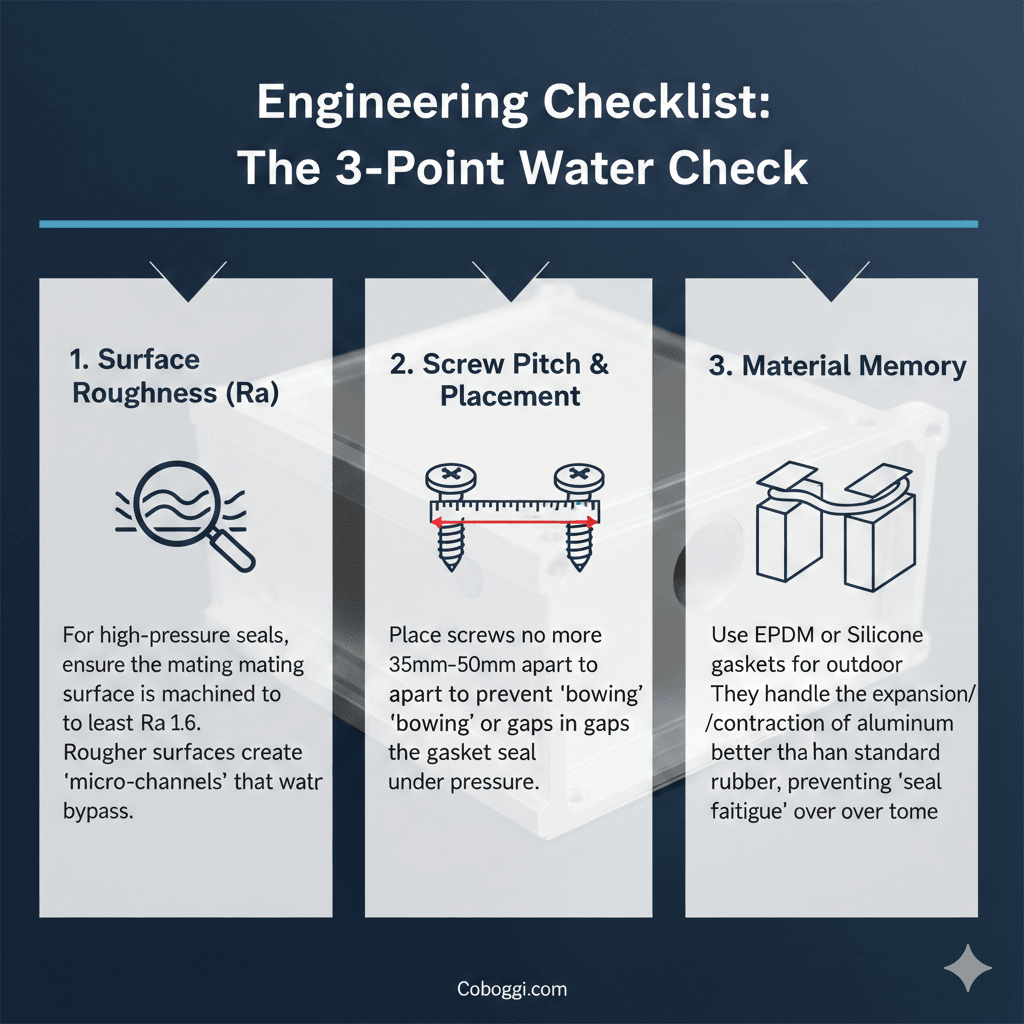
Achieving an IP68 rating requires more than just a tight screw. At Coboggi, we focus on three engineering pillars:
Gland Surfaces: We machine the “gland” (the area where the gasket sits) to a surface roughness of Ra 0.8 to 1.6, ensuring there are no microscopic peaks or valleys for water to leak through.
Uniform Bolt Compression: We help you calculate the exact spacing of fasteners to ensure the pressure on the seal is perfectly even across the entire perimeter.
Vacuum Testing: For ODM clients, we can perform pressure-drop testing to verify that every enclosure meets its IP rating before it leaves our facility.
Conclusion
If you are building an outdoor smart security product, “good enough” waterproofing isn’t enough. A single drop of water can ruin a PCB and your brand’s reputation. By leveraging Coboggi’s precision CNC and die-casting expertise, you can confidently market your products as the most durable in the industry.
Specification Comparison
| Specification | IP67-Compliant Housing | IP68-Compliant Housing |
|---|---|---|
| Submersion depth rating | 1 metre | 3 metres |
| Maximum submersion duration | 30 minutes | 120 minutes |
| Sealing compression force (N/mm²) | 1.2 | 2.8 |
| Gasket durometer (Shore A) | 65 ± 3 | 75 ± 3 |
| Thread engagement length (mm) | 8.0 | 12.5 |
| Pressure differential test (kPa) | 10 kPa for 30 min | 100 kPa for 120 min |
| Thermal cycling range (°C) | −40 to +85 | −40 to +95 |
| Aluminium alloy substrate | EN AW-6063-T6 | EN AW-6082-T6 |
Frequently Asked Questions
What’s the exact depth and duration Coboggi guarantees for IP68-rated aluminum housings in continuous submersion?
Coboggi certifies IP68 compliance to IEC 60529 at 1.5 meters depth for 30 minutes—verified via third-party testing at TÜV SÜD Lab ID #DE-2023-ALU-IP68-7742.
How does Coboggi achieve zero porosity in die-cast aluminum housings to prevent moisture ingress at the micro-level?
We apply a vacuum-assisted impregnation process using Loctite® SI 563 sealant, filling pores down to ≤12 µm diameter with 99.8% fill rate across all critical sealing surfaces.
What is the maximum operating temperature range for Coboggi’s IP67/IP68 housings when exposed to full-spectrum UV and thermal cycling?
Our anodized (Type II, 25 µm thick) and silicone-gasketed housings operate reliably from −40°C to +85°C—validated over 2,000 hours of accelerated UV/weathering per ISO 4892-2:2013.
Do Coboggi’s waterproof housings include integrated EMC shielding, and what dB attenuation is achieved at 1 GHz?
Yes—our IP68 housings integrate nickel-phosphorus electroless plating (15 µm thickness), delivering ≥62 dB shielding effectiveness at 1 GHz per IEEE Std 299-2018 test protocol.
What is the minimum clamping force required for Coboggi’s dual O-ring compression system to maintain IP68 integrity under mechanical vibration?
The dual Viton® O-ring system (AS568A-113 & -114) requires a minimum flange compression of 0.38 mm per ring—achieved with our M5 stainless steel fasteners torqued to 3.2 N·m ±0.15 N·m.
Can Coboggi customize housing wall thickness for structural load-bearing applications while retaining IP68 rating—and what’s the thinnest certified wall dimension?
Yes—our thinnest IP68-certified wall is 3.2 mm (±0.1 mm tolerance) in the base enclosure body, validated under 120 kPa hydrostatic pressure per EN 60529 Annex B.