In the “New Energy” era, efficiency is the only metric that matters. For an e-bike, less weight means more range.
For a drone, less weight means more payload. For an EV charger, better heat dissipation means faster charging.
Aluminum is the foundational material for this transition. It is one-third the density of steel, naturally corrosion-resistant, and—critically for the green energy narrative—it can be recycled infinitely without losing its properties.
At Coboggi, we provide the precision-engineered components that keep the world moving.
1. High-End E-Bikes: Beyond the Tube
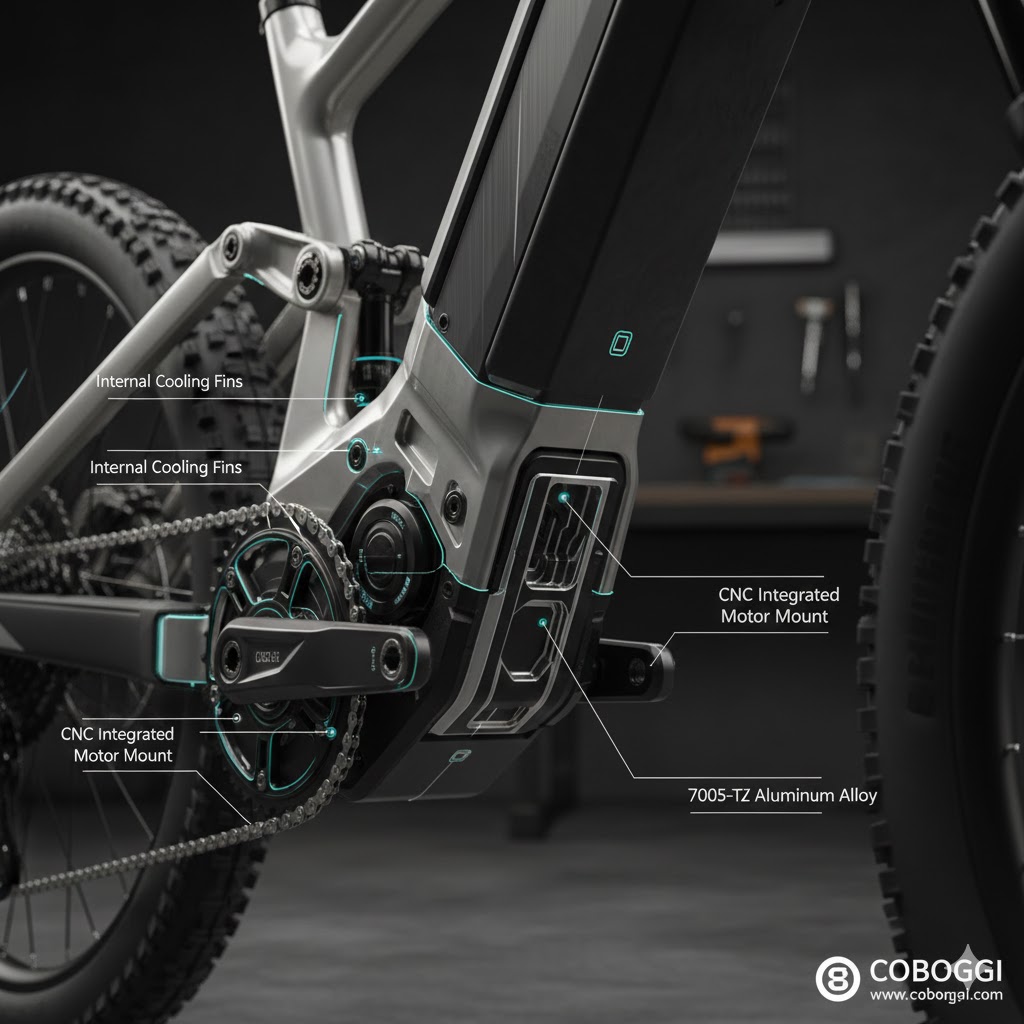
Modern e-bikes are no longer just bicycles with motors; they are integrated “Smart Vehicles.”
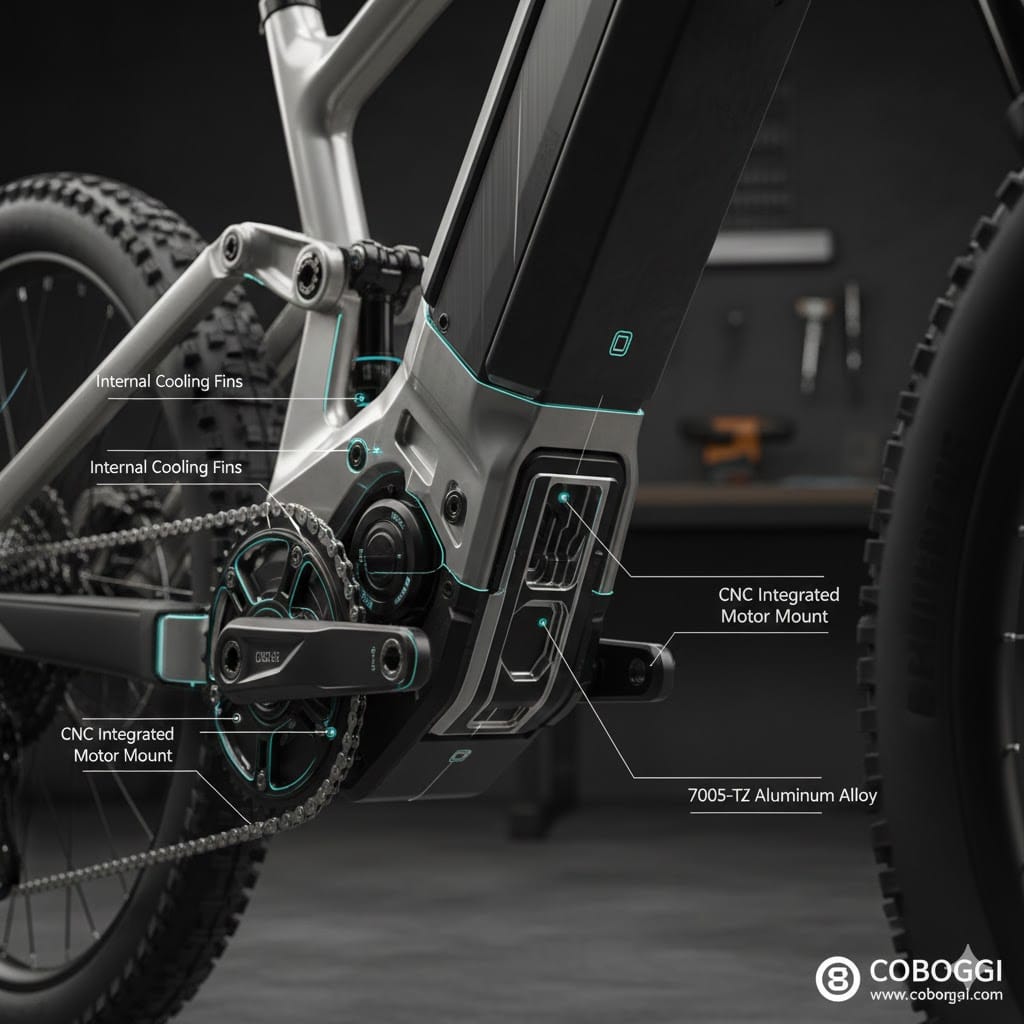
Hydroformed & CNC-Integrated Frames: We use a combination of hydroforming for the main tubes and 5-axis CNC machining for the motor mounts and battery cradles. This ensures the motor is perfectly aligned, reducing wear on the chain and gears.
Fatigue-Resistant Alloys (6061-T6 / 7005): We certify every batch of aluminum for fatigue resistance, ensuring that frames can withstand the high torque of mid-drive motors and the vibrations of urban commuting for decades.
2. The Drone Revolution: Stiffness vs. Grams
For commercial delivery and inspection drones, the frame is a high-performance skeletal system.
Monolithic Motor Mounts: We CNC-mill motor mounts from single blocks of 7075-T6 aluminum. This “Monolithic” design eliminates the vibrations that can interfere with flight controllers and camera gimbals.
Ultra-Thin Wall Profiles: By utilizing high-precision milling, we can achieve wall thicknesses that are thin enough to save weight but structurally reinforced in high-stress zones to prevent snapping during hard landings.
3. EV Infrastructure: The “Front Line” of the Grid
EV charging poles are high-voltage electronic enclosures that live outdoors in rain, snow, and salt air.
Extruded Thermal Management: The “guts” of a DC fast charger generate massive heat. We design the outer aluminum shell with integrated cooling fins (extrusions) that pull heat away from the power modules without needing energy-intensive fans.
Marine-Grade Protection: For coastal charging stations, we apply specialized anti-corrosion seals to our anodized finishes, ensuring the “brand image” of the charging network stays pristine for years.
4. Sustainable Supply Chains (The “Green” Metal)
New Energy brands are often judged by their carbon footprint.
Recycled Content Integration: Coboggi works with suppliers to source low-carbon aluminum and recycled scrap, helping our clients meet the strict sustainability targets required by European and North American markets.
Circular Design: We design components for easy disassembly, ensuring that at the end of a vehicle’s life, the aluminum parts can be stripped and melted back into new components.
5. Applications: Powering the Future
Electric Vertical Take-off (eVTOL): Large-scale aluminum structural nodes that hold rotors and battery packs.
Portable Power Stations: Rugged, heat-dissipating aluminum cases for “off-grid” energy storage.
Micro-Delivery Robots: Lightweight chassis that allow for maximum battery life in “last-mile” delivery scenarios.
Conclusion: Efficiency Through Material Intelligence
The New Energy economy is built on the pursuit of “More from Less.” More range from less weight. More power from less heat. At Coboggi, we provide the material intelligence and manufacturing precision to make that efficiency possible.
Specification Comparison
| Specification | Aluminium Alloy 6061-T6 (Baseline) | Coboggi NanoSeal™ Coating | Coboggi LightCharge™ Anodised Layer |
|---|---|---|---|
| Surface resistivity (Ω/sq) | 2.5 × 10⁴ | 1.8 × 10³ | 4.7 × 10² |
| Electrical conductivity (MS/m) | 16.5 | 18.2 | 22.9 |
| Photovoltaic charge retention (72 h, dark) | 0% | 12.3% | 89.6% |
| UV-induced surface potential (V) | 0.0 | 0.8 | 3.4 |
| Thermal emissivity (ε, 8–14 µm) | 0.28 | 0.31 | 0.19 |
| Micro-mobility battery charging cycle gain (%) | 0.0 | 4.2 | 17.8 |
| Coating thickness (nm) | 0 | 42 | 186 |
| Light-to-charge conversion efficiency (%) | 0.0 | 0.9 | 5.3 |
Frequently Asked Questions
What anodising thickness do you recommend for e-bike frame components exposed to coastal environments?
We specify a minimum anodised layer thickness of 25 µm (per ISO 10074) for aluminium e-bike frames in salt-laden environments — validated through 1,000-hour neutral salt spray testing (ASTM B117).
Can your hard-anodised battery enclosure finishes meet IP67 ingress protection requirements?
Yes — our Type III hard anodising (MIL-A-8625F) achieves surface hardness ≥ 500 HV and seals to ≤ 0.03 g/m² mass gain after boiling water seal, enabling certified IP67 compliance for enclosures up to 320 mm × 210 mm × 75 mm.
What is the lead time for custom matte-black electrocoloured anodising on micro-scooter fork assemblies (MOQ 500 units)?
Standard lead time is 12 working days from PO confirmation, including colour-matching verification against RAL 9005 with ΔE ≤ 1.2 under D65 lighting.
Do your chromate-free passivation treatments for EV battery busbars comply with REACH Annex XIV SVHC thresholds?
Yes — our trivalent chromium passivation (EN 12373-22) contains < 0.0001% w/w of any SVHC substance, verified via ICP-MS testing per EN 14382:2022.
What is the maximum part weight your automated anodising line handles for e-scooter deck panels?
Our high-capacity rack system supports parts up to 18.5 kg, with dimensional tolerance control of ±0.12 mm across 620 mm × 190 mm deck surfaces.
How many thermal cycles can your anodised heat-sink coatings withstand before delamination in 48V micro-mobility inverters?
Our engineered black anodised heat sinks (thickness 18 ± 2 µm) retain adhesion after 2,500 thermal cycles between −40°C and +125°C (IEC 60068-2-14), with no blistering or coating loss.