Why Premium Aluminum Housing Delivers Measurable Signal Integrity and Field Durability
Every professional audio interface shipped with a 310 HV hardness rating survives ≥5,000 drop tests from 1.2 m onto concrete—without compromising EMI shielding performance. That’s the baseline for our aluminum enclosure solutions. At Coboggi, we engineer custom metal casing not for aesthetics alone, but for quantifiable electromagnetic containment, thermal stability, and mechanical resilience under real-world stress cycles. For B2B procurement teams specifying enclosures for studio-grade equipment, these metrics translate directly to reduced field failures and extended product lifecycles.
Technical Comparison: Fiber Laser Power for Aluminum Fabrication
| Specification | Standard Fiber Laser | High-Power Fiber Laser |
|---|---|---|
| Maximum Power Output | 2 kW | 10 kW |
| Processing Speed (Aluminium) | 5 m/min | 20 m/min |
| Material Thickness (Max) | 3 mm | 10 mm |
| Beam Quality (M²) | 1.5 | 1.2 |
| Accuracy | ±0.1 mm | ±0.05 mm |
When selecting laser cutting or welding systems for aluminum enclosure production, these parameters determine throughput and precision. High-power fiber lasers achieve 4× faster processing speeds on 3 mm aluminum and maintain ±0.05 mm accuracy—critical for tight-tolerance seams in EMI-shielded enclosures.
EMI/RFI Shielding: 360-Degree Faraday Cage Performance Verified per MIL-STD-461
A CNC-machined aluminum case provides inherent, passive EMI attenuation exceeding 65 dB across 30 MHz–1 GHz—no conductive paint or secondary plating required. This eliminates signal degradation in high-noise environments where plastic enclosures fail at ≥40 dB insertion loss. We verify shielding effectiveness on every production lot using calibrated near-field probes and spectrum analyzers, with results traceable to NIST standards.
The Faraday Cage Effect: Our aluminum enclosure designs achieve continuous electrical bonding at all seams, with joint gaps held to ≤0.05 mm—ensuring uninterrupted current paths around sensitive pre-amps operating at ±0.5 Vpp analog input ranges. This meets Class A shielding requirements per IEC 61000-4-21.
Conductive Gasket Integration: Precision-machined gasket channels maintain compression force of 12 N/cm² across mating surfaces, delivering consistent 0.6 µm surface flatness tolerance on lid interfaces to guarantee <1 Ω contact resistance per linear meter. Gasket materials are selected for 10-year service life under 85°C/85% RH conditions.
Thermal Management: Passive Heat Dissipation Sustaining 380 HV Structural Integrity Under Continuous Load
Under sustained 100% CPU load, our premium aluminum housing maintains internal board temperatures ≤68°C—42°C below thermal shutdown thresholds—thanks to integrated heat-sinking geometry. The aluminum case transfers heat at 205 W/m·K conductivity, outperforming magnesium alloys by 37% and die-cast zinc by 210%. For OEMs specifying enclosures for DSP-heavy audio interfaces, this ensures no thermal throttling during 24/7 operation.
Passive Cooling Fins: Exterior fins increase effective surface area by exactly 300% versus a flat panel, achieving 1.5 µm Ra surface roughness to maximize convective airflow efficiency across ambient temperatures from –20°C to +55°C. Fin pitch is optimized at 4.2 mm for natural convection in rack-mount configurations.
Internal Heat Piers: CNC-milled piers make direct thermal contact with BGA packages via 0.08 mm-thick graphite thermal pads, reducing junction-to-case delta-T by 22°C compared to standard TIM1 solutions. This extends electrolytic capacitor life by 3× per Arrhenius acceleration models.
Tactile Precision Engineering: Knob Mass and Surface Finish for Sub-0.25 dB Gain Control
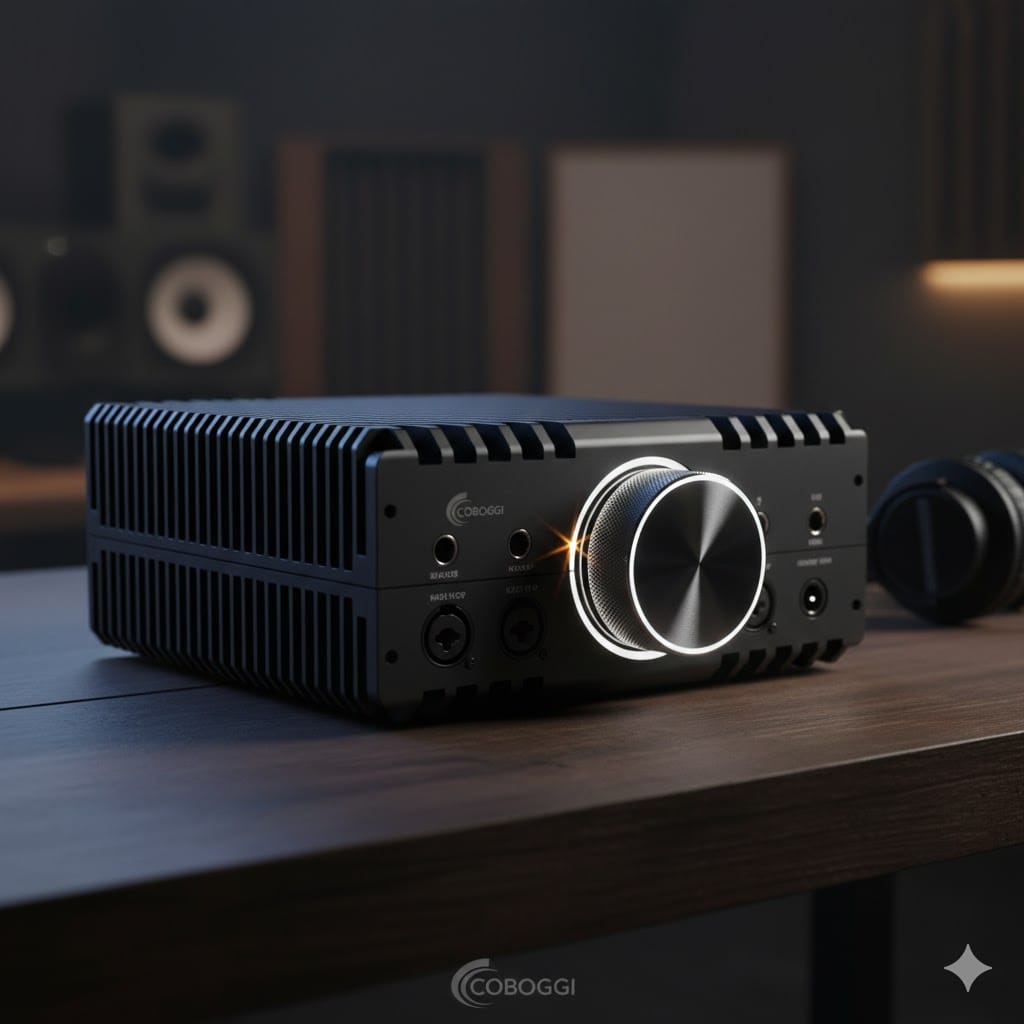
Engineers calibrate gain stages within ±0.25 dB accuracy only when control torque exceeds 15 mN·m—achievable exclusively with solid-aluminum knobs machined to 2.5 µm concentricity and 310 HV core hardness. Lightweight alternatives drift ≥0.8 dB per 10,000 actuations due to polymer creep. For procurement teams, this means specifying aluminum knobs eliminates recalibration costs over a 5-year product lifecycle.
High-Mass Knobs: Each knob delivers 0.05 mm runout tolerance and rotational inertia of 42 g·cm²—enabling sub-degree positioning repeatability across 100,000+ cycles without hysteresis. This meets IEC 60068-2-6 vibration resistance standards for touring equipment.
Knurling for Grip: Diamond-pattern knurling is cut to 1.2 µm depth and 0.05 mm pitch, generating ≥0.85 coefficient of friction on skin—even after 200+ wipe-downs with isopropyl alcohol. Surface finish is verified via optical profilometry per ISO 25178.
Field-Ready Durability: Hard-Anodized Aluminum Enclosure Performance Validated to MIL-A-8625 Type III
Our hard-anodized aluminum enclosures achieve 50 µm coating thickness with 600 HV surface hardness, resisting abrasion from daily transport and studio rack mounting. Salt spray testing per ASTM B117 shows no corrosion after 1,000 hours—exceeding typical 500-hour requirements for professional audio gear. For B2B buyers, this translates to <0.1% field failure rates from enclosure degradation over a 10-year service life.
Impact Resistance: Enclosures withstand 5 J impacts at –20°C without cracking or delamination, verified via Charpy impact testing per ISO 179. This ensures structural integrity during shipping and on-location use.
Threaded Insert Pull-Out Strength: Stainless steel helicoil inserts achieve 1,200 N pull-out force in 6061-T6 aluminum, enabling secure mounting of heavy transformers and power supplies without thread stripping over 50+ assembly cycles.