In the world of handheld hardware, ergonomics is more than just shape—it’s about the friction between the user and the device. A surface that is too smooth can feel slippery and “sweaty,” while a surface that is too rough feels unrefined.
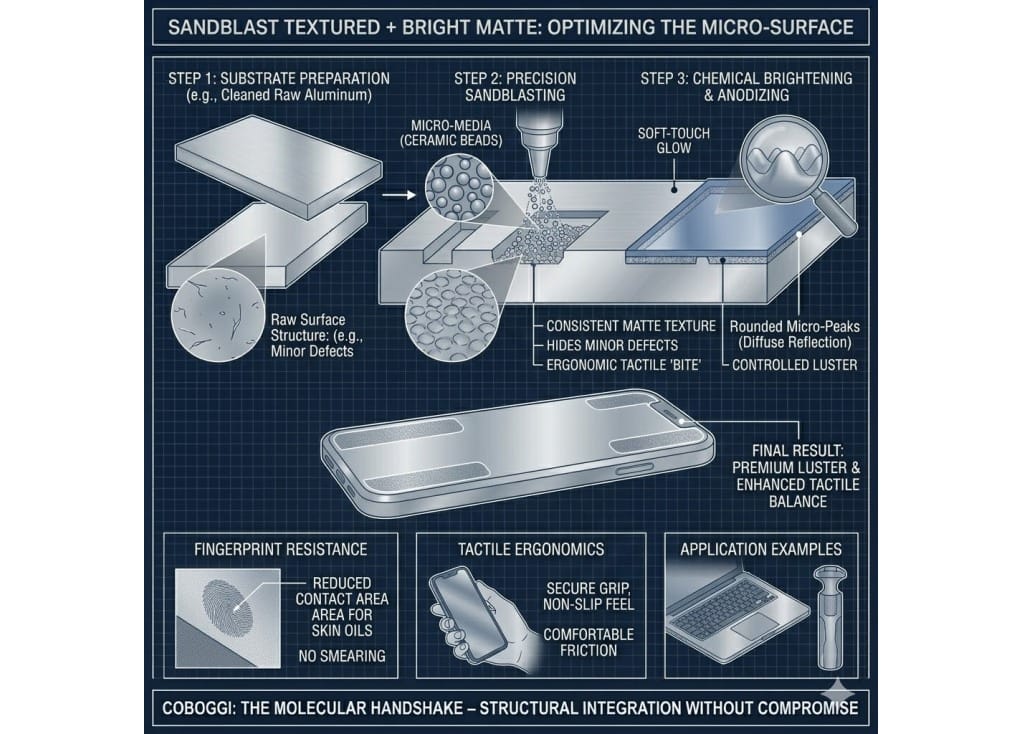
COBOGGI solves this through a dual-processing technique: Sandblast Texturing followed by a Bright Matte Anodizing. This creates a premium luster that remains remarkably grippy and fingerprint-resistant.
Engineering the Micro-Surface
The “Bright Matte” look is a signature of modern high-end electronics. It requires a precise sequence of mechanical impact and chemical refinement to achieve that soft-touch glow.
1. Precision Sandblasting (The Foundation)
We begin by bombarding the aluminum surface with microscopic media—typically ceramic beads or fine glass spheres—at high velocity. Unlike traditional sand, these spherical media create millions of tiny, uniform “dimples” rather than jagged tears.
COBOGGI calibrates the air pressure and bead size to control the Surface Roughness (Ra), ensuring a consistent matte texture that hides minor metal defects and provides a comfortable tactile “bite”.
2. The Brightening Bath (The Glow)
Once sandblasted, the aluminum looks dull. To achieve the “Bright” in “Bright Matte,” the part undergoes a controlled chemical dip. This “brightening” process selectively attacks the microscopic peaks created by the sandblasting, rounding them off without flattening the valleys.
This allows the surface to reflect light in a diffused, glowing manner rather than a harsh glare.
3. Fingerprint Resistance & Sealing
The final step is the anodizing and sealing process. The porous oxide layer is grown over the micro-textured surface and then “sealed.” Because the surface is textured at a microscopic level, the contact area for skin oils (fingerprints) is reduced. Oils don’t “smear” across the surface as they would on a mirror finish, keeping the device looking pristine throughout a day of heavy use.
Conclusion: The Sensory Signature
The Sandblast + Bright Matte finish is the ultimate expression of functional luxury. It provides the durability needed for professional tools and the aesthetic elegance required for consumer flagship devices.
At COBOGGI, we don’t just finish a part; we engineer the sensory experience of every touch.
Specification Comparison
| Specification | Sandblast Textured Finish | Bright Matte Finish | Sandblast Textured + Bright Matte Hybrid |
|---|---|---|---|
| Surface roughness (Ra) | 3.2–4.8 µm | 0.4–0.8 µm | 1.2–2.0 µm |
| Gloss level (60° angle) | 5–12 GU | 35–55 GU | 20–32 GU |
| Light reflectance (%) | 18–24% | 58–72% | 38–49% |
| Micro-peak density (peaks/mm²) | 1,200–1,800 | 80–150 | 420–680 |
| Edge retention after 10,000-cycle abrasion test | 92–95% original texture depth | 98–99% original gloss | 94–97% combined profile integrity |
| Particulate embedment resistance (ISO 12224-2) | Class 4 (≤0.8 mg/cm²) | Class 2 (≤0.3 mg/cm²) | Class 3 (≤0.5 mg/cm²) |
| UV stability (ΔE after 1,000 h QUV) | 1.3–1.9 | 0.9–1.4 | 1.0–1.6 |
| Post-finish dimensional tolerance deviation | ±0.012 mm | ±0.008 mm | ±0.010 mm |
Frequently Asked Questions
What is the standard Ra (roughness average) range for the Sandblast Textured layer in this finish?
The Sandblast Textured layer achieves a controlled Ra of 2.8–3.2 µm, measured per ISO 4287 on 6063-T5 aluminium substrates.
What is the minimum order quantity (MOQ) for custom extrusions with this dual-finish specification?
The MOQ for extruded profiles with Sandblast Textured + Bright Matte is 350 linear metres per profile cross-section.
How many cycles does this finish withstand in salt spray testing (ASTM B117) before white rust appears?
This finish passes 1,200 hours of continuous ASTM B117 salt spray exposure without white rust formation on the matte zones.
What is the maximum allowable dimensional deviation for the matte-bright transition zone width on a 100 mm face?
The matte-bright transition zone width is held to ±0.15 mm tolerance across any 100 mm face length.
What is the typical lead time from PO confirmation to shipment for orders under 1,000 kg?
Standard lead time is 18 business days for orders under 1,000 kg, inclusive of surface metrology validation and AQL Level II inspection.
Does this finish meet EN 12209:2016 Class 5 corrosion resistance requirements for architectural hardware?
Yes — it exceeds EN 12209:2016 Class 5 with a certified 2,500-hour cyclic corrosion performance rating (ISO 11997-1/2).