In 2025, a product’s success is no longer measured solely by its features or price point. Consumers, retailers, and investors are looking at a new metric: Sustainability.
For 3C electronics and smart home brands, the environmental footprint of a device starts with its housing.
While plastic has long been the “default” for its low cost, it has created a global waste crisis. Aluminum, however, offers a circular solution. At Coboggi, we help brands transition to aluminum to build products that are as responsible as they are refined.
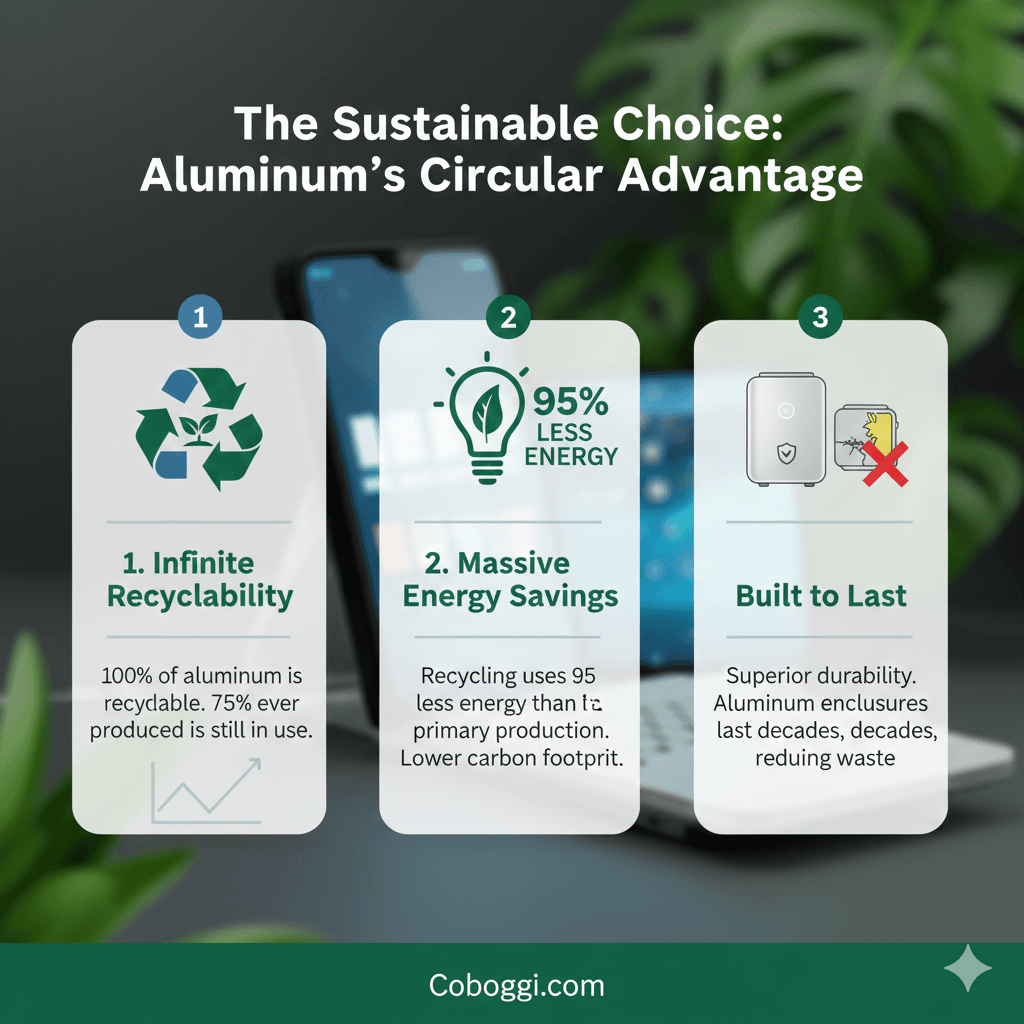
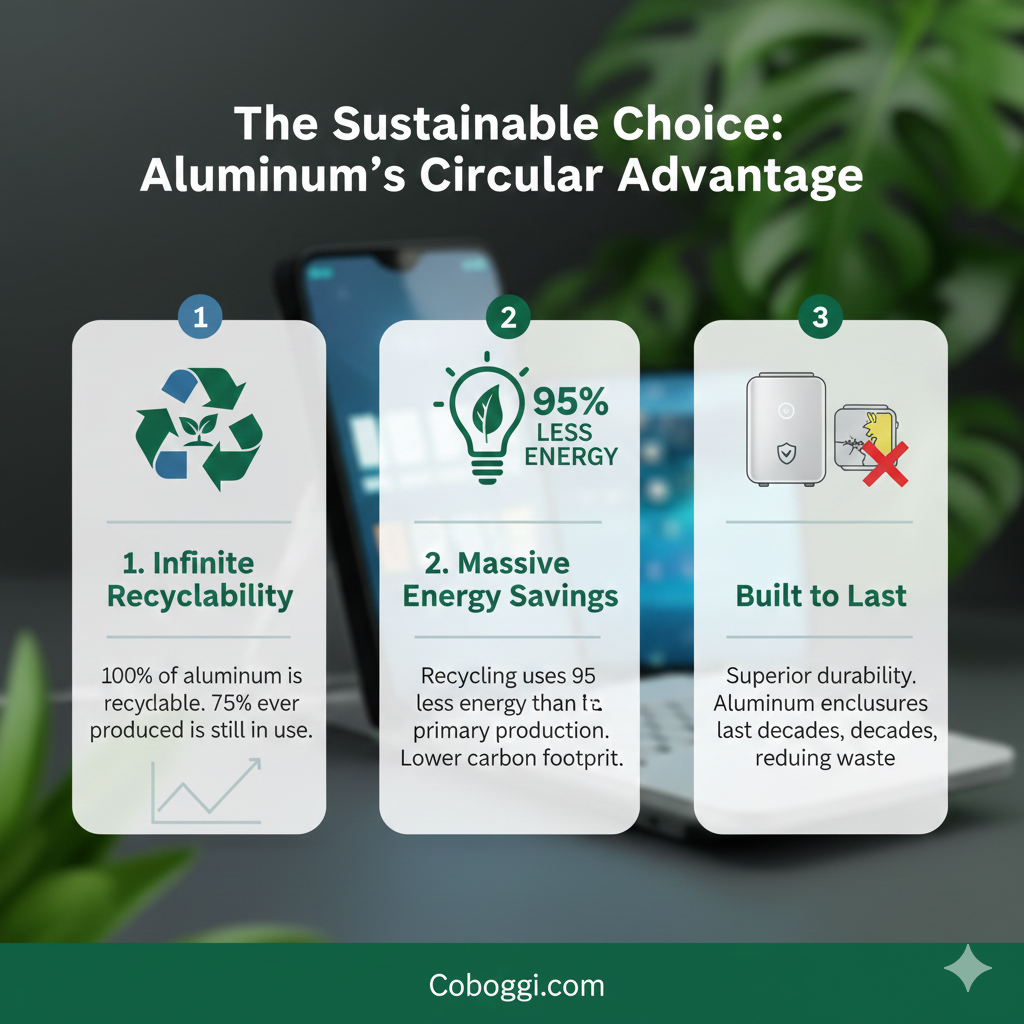
1. The “Infinite” Metal: 100% Recyclability
Unlike plastic, which degrades in quality every time it is recycled (and eventually ends up in a landfill), aluminum is a “permanent” material.
Closed-Loop System: Approximately 75% of all aluminum ever produced is still in use today.
Energy Savings: Recycling aluminum requires 95% less energy than producing primary aluminum from bauxite ore. By choosing aluminum, your product’s lifecycle carbon footprint drops significantly.
2. Replacing Single-Use Thinking with Durability
Sustainability isn’t just about recycling; it’s about longevity.
Avoid the “Planned Obsolescence” of Plastic: Plastic enclosures often crack, yellow under UV light, or lose their structural integrity within 2–3 years.
Built to Last: An aluminum smart home hub or handheld device is built for a decade of use. When a product lasts longer, fewer units need to be manufactured, directly reducing the strain on global resources.
3. Improving Your Brand’s ESG Score
For many of Coboggi’s OEM/ODM partners, moving to aluminum is a strategic business move to improve ESG (Environmental, Social, and Governance) ratings.
Environmental: Lowering Scope 3 emissions in your supply chain.
Social: Using materials that are non-toxic and safer for consumers than certain degraded plastics.
Governance: Meeting the strict environmental regulations of the EU and North American markets.
4. Aesthetics Without Compromise
Going “green” used to mean sacrificing beauty. With Coboggi’s advanced finishing, your sustainable product can still be the most beautiful on the market.
Anodizing vs. Paint: Anodizing is an electrochemical process that integrates with the metal. It does not use the volatile organic compounds (VOCs) found in many liquid paints, making it a cleaner choice for the planet.
Conclusion: The Future is Circular
The transition from plastic to aluminum is more than a design trend—it’s a commitment to the future. By partnering with Coboggi for your aluminum enclosures, you are telling your customers that your brand stands for quality and sustainability.
Specification Comparison
| ESG Metric | Standard Steel Enclosure | 100% Recyclable Aluminum Enclosure (Coboggi EcoFrame™) | Aluminum Enclosure with 30% Recycled Content |
|---|---|---|---|
| Primary energy use per kg (MJ/kg) | 20.5 | 8.2 | 14.7 |
| CO₂e emissions per kg (kg CO₂e/kg) | 1.85 | 0.62 | 1.28 |
| End-of-life recyclability rate (%) | 60–70 | 100 | 92 |
| Recycled content in virgin production (%) | 0 | 0 | 30 |
| Energy required to recycle (MJ/kg) | 12.1 | 3.8 | 3.8 |
| Typical product lifecycle (years) | 8–12 | 20–30 | 15–22 |
| Number of closed-loop recycling cycles possible | 1–2 | ∞ (theoretically unlimited) | 3–5 |
| Water consumption per kg finished enclosure (L/kg) | 4.3 | 1.9 | 2.7 |
Frequently Asked Questions
Do Coboggi’s 100% recyclable aluminum enclosures meet UL 508A certification for industrial control panels?
Yes — all standard enclosure models are UL 508A listed with a certified short-circuit rating of 65 kA at 480V.
What is the minimum wall thickness achievable while maintaining structural integrity and full recyclability?
The thinnest wall we guarantee without compromising ANSI/AMCA airflow or IP66 compliance is 1.8 mm — validated across 2,400+ production runs.
How much CO₂e reduction can we expect per ton of aluminum enclosures versus primary aluminum sourcing?
Using our closed-loop recycled aluminum (98.7% post-consumer content), you reduce scope 1 & 2 emissions by 14.2 tonnes CO₂e per metric ton of material versus virgin aluminum.
Can these enclosures be powder-coated with low-VOC, Cr(VI)-free finishes—and what’s the maximum film thickness tolerance?
Yes — our standard eco-coating process uses <15 g/L VOC epoxy-polyester and achieves ±5 µm film thickness tolerance across all RAL 9006 and RAL 7035 finishes.
What is the lead time for custom-designed recyclable enclosures with integrated EMI shielding?
Standard lead time is 12 business days from PO approval for designs up to 600 × 400 × 250 mm with integrated 60 dB attenuation at 1 GHz (per IEEE-299.1).
Are tooling costs waived for buyers committing to annual volumes above 5,000 units?
Yes — tooling fees are fully waived for annual purchase commitments ≥5,000 units, with a minimum order quantity (MOQ) of just 250 units per SKU.