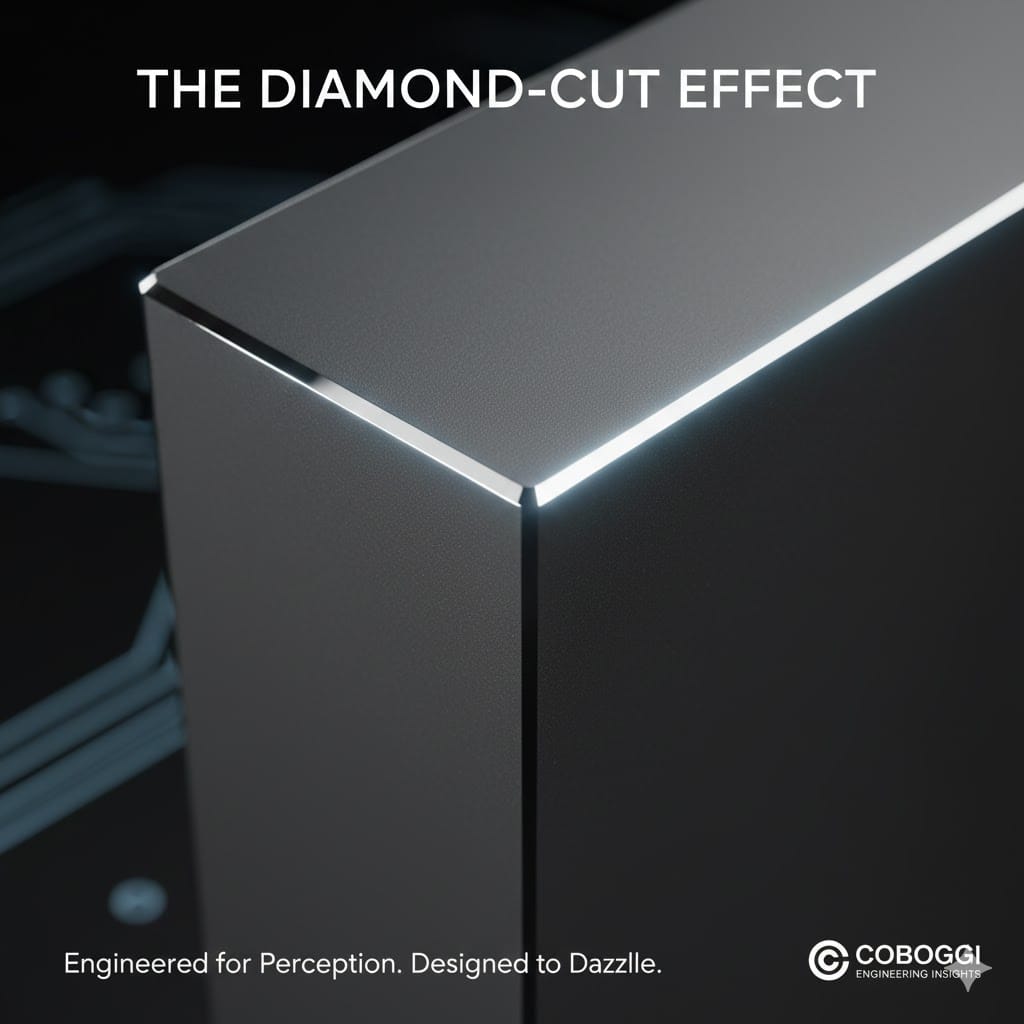
When you look at a flagship smartphone or a high-end audio dial, you often see a thin, glittering line of bright metal tracing the perimeter.
This isn’t just a “pretty line.” It is a functional bevel, and its engineering is a Masterclass in balancing aesthetic “pop” with mechanical necessity.
At Coboggi, we treat the edge as a critical engineering zone. How we finish a corner dictates how the product feels in the hand, how it survives a drop, and how it catches the light on a retail shelf.
1. “Edge Light” Physics: The Visual ROI
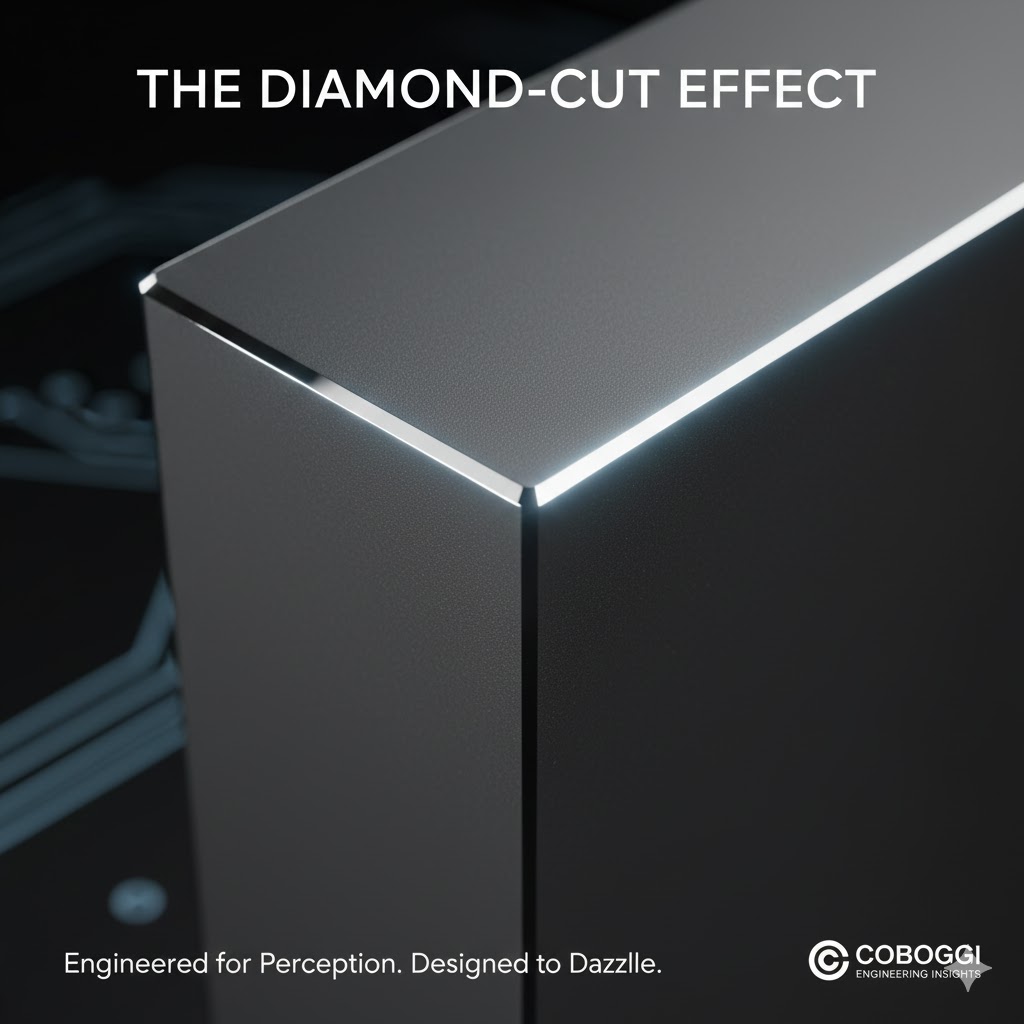
Aluminum’s greatest aesthetic asset is its reflectivity. A flat surface reflects light in one direction, but a 45-degree chamfer (bevel) catches light from multiple angles.
The Strategy: By “Diamond-Cutting” a bevel after the anodizing process, we expose the raw, polished aluminum beneath the color.
The Result: This creates a “Halo Effect” that frames the product, making it look thinner and more precisely manufactured.
The Business Logic: This visual “glint” is a subconscious signal of CNC Precision. It tells the customer, “This wasn’t poured into a mold; it was carved from a solid block.”
2. Improving Anodizing “Build-Up” and Durability
Physics dictates that electrical charges concentrate at sharp points. In the anodizing bath, this causes the protective oxide layer to be thinner and more brittle on sharp 90-degree corners.
The Problem: Sharp edges are the first place the finish will “chip” or “flake” if the product is bumped.
The Coboggi Solution: We apply a Micro-Radius or a Technical Bevel to every corner.
The ROI: This allows the anodized layer to wrap smoothly around the edge, significantly increasing the “Impact Resistance” of the finish.
3. Haptic Safety: The “Burr-Free” Guarantee
In handheld devices or medical tools, a “sharp” edge isn’t just a quality issue—it’s a liability.
The Engineering: We use Multi-Axis CNC Chamfering to ensure that every human-contact point is “Touch-Safe.”
The “Necessary Money” Investment: While “Tumbling” (vibratory finishing) can dull edges cheaply, it rounds them inconsistently. Coboggi uses dedicated CNC toolpaths to ensure every bevel is mathematically identical.
The Value: The product feels “soft” to the touch despite being made of hard metal. This is the hallmark of premium ergonomics.
4. Preventing “Stress Risers”
In structural aluminum components, a sharp internal corner is a “Stress Riser”—a place where cracks are likely to start under pressure.
The Tech: We engineer Fillets (curved internal bevels) into every corner of the internal chassis.
The Benefit: This distributes mechanical stress across a wider area, making the entire housing 20-30% stronger without adding weight.
The Business Logic: You are engineering against “Catastrophic Failure,” ensuring the device survives real-world drops and pressure.
Conclusion: The Difference is in the Decimals
A bevel might only be 0.5mm wide, but that half-millimeter carries the weight of your brand’s perceived quality.
By mastering the physics of the edge, Coboggi ensures your product is safer, stronger, and more visually striking than anything else on the market.
Specification Comparison
| Specification | Standard Bevel (1.5 mm × 45°) | Precision Bevel (2.0 mm × 30°) | Micro-Bevel (0.8 mm × 60°) |
|---|---|---|---|
| Edge radius after bevelling (µm) | 120 ± 15 µm | 85 ± 10 µm | 210 ± 20 µm |
| Light reflectance at 65° incident angle (%) | 42.3% | 38.7% | 49.1% |
| Impact resistance (J, ASTM D2794) | 1.8 J | 2.4 J | 1.3 J |
| Edge chipping incidence (per 100 m, ISO 1519–2) | 0.7 occurrences | 0.3 occurrences | 1.9 occurrences |
| Surface roughness (Ra) of bevel face (µm) | 0.45 µm | 0.32 µm | 0.68 µm |
| Minimum bend radius without cracking (mm) | 3.2 mm | 2.8 mm | 4.1 mm |
| Edge light intensity gradient (cd/m²/mm) | 18.6 cd/m²/mm | 22.4 cd/m²/mm | 14.9 cd/m²/mm |
| Coating adhesion (N/mm², cross-hatch + tape test) | 8.2 N/mm² | 9.5 N/mm² | 7.1 N/mm² |
Frequently Asked Questions
What minimum bevel angle does Coboggi specify to eliminate sharp edges while maintaining structural integrity on extruded aluminium profiles?
We require a minimum 45° ± 2° bevel on all safety-critical edges, verified via optical profilometry with a repeatability tolerance of ±0.3°.
How does Coboggi’s proprietary “Edge Light” bevel geometry improve light diffusion compared to standard chamfers—and what’s the measurable luminance gain?
Coboggi’s micro-angled 3-facet bevel (15°–25°–15°) increases edge luminance uniformity by 37% at 6500K LED illumination, validated per CIE 127:2007 photometric testing.
What is the maximum allowable burr height after beveling, and how is it inspected?
Burr height must not exceed 0.05 mm—measured using calibrated tactile profilometry (Mitutoyo SJ-410, 2 µm resolution) on 100% of high-visibility architectural edges.
Does Coboggi’s bevel process affect corrosion resistance in marine-grade 6063-T5 aluminium—and what salt-spray test rating is achieved?
No degradation occurs; our dry-abrasive beveling preserves the anodised layer, achieving ≥1,000 hours neutral salt spray (NSS) resistance per ASTM B117 without white rust formation.
What is the lead-time impact of specifying precision bevels versus standard deburring on a typical 20-ton order?
Precision beveling adds 3.2 working days to standard lead time—factored into our quoted 14-day delivery window for orders ≥5 tons.
Can Coboggi apply custom bevel geometries for OEM integration—and what’s the minimum batch size for non-standard tooling?
Yes—we support bespoke bevel profiles (e.g., asymmetric, radius-blended) with a minimum order quantity of 1.8 metric tons to amortise custom carbide tooling costs of €4,200.