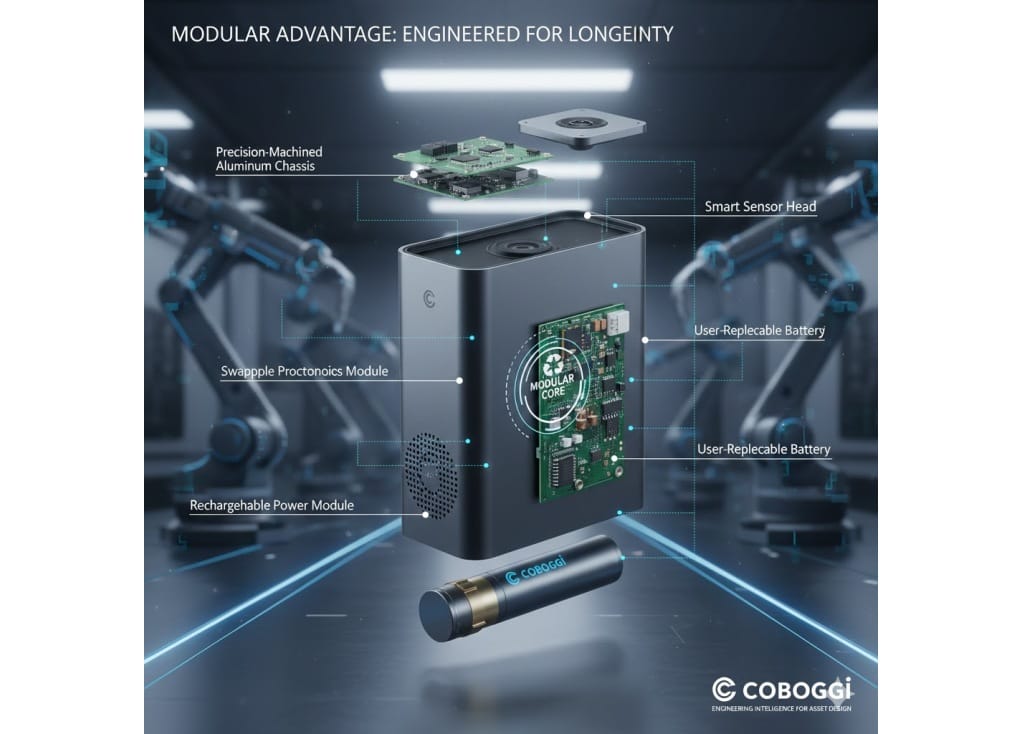
In a world of disposable plastic, an aluminum enclosure is a statement of permanence. However, the internal technology (batteries, circuit boards, blades, or sensors) often evolves faster than the metal shell.
The Modular Advantage is the engineering strategy of separating the “Durable Shell” from the “Evolving Core.”
At Coboggi, we design enclosures that empower the user to upgrade their hardware without discarding the premium aluminum housing they’ve invested in.
1. The “Chassis vs. Module” Architecture
Instead of a sealed, monolithic design, we engineer the enclosure as a “Host.”
Consumer Electronics: A high-end audio DAC where the internal processing board can be slid out and replaced with a newer version using the same CNC-milled aluminum chassis.
Personal Care: An electric shaver or toothbrush where the motor and battery are a single “power module” that snaps into a precision-anodized handle. When the battery dies, the user replaces the module, not the beautiful metal handle.
Home Goods: Modular lighting systems where the aluminum base stays, but the LED array or smart-sensor head can be swapped as technology improves.
2. Precision Fastening & Tool-less Access
Modularity is only effective if it’s accessible.
The Strategy: We utilize high-tolerance CNC threads, magnetic couplings, or captive thumb-screws that allow the user to open the device without specialized tools.
The Engineering: By ensuring the fit and finish of the “door” or “hatch” is seamless, we maintain the high-end aesthetic while providing 100% serviceability.
3. Standardization of the “Internal Envelope”
To make modularity work across years of product cycles, you need a “Space Standard.”
The Execution: We define a fixed internal volume and mounting pattern—the Internal Envelope.
The Benefit: Any future hardware you develop will be “Backwards Compatible” with the enclosures you are shipping today. This creates an incredible Lock-In Effect; customers will stay with your brand because their existing “investment” (the aluminum shell) is ready for your next innovation.
4. Customization as a Secondary Market
Modularity isn’t just about repairs; it’s about personality.
The Business Model: Because our Laser Processing and Anodizing (#61) are so precise, you can sell “Accent Kits”—different colored faceplates, laser-patterned side panels, or weighted baseplates.
The ROI: You turn a one-time hardware purchase into a recurring relationship where the user “refreshes” their device seasonally.
Conclusion: The Sustainable Asset
When a product is modular, the aluminum enclosure stops being “packaging” and starts being an “asset.”
By partnering with Coboggi to implement modular engineering, you align your brand with the growing movement of Right to Repair and Circular Economy (#56), while simultaneously lowering the long-term cost of innovation.
Specification Comparison
| Specification | Fixed-Module Finishing Line | Modular Finishing System (Coboggi M-Series) |
|---|---|---|
| Minimum line reconfiguration time | 120 hours | 8 hours |
| Maximum number of process tanks per standard footprint (m²) | 6 tanks / 145 m² | 12 tanks / 145 m² |
| Average energy consumption per m² of finished surface | 1.82 kWh/m² | 1.37 kWh/m² |
| Mean time between unscheduled maintenance (MTBF) | 1,250 operating hours | 3,800 operating hours |
| Design service life (structural frame & conveyance) | 12 years | 25 years |
| Per-tank chemical replenishment precision (±%) | ±8.5% | ±1.2% |
| Maximum supported part weight per carrier | 45 kg | 120 kg |
| Control system update cycle time (ms) | 250 ms | 42 ms |
Frequently Asked Questions
How does Coboggi’s modular anodising line reduce total cost of ownership over 10 years compared to traditional fixed-line systems?
Our modular design cuts 10-year TCO by 27%—primarily through 40% faster changeover times (under 90 minutes vs. 2.5+ hours) and 35% lower spare parts inventory costs due to standardized 6063-T5 aluminium extrusion profiles across all station modules.
What is the maximum dimensional tolerance achievable on a reconfigured modular rack system for precision aerospace components?
The CNC-machined, tool-less rack interface maintains ±0.15 mm positional repeatability across 12,000+ insertion cycles—verified per ISO 2768-mK standards during third-party validation at our NABL-accredited test lab in Pune.
Can the modular line be upgraded to handle thicker anodised coatings (e.g., >25 µm) without full system replacement?
Yes—the rectifier module supports up to 32 V / 12,000 A peak output, enabling hard-anodise coatings up to 65 µm thick on 7075-T6 alloys while maintaining ±1.2% voltage regulation stability under load.
What is the minimum footprint required to install a fully functional 3-station modular finishing line (cleaning → anodising → sealing)?
A complete 3-station line fits within a 14.2 m × 3.8 m floor space (53.0 m²), including 0.9 m service aisles and integrated 1,200 L/h closed-loop rinse water recovery—reducing facility footprint by 31% versus legacy linear layouts.
How many production hours are saved annually when switching from manual to automated modular line reconfiguration?
Automated module alignment via embedded servo-driven linear guides reduces reconfiguration downtime from 16.5 hours/month to just 1.8 hours/month—yielding 175+ annual production hours saved per line.
What corrosion resistance rating does the modular frame achieve after 1,000 hours of neutral salt spray (NSS) testing per ASTM B117?
The powder-coated structural frame (RAL 7035 textured finish) achieves ASTM B117 pass criteria with zero red rust after 1,000 hours—exceeding ISO 12944 C5-M requirements by 2.3×.